How to Create a Customer Acquisition Strategy in 9 Steps
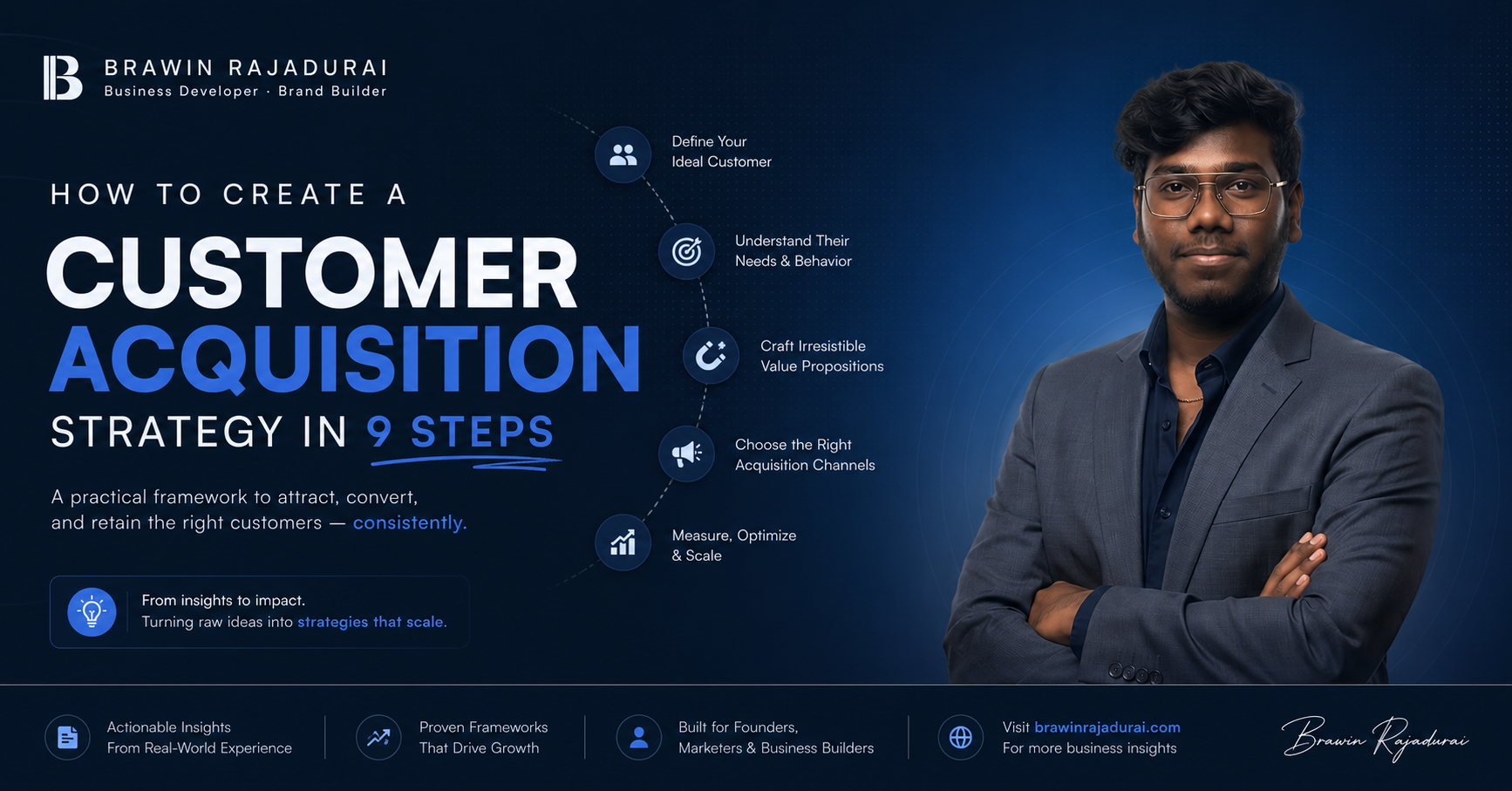
Most businesses do not have a customer acquisition problem. They have a guessing problem.
They boost a post on Monday, print pamphlets on Wednesday, and try a WhatsApp blast on Saturday. Money leaves. Customers trickle in. Nobody can say which effort actually worked. I’ve lived this.
Building Sparow, a packaged drinking water brand in Tamil Nadu, meant learning acquisition the expensive way through distributor negotiations that went nowhere, ad spend that bought impressions instead of orders, and a slow realisation that our best channel was one we’d been ignoring.
If that sounds familiar, you are in the right place. Learning how to create a customer acquisition strategy is what separates businesses that grow predictably from businesses that ride luck.
Here is the uncomfortable part. Acquisition costs in India have climbed sharply as more brands crowd the same digital auctions. The cheap traffic era is over.
The good news? A structured strategy beats a bigger budget almost every time. This guide walks you through the exact nine steps — with Indian and Tamil Nadu examples, real maths, and a 90-day rollout plan you can start on Monday.
What Is a Customer Acquisition Strategy? (Quick Answer)
A customer acquisition strategy is a documented plan that defines who your ideal customer is, which channels reach them profitably, what message converts them, and how much you can afford to spend to win them. To create one, map your ICP, choose two or three channels, build a funnel, set CAC and LTV targets, then test and scale what works.
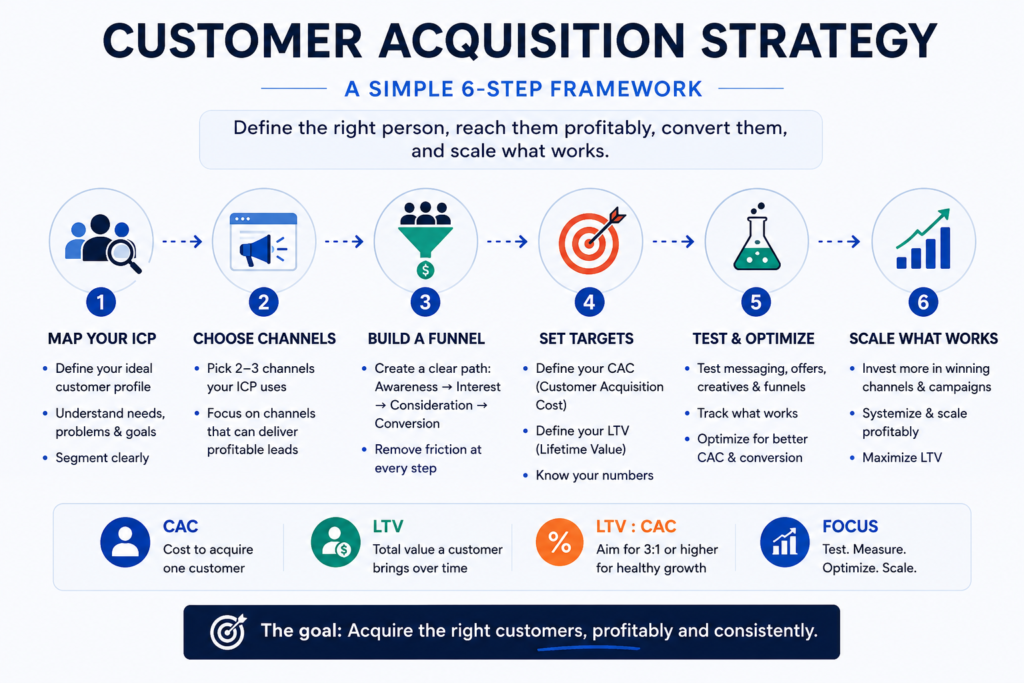
Table of Contents
What Is a Customer Acquisition Strategy?
A customer acquisition strategy is your written answer to one question: how will this business reliably turn strangers into paying customers?
Not “we’ll do some marketing.” A real plan names the customer, the channel, the message, the conversion path, and the budget ceiling.
Think of it as the difference between fishing and building a fishery. Fishing is a Diwali offer that spikes sales for four days. A fishery is a system that produces customers every single month.
Customer Acquisition vs Lead Generation vs Marketing
These three get mixed up constantly, and the confusion costs money. Here is the clean separation.
| Term | What It Covers | Success Metric |
|---|---|---|
| Marketing | Everything — brand, positioning, awareness, demand | Brand recall, share of voice |
| Lead generation | Capturing contact details of interested people | Cost per lead, lead volume |
| Customer acquisition | The full path from stranger to first paid transaction | CAC, conversion rate, payback period |
Lead generation is a step inside acquisition. Acquisition is a step inside marketing. Getting 500 leads means nothing if none of them buy.
The Four Pillars of Any Acquisition Strategy
Every strong customer acquisition strategy rests on four pillars. Miss one and the structure wobbles.
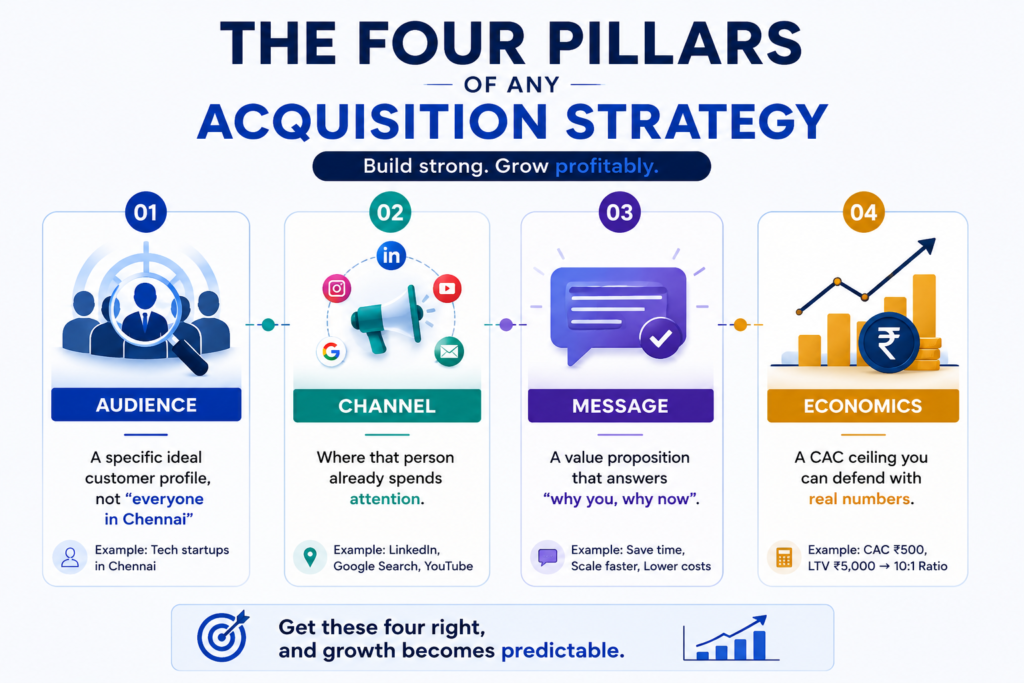
- Audience: a specific ideal customer profile, not “everyone in Chennai”
- Channel: where that person already spends attention
- Message: a value proposition that answers “why you, why now”
- Economics: a CAC ceiling you can defend with real numbers
Most businesses obsess over channel and ignore the other three. That is why their ads underperform while a competitor with a worse budget outsells them.
Why a Customer Acquisition Strategy Matters More in India Right Now
Something shifted in the Indian market over the last few years. Digital acquisition got crowded, fast.
Cheap internet brought hundreds of millions of users online. Then every brand — national, regional, and local — piled into the same Meta and Google auctions chasing them.
The result is predictable. Ad costs rose. Attention got scarcer. The businesses still winning are the ones with a documented plan, not the ones with the loudest creative.
Three Forces Reshaping Acquisition in India
Vernacular is no longer optional. A large majority of new internet users in India prefer content in their own language. In Tamil Nadu, a Tamil landing page and Tamil ad copy will routinely outperform an English equivalent for local audiences.
Payments dissolved friction. UPI turned “I’ll think about it” into an instant tap. That means your conversion bottleneck has moved upstream — to trust and clarity, not payment.
Commerce got decentralised. Between ONDC, WhatsApp storefronts, marketplace listings, and quick-commerce, customers now discover brands in a dozen places. Your strategy must pick a lane instead of spreading thin.
Who This Guide Is For
This works whether you run a D2C brand in Coimbatore, a SaaS product in Chennai, a garment export unit in Tiruppur, or a services firm in Madurai.
The maths does not change. Only the channel mix does.
Step 1: Define Your Ideal Customer Profile
This is where 80% of acquisition strategies die. Founders describe their customer as “small businesses” or “young people” and wonder why nothing converts.
An ideal customer profile is uncomfortably specific. It should feel almost too narrow.
What a Weak ICP Looks Like vs a Strong One
| Weak ICP | Strong ICP |
|---|---|
| Small businesses in Tamil Nadu | Textile units in Tiruppur with 20–80 workers, ₹2–10 crore turnover, currently tracking orders on paper |
| Young women who like fashion | Working women 25–34 in Chennai and Bengaluru, buying office wear online 2–3 times a year, price-sensitive above ₹2,000 |
| Startups needing software | Indian SaaS startups, 10–50 employees, post-seed, whose finance lead still reconciles subscriptions in spreadsheets |
Notice the pattern. The strong versions include a current painful behaviour. That behaviour is your entry point.
How to Build Your ICP in a Week
- List your 10 best customers. Best means highest value, fastest to close, least support burden.
- Find what they share. Industry, size, location, trigger event, budget authority.
- Call five of them. Ask what they were doing before you, and what made them finally act.
- Write the trigger down. “We hired our fifth employee.” “Our old vendor missed a deadline.” Triggers are gold.
- Name the anti-customer. Who should you actively refuse? This sharpens targeting more than anything.
The Question That Unlocks Everything
Ask this in every customer call: “What would you have done if we didn’t exist?”
When we asked this at Sparow, the answer wasn’t a rival water brand. It was “we’d boil water at home” or “we’d take whatever the local supplier drops off.” Our real competitor was inertia, not another label and that reframed our entire message.
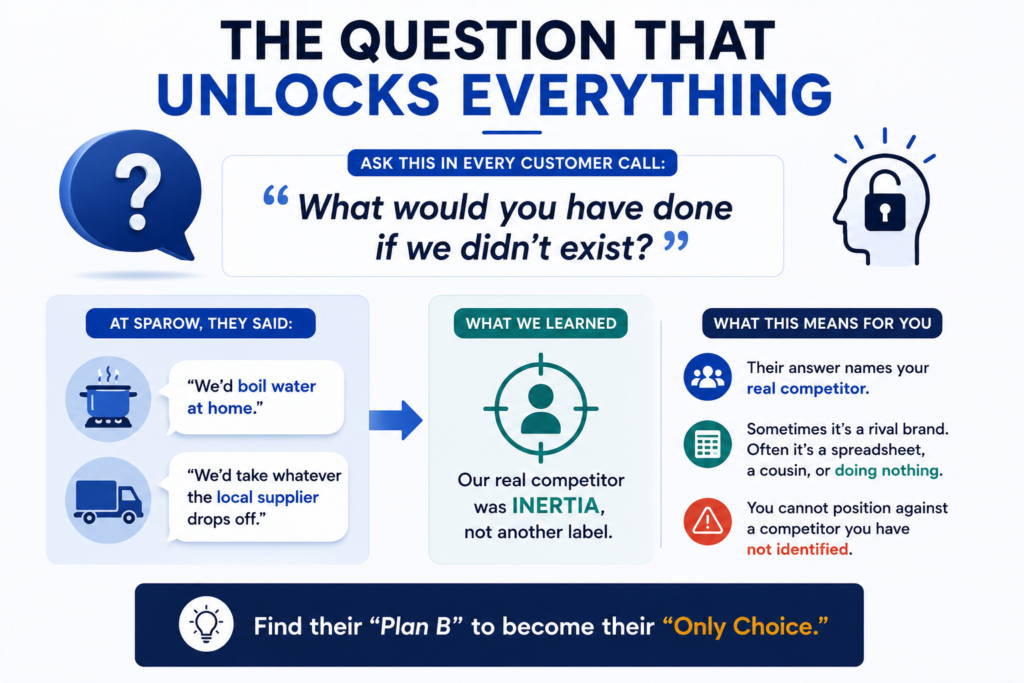
Their answer names your real competitor. Sometimes it’s a rival brand. Often it’s a spreadsheet, a cousin who helps out, or doing nothing at all.
You cannot position against a competitor you have not identified.
Segment Before You Spend
Most businesses have three to five distinct customer segments hiding inside their base. Each needs a different message.
A tuition centre in Chennai, for example, serves anxious parents of Class 10 students and ambitious parents of Class 8 students. Same service. Completely different emotional driver.
Run one campaign for both and you will speak to neither.
Step 2: Map the Customer Journey
People do not go from stranger to buyer in one leap. They move through stages, and each stage has a different job.
Map those stages and your channel decisions stop being guesswork.
The Five Stages That Actually Matter
| Stage | Customer’s Question | Your Job | Typical Channel |
|---|---|---|---|
| Unaware | “I have no problem.” | Name the problem | Reels, YouTube, influencers |
| Problem-aware | “This is annoying.” | Show it’s solvable | Blog, SEO, community posts |
| Solution-aware | “What are my options?” | Enter the shortlist | Comparison content, reviews |
| Brand-aware | “Why you?” | Prove it | Case studies, demos, testimonials |
| Ready | “Is this safe to buy?” | Remove friction | Search ads, WhatsApp, retargeting |
The Message-Stage Mismatch That Wastes Crores
Here is the single most expensive error in Indian digital marketing: running “Buy Now, 20% Off” ads at an unaware audience.
You are proposing marriage on a first date. They scroll past. Your CPM rises. Your account learns you are irrelevant.
Match the message to the stage. Awareness content earns attention. Conversion content harvests intent. Different jobs, different assets.
Find Your Leak Before Adding Traffic
Before spending another rupee on top-of-funnel, find where people currently drop off. Nine times out of ten the leak is not traffic.
- Enquiries come in but nobody replies within an hour
- The landing page loads in six seconds on a 4G phone
- Pricing is hidden, so serious buyers bounce
- The WhatsApp number in the ad goes to a personal phone
Fixing a leak is cheaper than buying more water.
Step 3: Set Your Acquisition Maths (CAC, LTV, Payback)
This step feels like homework. Skip it and everything downstream becomes opinion.
You need three numbers. That is all.
Customer Acquisition Cost (CAC)
CAC is total sales and marketing spend divided by new customers acquired in the same period.
Formula: CAC = (Marketing Spend + Sales Spend) ÷ New Customers
Include everything. Ad spend, agency fees, salaries of people doing sales, tools, creative costs. Businesses that exclude salaries flatter themselves and then wonder why the bank balance disagrees.
Example: A Chennai D2C skincare brand spends ₹4,00,000 in a month — ₹2,80,000 on ads, ₹80,000 on a marketer’s salary, ₹40,000 on creative and tools. It acquires 500 new customers. CAC = ₹800.
Lifetime Value (LTV)
LTV is the total gross profit one customer generates before they leave.
Simple formula: LTV = Average Order Value × Purchases Per Year × Years Retained × Gross Margin %
Same brand: AOV ₹1,200 × 3 purchases a year × 2 years × 60% margin = ₹4,320 LTV.
Use gross profit, never revenue. Revenue-based LTV is how brands convince themselves they are profitable while burning cash.
The Ratio That Decides Your Fate
Divide LTV by CAC. In our example: ₹4,320 ÷ ₹800 = 5.4:1. Healthy.
| LTV:CAC Ratio | What It Means | What to Do |
|---|---|---|
| Below 1:1 | You lose money on every customer | Stop spending. Fix pricing or margin. |
| 1:1 to 2:1 | Barely viable, no room for overhead | Raise LTV before scaling ads |
| 3:1 | Generally considered healthy | Scale carefully |
| Above 5:1 | You are likely underinvesting | Spend more, capture the market |
That last row surprises people. A very high ratio is not a trophy. It usually means a competitor is about to outspend you into irrelevance.
CAC Payback Period
Formula: Payback = CAC ÷ (Monthly Gross Profit Per Customer)
This is the cash-flow number. It tells you how many months until a customer repays what you spent to get them.
For most Indian SMEs without external funding, a payback period under six months is sensible. Under three months is comfortable. Beyond twelve, you need funding or a different plan.
Setting Your CAC Ceiling
Work backwards. If your LTV is ₹4,320 and you want a 3:1 ratio, your maximum CAC is ₹1,440.
Write that number on a whiteboard. Every channel decision now has an objective pass/fail test.
This is the discipline most competitors lack, and it is why understanding how to create a customer acquisition strategy around real economics beats out-shouting people with a bigger budget.
Step 4: Choose Your Acquisition Channels
Now the fun part. But resist the urge to do everything.
The most common failure in Indian SME marketing is being mediocre on seven channels instead of excellent on two.
The Rule of Two
Pick two channels. Master them. Only then add a third.
Why two? Because one channel is a single point of failure algorithm change, cost spike, policy ban and three or more spreads a small team so thin nothing compounds.
What Channel Discipline Looks Like in Practice
We learned this the hard way. Early on at Sparow we tried Meta ads, print, a distributor push, and local events simultaneously four channels, one small team, nothing compounding.
Cutting back to two changed the trajectory. Distributor and retail relationships on the ground, plus local search visibility so buyers nearby find you at the moment of need. In a trust-driven, geography-bound category, local reputation compounds in a way paid reach simply doesn’t.
Pick the two channels where your unfair advantage actually applies. Let competitors exhaust themselves everywhere else.
How to Choose Your Two
Score each candidate channel across four dimensions. Use a simple 1–5 scale.
- Audience density: Is your ICP actually there in numbers?
- Intent quality: Are they looking to solve this problem right now?
- Cost to compete: Can you afford the auction or the effort?
- Your unfair advantage: Do you have something others cannot copy — a founder who speaks well on camera, an existing WhatsApp list, a local reputation?
That fourth one is the tiebreaker. If your founder is a natural on video, Reels beats SEO even if SEO scores better on paper.
The Paid vs Organic Question
People frame this as a war. It is not. They serve different timelines.
| Paid Acquisition | Organic Acquisition | |
|---|---|---|
| Speed | Results in days | Results in 4–9 months |
| Cost curve | Rises with scale | Falls with scale |
| Stops when you stop | Yes, immediately | No, compounds |
| Best for | Testing, harvesting intent | Moats, trust, low CAC |
| Risk | Renting attention forever | Slow, hard to attribute |
The sensible answer: use paid to learn fast, use organic to make the learning permanent.
Run ads to discover which message converts. Then build content and SEO around that proven message so you eventually stop paying for it.
A Practical Budget Split
For a business spending under ₹5 lakh a month on acquisition, this split works well:
- 60% — proven channel that already hits your CAC ceiling
- 25% — second channel being scaled
- 15% — experiments you fully expect to fail
That 15% is not waste. It is how you find next year’s 60%.
Step 5: Build the Offer and Message
Channels get you seen. The offer gets you paid.
A weak offer on a great channel loses to a great offer on a mediocre channel. Every time.
The Value Proposition Test
Your value proposition should survive this sentence: “We help [specific ICP] achieve [specific outcome] without [the thing they hate].”
Examples that pass:
- “We help Tiruppur textile units track every order in real time without hiring another supervisor.”
- “We help Chennai homeowners get interiors done in 45 days without the usual cost overruns.”
- “We help Indian D2C brands cut return rates without adding checkout friction.”
Notice what is missing. No “best in class.” No “leading provider.” No adjectives that any competitor could also claim.
Risk Reversal Wins in India
Indian buyers are, on average, more risk-averse than Western buyers. Decades of poor service standards taught them caution.
So the highest-leverage lever in your offer is usually not a discount. It is removing risk.
- Free trial with no card required
- Pay after delivery, or partial advance only
- Written service guarantee with a penalty clause
- Visible, real reviews with names and photos
- A phone number that a human answers
A ₹500 discount attracts bargain hunters. A credible guarantee attracts buyers.
Vernacular Beats Polish
In Tamil Nadu, a rough Tamil video shot on a phone routinely outperforms a slick English production.
Why? Because it signals “we are one of you.” That signal converts better than production value.
Test Tamil creative against English creative in your next campaign. The gap will surprise you.
Step 6: Design the Conversion Path
You have attention and an offer. Now do not fumble the handoff.
The conversion path is every step between “interested” and “paid.” Each step loses people. Fewer steps, fewer losses.
The Mobile-First Reality
The overwhelming majority of your Indian traffic is on a mid-range Android phone, often on a patchy 4G connection.
Design for that person, not for your MacBook.
- Landing page under 3 seconds on 4G, or you lose half of them
- Thumb-reachable buttons, no pinch-zooming
- Forms with three fields maximum
- UPI as the first payment option, not buried under card fields
- WhatsApp as a contact option — for many buyers it is the only one they trust
Speed of Response Is a Conversion Lever
Here is a lever nobody talks about: reply time.
A lead that gets a response in five minutes converts dramatically better than one contacted after an hour. Interest decays fast, and your competitor is one WhatsApp message away.
Set up an auto-acknowledgement, then a real human follow-up within thirty minutes during business hours.
The WhatsApp Advantage
WhatsApp Business is arguably India’s most underrated acquisition asset.
Open rates dwarf email. Buyers can ask questions in Tamil. Catalogues, payments, and support live in one thread the customer already checks fifty times a day.
Build your conversion path to end in a WhatsApp conversation, not a contact form nobody reads.
Reduce, Then Reduce Again
Count the clicks from ad to payment. If it is more than three, cut one.
Every removed field, page, and decision lifts conversion. This is the cheapest CAC reduction available to you.
Step 7: Build Your Measurement System
If you cannot measure it, you are not running a strategy. You are running a hobby.
But do not overbuild. Ten metrics tracked badly are worse than four tracked well.
The Four Numbers to Track Weekly
- CAC by channel — where is money working?
- Conversion rate by stage — where do people leak?
- LTV by segment — which customers are worth chasing?
- Payback period — can cash flow survive scaling?
Attribution Without a Data Team
Perfect attribution does not exist. Stop chasing it.
Instead use two cheap methods that work surprisingly well together:
Ask them. Add “How did you hear about us?” as an optional field. Self-reported attribution is imperfect but catches word-of-mouth that no pixel will ever see.
Test by holdout. Turn a channel off for two weeks in one region. Watch what happens to total enquiries. If nothing changes, that channel was taking credit for demand you already had.
Set Up a Simple Dashboard
A single spreadsheet, updated every Monday, beats an expensive tool nobody opens.
| Channel | Spend | Leads | Customers | CAC | vs Ceiling |
|---|---|---|---|---|---|
| Google Search | ₹80,000 | 210 | 62 | ₹1,290 | PASS |
| Meta Ads | ₹1,20,000 | 640 | 58 | ₹2,069 | FAIL |
| Organic / SEO | ₹40,000 | 180 | 44 | ₹909 | PASS |
| Referral | ₹15,000 | 36 | 24 | ₹625 | PASS |
Look at that table for ten seconds and you know exactly what to do next. That is the whole point.
Step 8: Test, Kill, and Scale
Your first strategy will be partly wrong. That is expected and fine.
What matters is the speed at which you find out.
Run Tests That Can Actually Fail
A good test has a hypothesis, a budget cap, a deadline, and a pre-agreed kill criterion.
Bad test: “Let’s try LinkedIn ads and see.”
Good test: “We believe Chennai finance managers will book demos from LinkedIn ads. Budget ₹60,000 over 21 days. If CAC exceeds ₹6,000 or we get under 8 demos, we kill it.”
Write the kill criterion before you start. Otherwise sunk cost will talk you into month four of a failed experiment.
What to Test, in Order
- Audience — biggest swings come from targeting the right person
- Offer — second biggest
- Message and creative — third
- Landing page — fourth
- Button colours — never, until you are doing crores
Most teams do this list backwards and wonder why gains are tiny.
Scaling Without Breaking CAC
Here is the trap. You find a channel at ₹900 CAC, triple the budget, and CAC jumps to ₹2,400.
This is normal. You exhausted the cheapest slice of the audience. Scaling always costs more per unit.
So scale in 20–30% increments, weekly. Watch CAC after each step. The moment it crosses your ceiling, stop and hold. You have found that channel’s ceiling for now.
Step 9: Close the Loop With Retention and Referral
This is the step that makes everything else affordable.
Acquisition and retention are usually treated as separate departments. That is a mistake — retention is an acquisition strategy.
Why Retention Lowers CAC
Follow the logic. Better retention raises LTV. Higher LTV raises your CAC ceiling. A higher ceiling lets you outbid competitors for the same customer.
The brand that keeps customers longest can afford to pay the most to acquire them. That is a structural advantage no amount of clever creative overcomes.
Building a Referral Loop That Works in India
Word of mouth is disproportionately powerful in Indian markets — family networks, trade associations, WhatsApp groups, and local community ties carry enormous trust.
Yet most businesses leave it to chance. Systematise it instead.
- Pick the moment. Ask right after a customer experiences the value, not at month-end.
- Make it two-sided. Both referrer and friend get something. One-sided rewards feel like a commission.
- Make sharing one tap. A pre-written WhatsApp message with a link. Nothing to type.
- Close the loop. Tell the referrer when their friend signed up. Recognition drives repeat referrals more than cash.
The Onboarding Window
The first 30 days decide whether a customer stays. Most churn is baked in during week one, not month six.
So invest there. A welcome call. A quick-start guide in Tamil. A check-in on day seven asking one question: “Is anything not working?”
This is cheap. It raises LTV. It raises your CAC ceiling. Everything connects.
Best Acquisition Channels for Indian Businesses
Channel choice makes or breaks the plan. But channels are not universally good or bad — they are good or bad for a specific ICP.
Here is an honest breakdown of the main options in the Indian market.
| Channel | Best For | Time to Results | Relative CAC | Main Weakness |
|---|---|---|---|---|
| Google Search Ads | Existing demand, services, B2B | Days | Medium–High | Only works if people search for it |
| Meta Ads (FB/IG) | D2C, visual products, local | Days–weeks | Medium | Creative fatigue, rising costs |
| SEO / Content | Considered purchases, SaaS | 4–9 months | Low (long run) | Slow, needs consistency |
| WhatsApp Business | Local, repeat, relationship sales | Immediate | Very low | Needs an existing list |
| Local SEO / GBP | Anyone with a physical location | Weeks | Very low | Geographically capped |
| Marketplaces | Products with existing demand | Weeks | Medium | You rent the customer, not own |
| Micro-influencers | D2C, regional reach | Weeks | Low–Medium | Hard to scale, inconsistent |
| B2B, high ticket | Weeks–months | High | Expensive, small Indian pool | |
| Trade bodies / events | B2B, manufacturing, exports | Months | Medium | Slow, relationship-heavy |
| Referral programme | Everyone, once you have customers | Weeks | Lowest | Needs a base to start |
The Underrated Trio
Google Business Profile. If you have a physical presence anywhere in Tamil Nadu, this is free, high-intent traffic. Photos, reviews, and correct hours will out-earn a small ad budget.
IndiaMART and Justdial. Unglamorous, but for B2B and services in tier-2 cities they still deliver enquiries that convert. Do not dismiss them because they lack polish.
Trade associations. For manufacturing and exports, membership in bodies like CII or regional textile associations opens doors no ad budget can. This is slow, compounding, and nearly impossible for a newcomer to copy.
The Tamilnadu Playbook
Tamil Nadu is not a scaled-down version of the national market. It has its own logic.
The state carries one of India’s strongest manufacturing bases — automotive around Chennai, textiles in Tiruppur and Erode, engineering in Coimbatore, leather in Ambur. Layer on a growing Chennai tech and SaaS ecosystem and you get a market with unusually distinct pockets.
Four Rules That Apply Here
1. Tamil is a trust signal, not a translation. Do not run English copy through a translator. Write in Tamil, for Tamil readers. Idiom matters more than grammar.
2. Cluster geography is your friend. If you sell to textile units, they are physically concentrated in Tiruppur. One good customer there creates a referral chain across an entire industrial estate. Density beats reach.
3. Relationships close, ads only open. In much of Tamil Nadu B2B, a digital ad gets you the meeting. The order comes from the relationship. Budget for both.
4. Tier-2 CAC is cheaper — for now. Auction costs in Coimbatore, Madurai, Salem, and Trichy remain meaningfully below Chennai. If your product travels, test tier-2 before assuming metros.
A Quick Worked Example
Take a Coimbatore-based ERP software firm selling to small manufacturers. Their customer acquisition strategy might look like this:
- ICP: engineering units, 25–100 workers, ₹5–25 crore turnover, currently on Tally plus spreadsheets
- Channel 1: Google Search for high-intent terms plus Google Business Profile
- Channel 2: trade association presence and shop-floor demo visits
- Offer: free 30-day pilot on one production line, Tamil-language onboarding, no advance
- CAC ceiling: ₹18,000 against an LTV of roughly ₹1.2 lakh
- Referral loop: one free month for any referral that becomes a customer
Nothing exotic. Just specific. That is what a working plan looks like.
Government and Ecosystem Support
Tamil Nadu has an active startup and MSME support ecosystem, including StartupTN and central schemes under Startup India and the Ministry of MSME.
These matter for acquisition in an indirect but real way — they provide access to networks, events, and credibility markers that lower the trust barrier with cautious buyers.
7 Mistakes That Quietly Drain Your Budget
These are the patterns that break an otherwise sound plan. Each one is expensive, and each is fixable this week.
1. Targeting Everyone
Broad targeting feels safe. It is actually the most expensive choice you can make, because you pay to reach people who will never buy.
2. Confusing Activity With Progress
Posting daily is activity. Acquiring customers at a defensible CAC is progress. Do not confuse the two just because one is easier to measure.
3. Ignoring the Payback Period
A 3:1 LTV:CAC ratio means nothing if it takes eighteen months to collect. Many profitable-on-paper Indian SMEs run out of cash this way.
4. Never Killing Anything
Channels accumulate. Nobody wants to admit a bet failed. Six months later you are funding four underperformers because turning them off feels like defeat.
5. Discounting as a Default
Discounts train your market to wait for discounts. You are not acquiring customers — you are renting transactions and destroying LTV in the process.
6. Treating Retention as Someone Else’s Job
If churn is high, your acquisition maths breaks no matter how good the ads are. Fix the bucket before opening the tap.
7. Copying a Competitor’s Strategy
Their strategy fits their margins, their team, and their unfair advantage. Copying the visible part without the underlying economics is how businesses go broke while looking busy.
Your 90-Day Customer Acquisition Strategy Rollout Plan
Strategy without a calendar is a wish. Here is how to execute the nine steps over one quarter.
| Phase | Focus | Key Actions | Success Marker |
|---|---|---|---|
| Days 1–14 | Clarity | Interview 5 best customers, write ICP, calculate CAC and LTV, set CAC ceiling | One-page ICP and a CAC ceiling on the wall |
| Days 15–30 | Foundation | Fix landing page speed, cut form fields, set up WhatsApp Business, build the weekly dashboard | Under-3-second page, 3-field form, dashboard live |
| Days 31–60 | Test | Launch 2 channels with written kill criteria, test 3 offers, test Tamil vs English creative | At least one channel under the CAC ceiling |
| Days 61–90 | Scale & loop | Scale winner in 25% steps, kill losers, launch referral programme, fix onboarding week one | Predictable monthly customer numbers |
The Weekly Rhythm
Every Monday, thirty minutes, same four questions:
- What was CAC by channel last week?
- Which channel is above the ceiling?
- What test is running, and when does it die?
- What is the single biggest leak right now?
That meeting, held without fail for a year, will outperform any agency you hire.
-
What is a customer acquisition strategy?
A customer acquisition strategy is a documented plan for turning strangers into paying customers profitably. It defines your ideal customer profile, the channels that reach them, the message and offer that converts them, the conversion path they travel, and the maximum you can afford to spend acquiring each one. Unlike general marketing, it is measured strictly through customer acquisition cost, conversion rate, and payback period. Without documentation, it is not a strategy — it is a collection of tactics that cannot be evaluated or improved.
-
How do I create a customer acquisition strategy with a small budget?
Start with channels that cost time rather than money. Optimise your Google Business Profile, build a WhatsApp Business list from existing contacts, and systematise referrals from current customers — referral CAC is almost always your lowest. Then narrow your ICP aggressively so that whatever small paid budget you do have is not wasted on people who will never buy. Fix your conversion path before adding traffic. A small budget forces the discipline that large budgets let you avoid, which is often an advantage.
-
What is a good customer acquisition cost in India?
There is no universal number, because CAC is only meaningful relative to lifetime value. A ₹5,000 CAC is excellent for a B2B service with ₹2 lakh LTV and catastrophic for a ₹600 consumer product. The right approach is to calculate your own LTV using gross profit, then divide by three to set your CAC ceiling. Judge every channel against that ceiling. Comparing your CAC to another company’s is meaningless unless their margins, pricing, and retention match yours closely.
-
What is a good LTV to CAC ratio?
Around 3:1 is widely treated as healthy — it leaves room for overhead and profit after acquisition costs. Below 1:1 you lose money on every customer. Between 1:1 and 2:1 you are technically viable but have no margin for error. Above 5:1 is usually a warning rather than a win: it typically signals you are underinvesting in growth and leaving market share for a competitor who is willing to spend. Always pair the ratio with payback period before scaling.
-
Which acquisition channel works best for Indian businesses?
It depends entirely on where your ideal customer already spends attention. Google Search works when demand already exists and people search for solutions. Meta Ads suit visual, impulse-friendly D2C products. WhatsApp Business is unmatched for relationship-driven and repeat sales. Local SEO wins for any business with a physical location. Trade associations and referrals dominate B2B manufacturing. Pick two channels that match your ICP, master them, and only then consider a third.
-
How long does a customer acquisition strategy take to show results?
Paid channels can show directional signals within two to three weeks, though reliable CAC data usually needs a full month. Organic channels like SEO and content typically need four to nine months before meaningful traffic arrives. Referral programmes show results within weeks if you already have satisfied customers. Expect roughly 90 days to know whether your overall strategy is directionally correct, and around six to twelve months for it to become genuinely predictable.
-
What is the difference between customer acquisition and retention?
Acquisition brings in new customers. Retention keeps existing ones. They are usually treated as separate functions, which is a mistake — retention directly determines your lifetime value, and lifetime value determines how much you can afford to spend on acquisition. A business with strong retention can outbid competitors for the same customer and still stay profitable. In that sense, improving retention is one of the most effective acquisition strategies available.
-
How do I calculate customer acquisition cost?
Add all sales and marketing spend for a period, then divide by the number of new customers acquired in that same period. Include ad spend, agency fees, salaries of marketing and sales staff, tools, and creative production. Many businesses exclude salaries, which produces a flattering number that does not match their bank balance. Calculate CAC per channel separately, not just as a blended average — blended CAC hides the fact that one channel is subsidising another’s failure.
-
Should I use Tamil or English in my marketing in Tamil Nadu?
Test both, but expect Tamil to win for most local consumer and small-business audiences. Tamil signals cultural familiarity and trust, which matters enormously to risk-averse buyers. Do not translate English copy mechanically — write natively in Tamil so idiom and tone land correctly. For enterprise B2B or Chennai tech buyers, English may perform equally well. The only reliable answer comes from running both versions against the same audience and comparing conversion.
-
How many acquisition channels should I run at once?
Two, until they are genuinely working. One channel is a single point of failure — an algorithm change or cost spike can end your pipeline overnight. Three or more spreads small teams so thin that no channel gets the iteration it needs to compound. Once your first two consistently deliver customers below your CAC ceiling, add a third with a fixed test budget and a written kill criterion. Depth beats breadth almost every time.
Conclusion
Knowing how to create a customer acquisition strategy is not about discovering a secret channel nobody else has found. That channel does not exist.
It is about doing ordinary things in the right order. Know exactly who you serve. Understand the maths. Pick two channels and go deep. Remove friction. Measure honestly. Kill what fails without ego. Keep the customers you win.
Here are the takeaways worth writing down:
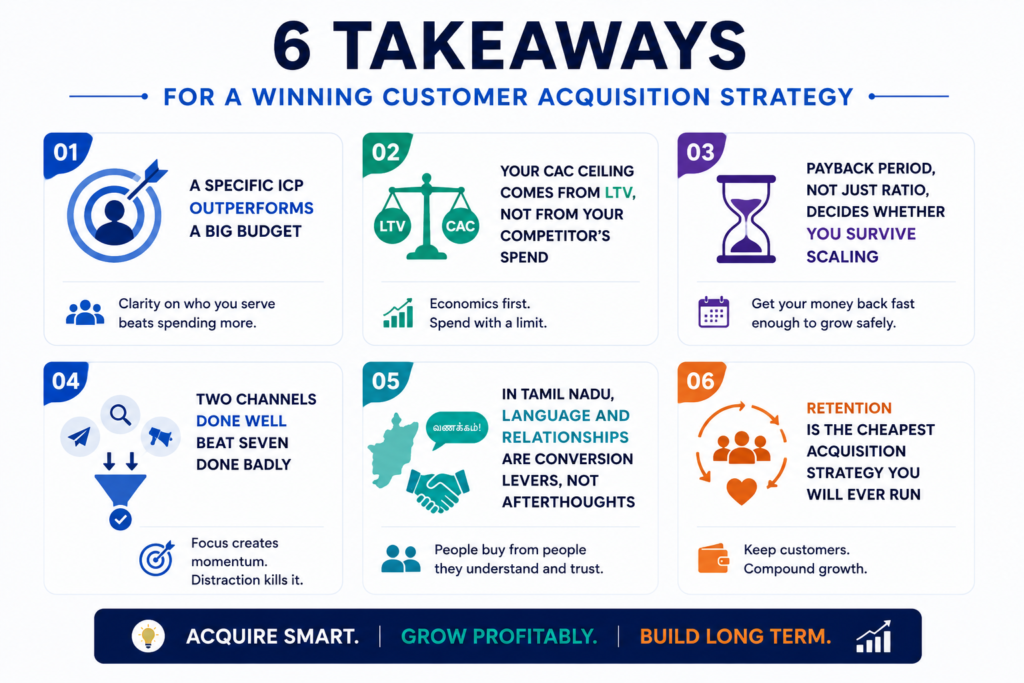
- A specific ICP outperforms a big budget
- Your CAC ceiling comes from LTV, not from your competitor’s spend
- Payback period, not just ratio, decides whether you survive scaling
- Two channels done well beat seven done badly
- In Tamil Nadu, language and relationships are conversion levers, not afterthoughts
- Retention is the cheapest acquisition strategy you will ever run
Most businesses will read this and change nothing. The ones that spend two weeks on Step 1 alone will quietly pull ahead of competitors who are still boosting posts and hoping.
Start with your ICP this week. Everything else follows from getting that right.
Further Reading & References
These are the sources worth bookmarking if you’re building an acquisition plan for an Indian business. All are primary sources — government portals and established research — rather than second-hand summaries.
- Startup India (DPIIT, Ministry of Commerce & Industry) — The central government’s startup portal. Useful for DPIIT recognition, seed fund schemes, and national ecosystem data. Worth noting that roughly half of India’s recognised startups now come from tier-2 and tier-3 cities, which has direct implications for where you look for cheaper acquisition.
- StartupTN (Tamil Nadu Startup and Innovation Mission) — The state nodal agency under the MSME Department. Relevant here for funding programmes like TANSEED and TANFUND, and for the regional hubs and sectoral forums that function as genuine B2B acquisition channels in Tamil Nadu.
- Ministry of Micro, Small & Medium Enterprises — Official MSME definitions, scheme documentation, and sector reports. If your ICP is “small manufacturers,” this is where the actual definitions and market sizing live rather than in a blog post’s guesswork.
- Food Safety and Standards Authority of India (FSSAI) — Essential for anyone in food and beverage. Compliance is an acquisition asset in this category: for packaged drinking water, mandatory BIS certification was withdrawn in October 2024 and replaced by an FSSAI Scheme of Testing effective 1 January 2026. Trust signals like these convert cautious buyers.
- Tamil Nadu State Startup Policy — The state’s policy framework in one place, hosted on the Startup India portal. Useful context on funding, mentorship, and market-access support available to businesses operating in the state.
Regulations and schemes change. Verify current requirements on the official portal before acting on anything here.
Ready to Build Your Acquisition Engine?
You now have the framework. The gap between reading it and running it is usually just a second pair of eyes on your numbers.
If you would like help pressure-testing your ICP, calculating a defensible CAC ceiling, or choosing the right two channels for your market, we are happy to look at it with you.
👉 Request a free acquisition strategy review — send us your current numbers and we will tell you honestly where the leak is.
👉 Subscribe to our newsletter for practical growth breakdowns built for Indian and Tamil Nadu businesses, sent once a fortnight. No fluff, no spam.
Have a question about your specific situation? Drop it in the comments — we reply to every one.
Enjoyed this? Get the next one by email.
Occasional, considered notes on brand and building. No noise.