How to Choose the Right Acquisition Channels: 7 Rules That Actually Work

How to choose the right acquisition channels: Identify where your customers already buy, match each channel to your product’s purchase frequency and margin, then test two channels at a time with a fixed budget and clear success metric. Keep channels where customer acquisition cost stays below one-third of lifetime value. Scale winners before adding new channels.
The ₹10 Lakh Lesson Most Founders Pay For
Most businesses do not fail because the product is bad.
They fail because they sold a good product through the wrong door.
That is the uncomfortable truth behind the question every founder eventually asks: how to choose the right acquisition channels without burning capital learning the answer the hard way. It sounds like a marketing question. It is actually a survival question.
Get it right and every rupee that follows works harder. Get it wrong and no amount of product quality saves you. This is why how to choose the right acquisition channels is the first question, not a later one.
Here is the pain point. A founder launches. The product works. Early customers love it. Then growth stalls — not because demand disappeared, but because the channel carrying that demand has a ceiling nobody measured.
So the founder adds another channel. Then another. Six months later there are five channels running, none profitable, and a cash position that looks worse than it did at launch.
This is not a rare story. It is the default story.
The founders who escape it do one thing differently. They treat channel selection as a structured decision, not a series of hopeful experiments. They know that learning how to choose the right acquisition channels early compounds into every rupee of growth that follows.
This guide lays out that structure. Seven rules. One scorecard. Real numbers from the Indian market — specifically the packaged drinking water category in South Tamil Nadu, where the difference between the right channel and the wrong one is measured in truck routes and shelf space, not click-through rates.
Whether you are building an FMCG brand, a service business, or a SaaS product, the logic holds. The channels change. The decision framework does not.
Table of Contents
What Are Acquisition Channels, Really?
An acquisition channel is any repeatable path through which a stranger becomes a paying customer.
That word repeatable is doing heavy lifting. A one-off order from a friend’s uncle is not a channel. A distributor who moves 400 cases a month, every month, is.
Channel vs. Tactic: The Distinction That Saves Budgets
Here is where most founders lose money before they even start.
They confuse a channel with a tactic.
A channel is a structural route to market. A tactic is something you do inside that route.
| Channel (Structural) | Tactic (Executional) |
|---|---|
| General trade retail | Running a shelf-display scheme |
| Institutional / B2B sales | Cold-calling office admins |
| Quick commerce | Discounting on Blinkit |
| WhatsApp direct ordering | Sending a festive offer broadcast |
| Distributor network | Increasing dealer margin by 2% |
| Digital advertising | Testing a new creative |
Why does this matter? Because when a tactic fails, founders often kill the whole channel. And when a channel is structurally wrong, founders keep trying new tactics inside it — spending months optimising a route that was never going to work.
Diagnosis rule: If three genuinely different tactics all fail in the same channel, the channel is wrong. If one tactic fails, the tactic is wrong.
This distinction is the foundation of how to choose the right acquisition channels with any precision. Confuse the two and you will fix the wrong thing for a year.
The Full Channel Universe for Indian Businesses
Before you choose, you need to see the whole board. Most founders only consider four or five options. There are far more.
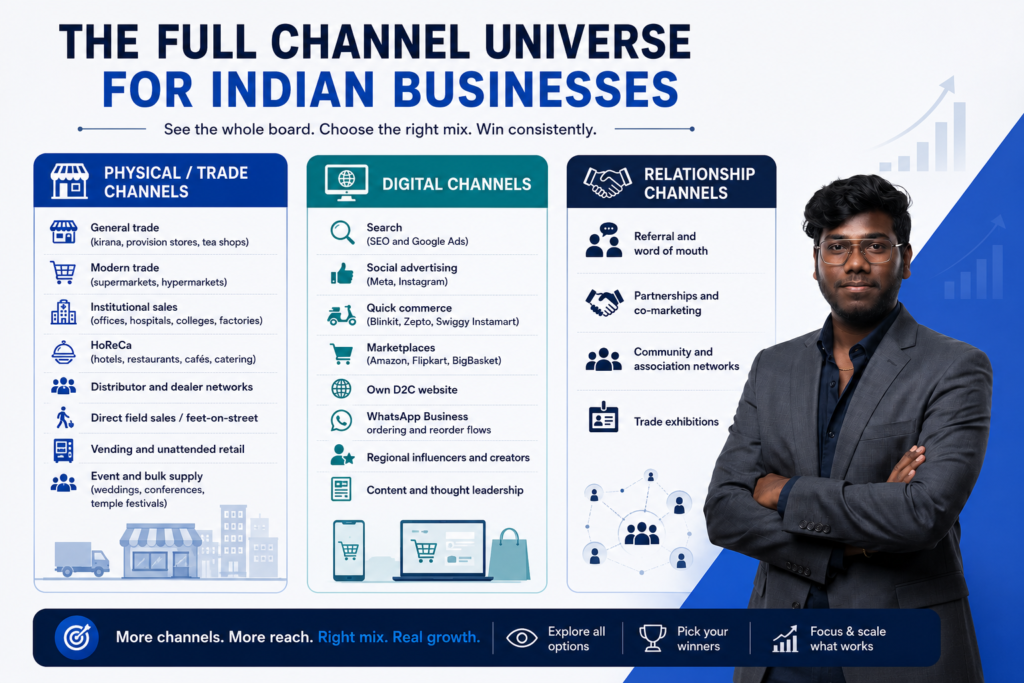
Physical / Trade Channels
- General trade (kirana, provision stores, tea shops)
- Modern trade (supermarkets, hypermarkets)
- Institutional sales (offices, hospitals, colleges, factories)
- HoReCa (hotels, restaurants, cafés, catering)
- Distributor and dealer networks
- Direct field sales / feet-on-street
- Vending and unattended retail
- Event and bulk supply (weddings, conferences, temple festivals)
Digital Channels
- Search (SEO and Google Ads)
- Social advertising (Meta, Instagram)
- Quick commerce (Blinkit, Zepto, Swiggy Instamart)
- Marketplaces (Amazon, Flipkart, BigBasket)
- Own D2C website
- WhatsApp Business ordering and reorder flows
- Regional influencers and creators
- Content and thought leadership
Relationship Channels
- Referral and word of mouth
- Partnerships and co-marketing
- Community and association networks
- Trade exhibitions
That is over twenty options. You will use three. The entire discipline of learning how to choose the right acquisition channels is the discipline of saying no to seventeen of them — on purpose, with reasons.
Why Most Founders Choose Acquisition Channels Wrong
Before the framework, understand the failure modes. They are remarkably consistent.
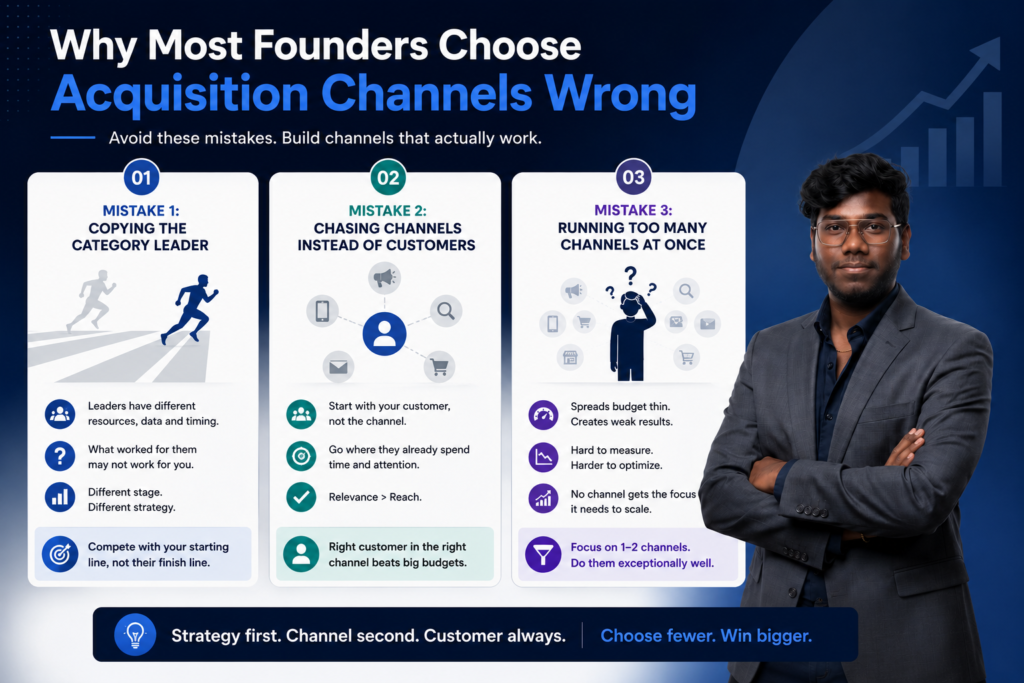
Mistake 1: Copying the Category Leader
This is the most expensive mistake in the book.
A new packaged water brand looks at Bisleri and thinks: they are everywhere, so I should be everywhere. According to IBEF, Bisleri remains one of the most widely recognised brands, supported by an extensive pan-India distribution network across retail and institutional channels.
But that network took decades and enormous capital to build. Copying its shape at year one is not strategy — it is cosplay.
The principle: Category leaders won using channels that were cheap when they entered. By the time you arrive, those channels are saturated and expensive. Their current channel mix tells you what worked twenty years ago, not what works for you today.
What to do instead: Study the leader’s weakest channel, not their strongest. That is where a challenger has room.
Understanding how to choose the right acquisition channels as a challenger means reading the leader’s gaps, not their strengths.
Mistake 2: Chasing Channels Instead of Customers
Founders read that quick commerce is exploding. So they chase quick commerce.
The market data supports the excitement — Coca-Cola’s strategic focus for Kinley now explicitly includes quick commerce channel scaling via Blinkit, Zepto, and Swiggy Instamart. Quick commerce is genuinely growing.
But growth in a channel is not the same as fit with your customer.
Ask the harder question: Does my actual customer buy this way? A construction site supervisor ordering forty 20-litre jars for a worksite in Thoothukudi is not opening Zepto. He is calling a number he has saved for three years.
The principle: Channels do not have customers. Customers have channels. Start with the human, not the platform.
Mistake 3: Running Too Many Channels at Once
Five channels at 20% effort each is not diversification. It is five failures running in parallel.
Every channel has a threshold of viability — a minimum level of investment, attention, and time below which it simply will not produce results. Split your resources thin enough and you cross below that threshold everywhere at once.
The principle: Two channels done properly beat six channels done partially. Always.
The test: If you cannot name the specific person responsible for a channel and the specific number they are accountable for, you are not running that channel. You are dabbling in it.
Founders who master how to choose the right acquisition channels are recognisable by what they refuse, not by what they run.
How to Choose the Right Acquisition Channels: The 7-Rule Framework
This is the core of the guide. Seven rules, applied in order. Skipping ahead is how founders end up back at the three mistakes above.
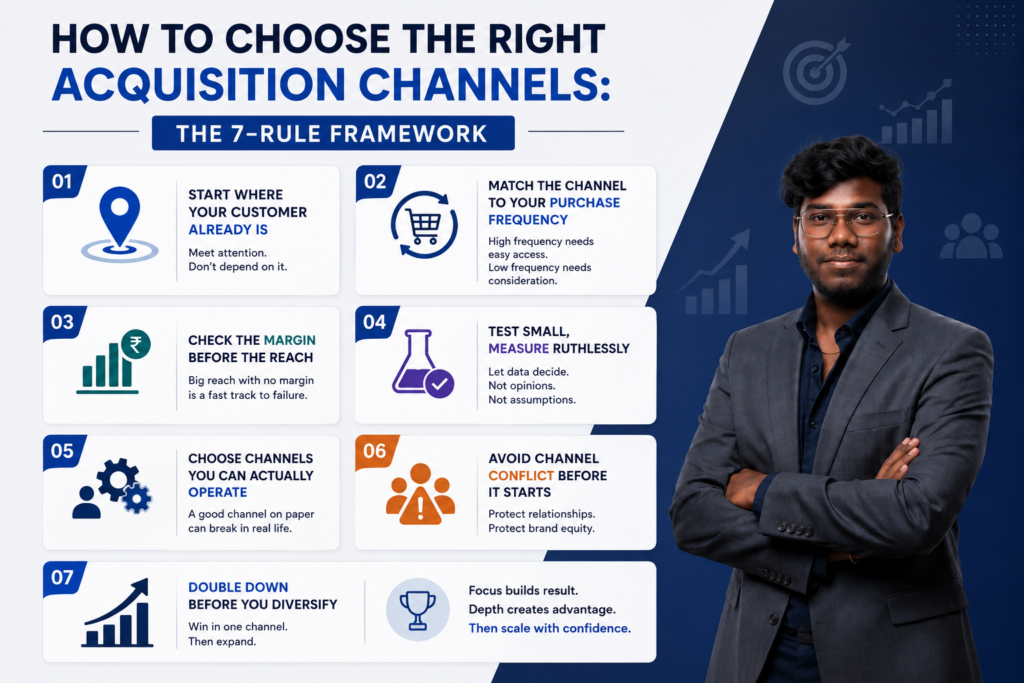
Rule 1: Start Where Your Customer Already Is
Do not create new behaviour. Intercept existing behaviour.
Creating behaviour is the most expensive thing in business. Intercepting it is the cheapest.
How to apply it:
- Write down your single most valuable customer segment. Be specific. Not “households” — “families in Nagercoil who currently buy 20-litre jars from an unbranded local supplier.”
- Map their current purchase journey for your category. Where do they buy today? Who do they call? What do they see?
- List every touchpoint in that journey.
- Your first channel must be one of those touchpoints.
Real example: In South Tamil Nadu’s packaged water market, the household bulk-jar buyer does not discover brands online. They inherit a supplier — from a neighbour, a previous tenant, or a shop nearby. The touchpoint is the neighbour, not the search engine.
That is how to choose the right acquisition channels in practice: one honest observation about customer behaviour, redirecting an entire strategy.
That single insight redirects the entire channel strategy toward referral density and route-level penetration, and away from digital ads that would have looked reasonable on a slide.
Rule 2: Match the Channel to Your Purchase Frequency
This rule is criminally underused, and it is the fastest way to eliminate wrong channels.
Purchase frequency determines which channel economics can survive.
| Purchase Frequency | Channel Logic | Example Channels |
|---|---|---|
| Daily / weekly | Convenience wins. Be physically closest. | General trade, quick commerce, route delivery |
| Monthly | Reminder + reliability wins. | WhatsApp reorder, subscription, distributor |
| Quarterly | Trust + comparison wins. | Search, referrals, field sales |
| Annual / one-time | Authority + proof wins. | Content, thought leadership, partnerships |
Why it works: A daily-purchase product cannot afford a high-touch sales channel — the acquisition cost never amortises. An annual-purchase product cannot rely on convenience — nobody remembers you eleven months later.
Applied to packaged water: A 500ml bottle is an impulse buy. Its channel must be within arm’s reach at the moment of thirst — meaning general trade, transport hubs, and HoReCa. A 20-litre home jar is a recurring monthly commitment. Its channel is a route and a relationship, not a shelf.
Same brand. Same factory. Completely different channels. Getting this wrong is why so many water brands overspend on retail while under-serving the far more profitable bulk segment.
Rule 3: Check the Margin Before the Reach
Reach is seductive. Margin is real.
Every channel takes a cut. In Indian FMCG, that cut is often larger than founders model.
The margin stack, layer by layer:
| Layer | Typical Take | What’s Left |
|---|---|---|
| MRP | — | 100% |
| Retailer margin | Varies by category and trade type | — |
| Distributor / stockist margin | Varies by territory and volume | — |
| Trade schemes & promotions | Often seasonal | — |
| Logistics & last-mile | Distance-dependent | — |
| Damages & returns | Category-dependent | — |
| Your net realisation | — | The only number that matters |
Note: exact percentages vary sharply by category, territory, and negotiating position — model your own rather than borrowing benchmarks.
The discipline: Never evaluate a channel by its top-line reach. Evaluate it by net realisation per unit and cash conversion cycle.
A channel that reaches 10,000 customers at a 4% net margin and 90-day payment terms is worse than a channel that reaches 800 customers at 22% net margin and cash-on-delivery. The second one funds itself. The first one funds someone else.
This is the single point where founder instinct and investor instinct diverge most sharply — and where a founder who can articulate net realisation by channel immediately sounds like an operator rather than a dreamer.
Rule 4: Test Small, Measure Ruthlessly
You cannot think your way to the right channel. You have to test.
But most channel “tests” are useless because they have no defined shape.
A valid channel test has five components:
- A fixed budget. Decided in advance. Not extended mid-test.
- A fixed duration. Long enough to see a full purchase cycle, at least twice.
- A single success metric. Not three. One.
- A pre-committed kill threshold. Written down before you start.
- A named owner. One person accountable.
Duration guidance by channel type:
| Channel | Minimum Test Window | Why |
|---|---|---|
| Digital ads | 4–6 weeks | Learning phase + statistical significance |
| General trade | 3–4 months | Needs repeat offtake to prove velocity, not just fill |
| Institutional / B2B | 4–6 months | Long procurement cycles, annual contracts |
| Quick commerce | 6–8 weeks | Fast data, but heavy promo distortion early |
| Referral | 3+ months | Requires an installed base to refer from |
Testing is where how to choose the right acquisition channels stops being a framework and becomes a discipline. The rules only matter if you honour the kill threshold.
The trap to avoid: Confusing primary sales with secondary sales. Getting your product into 200 shops is not proof of a working channel. It is proof of a working salesperson. The channel only works when those 200 shops reorder without being pushed.
That distinction — primary versus secondary sales — separates FMCG founders who survive from those who report impressive early numbers and then quietly stall.
Rule 5: Choose Channels You Can Actually Operate
A channel is a promise to a customer. Can you keep it?
This is where strategy meets reality, and where beautiful plans die.
The operating capability audit:
Ask, honestly:
- Do I have the people to run this channel weekly?
- Do I have the cash cycle to survive its payment terms?
- Do I have the infrastructure for its service level?
- Do I have the compliance it demands?
That last one is not optional in packaged water. The regulatory environment has tightened significantly — FSSAI classified packaged water as high-risk in December 2024, implementing stricter quality controls, and the transition from voluntary BIS certification to mandatory FSSAI licensing creates operational complexities, particularly for smaller manufacturers who struggle with infrastructure investments and testing protocol implementation.
Translation: modern trade and institutional channels will audit you. If your documentation is not immaculate, the channel is closed regardless of how good your water is. Compliance is not a back-office cost — it is a channel unlock.
The principle: An unoperated channel is worse than an unopened one. A retailer whose stock you cannot replenish on time does not become neutral toward you. He becomes an active detractor to every other retailer on that street.
Rule 6: Avoid Channel Conflict Before It Starts
Channel conflict happens when two of your own channels compete for the same customer — and someone loses trust.
The classic version in India: your D2C website or quick-commerce listing runs a discount that undercuts the local retailer’s MRP. That retailer now has a reason to push a competitor’s brand instead. You did not gain a customer. You lost a shelf.
Prevention rules:
- Segment by pack size. Different formats for different channels. Keep the trade’s SKU exclusive to the trade.
- Segment by geography. Do not launch digital in territories where your distributor is still building.
- Segment by customer type. Institutional pricing must be structurally invisible to retail buyers.
- Hold price discipline. If MRP means nothing, your distributor’s margin means nothing — and so does his loyalty.
Founders often treat conflict as a scaling problem. It is a selection problem — how to choose the right acquisition channels includes choosing which ones can coexist.
The founder discipline: Before adding any channel, ask: “Which existing channel does this make angry?” If you cannot answer, you have not thought about it enough.
Rule 7: Double Down Before You Diversify
This is the rule founders resist most, and it is the one that separates ₹1 crore businesses from ₹10 crore ones.
When a channel starts working, the instinct is to add a new one. That instinct is almost always wrong.
Why: A working channel is rarely maxed out when it starts working. It is usually at 20–30% of its ceiling. The marginal rupee spent deepening a proven channel returns far more than the first rupee spent on an unproven one — because the proven channel has no learning cost, no setup cost, and no failure risk.
The 70/20/10 allocation:
| Allocation | Purpose |
|---|---|
| 70% | Your proven, working channel — deepen it |
| 20% | Your second channel — scale toward proof |
| 10% | Structured experiments — the future |
The trigger to diversify: Only add a channel when the current one shows genuine saturation — declining returns on additional investment despite good execution. Not boredom. Not FOMO. Not because a competitor announced something on LinkedIn.
Saturation is a number. If you cannot show the number, you are not saturated. You are impatient.
Channel selection is one component of a broader customer acquisition strategy the sequencing, the budget discipline, and the exit rules all have to hold together. Choose channels in isolation and you optimise a part while the whole erodes.
The Channel Scorecard: A Practical Tool
Frameworks are useless without a decision instrument. Here is the scorecard.
Score each candidate channel from 1 to 5 on seven dimensions. Multiply by the weight. Sum.
| Dimension | Question | Weight |
|---|---|---|
| Customer presence | Is my customer already here? | ×3 |
| Net margin | What do I keep per unit after all cuts? | ×3 |
| Operability | Can I run this every week, reliably? | ×2 |
| Cash cycle | How fast does money come back? | ×2 |
| Scalability | Can this 10× without breaking? | ×2 |
| Defensibility | Can a competitor copy this next month? | ×1 |
| Conflict risk | Does this damage another channel? | ×1 (reverse-scored) |
Maximum score: 70
Interpretation:
| Score | Verdict |
|---|---|
| 55–70 | Priority channel. Commit properly. |
| 40–54 | Viable. Test with a fixed budget and kill threshold. |
| 25–39 | Watchlist. Revisit when capability or capital improves. |
| Below 25 | Say no. Write down why, and move on. |
How to use it well: Score channels as a team, independently, then compare. Where scores diverge sharply, you have found a genuine assumption gap — which is more valuable than the score itself. The argument is the deliverable.
Run this exercise once a quarter. Channels drift. So do scores.
Channel Selection in the Indian Context
Global playbooks break at the Indian border. Here is why.
The market itself is enormous and growing. IBEF reports the India packaged drinking water market size was valued at Rs. 32,040 crore (US$ 3.6 billion) in 2025 and is projected to reach value of Rs. 57,850 crore (US$ 6.5 billion) by 2032. Attractive on a slide.
But that number hides the real structure — and the structure is what determines channel choice.
The Tamil Nadu Distribution Reality
Three structural facts shape channel decisions in South Tamil Nadu.
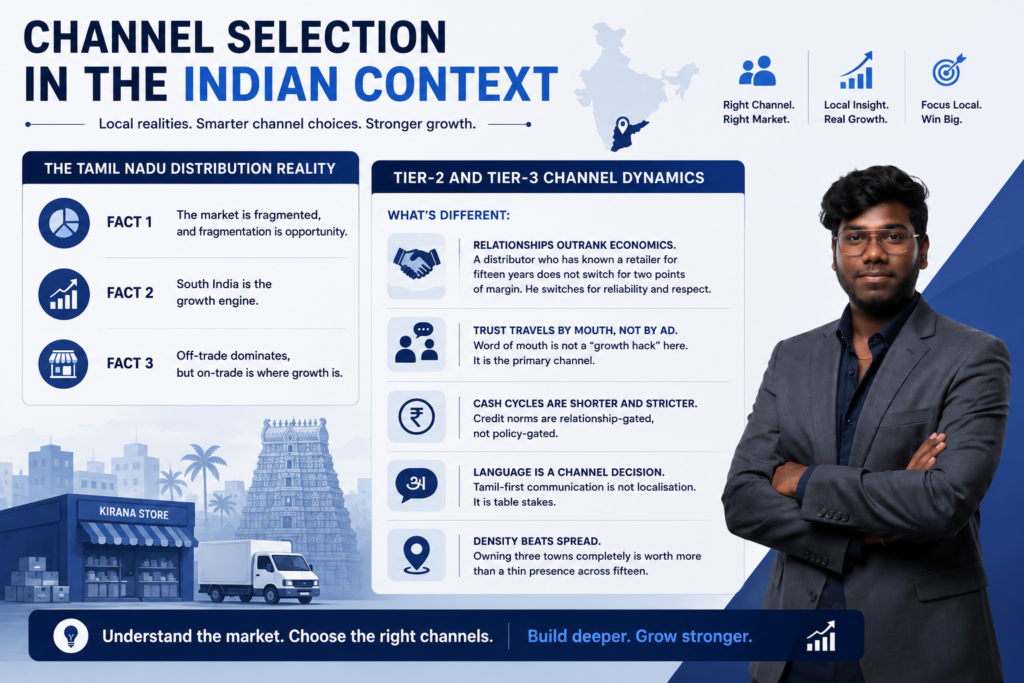
Fact 1: The market is fragmented, and fragmentation is opportunity.
The industry is highly fragmented, with thousands of local and regional players operating across India. However, the top 5 players collectively account for approximately 35% of the total market share.
Read that again. Roughly two-thirds of the market is not the big brands. That is not a footnote — that is the entire opportunity for a regional player. It also means your real competition in Tirunelveli is not Bisleri. It is the unbranded unit four kilometres away with a lower price and a faster truck.
Fact 2: South India is the growth engine.
Persistence Market Research identifies South India emerges as fastest-growing region with 12.5% CAGR fueled by severe water scarcity, educated consumer base, and thriving IT/tourism sectors demanding premium hydration.
Faster growth means channels are still forming. In a formed market, you fight for share. In a forming market, you build the road. The second is cheaper.
Fact 3: Off-trade dominates, but on-trade is where growth is.
By channel, off-trade sales accounted for over two-thirds of the market in 2024, while on-trade consumption through hotels, restaurants and cafes is expected to grow faster over the medium term, supported by tourism, hospitality recovery and rising out-of-home consumption.
For South Tamil Nadu, this is directly actionable. The temple and pilgrimage circuit — Rameswaram, Madurai, Kanyakumari, Tiruchendur — is a concentrated, seasonal, high-volume on-trade opportunity that national brands service generically and regional brands can service specifically.
Tier-2 and Tier-3 Channel Dynamics
The rules change outside metros. Founders trained on Bangalore or Chennai playbooks consistently misjudge Tirunelveli and Thoothukudi.
What’s different:
- Relationships outrank economics. A distributor who has known a retailer for fifteen years does not switch for two points of margin. He switches for reliability and respect.
- Trust travels by mouth, not by ad. Word of mouth is not a “growth hack” here. It is the primary channel.
- Cash cycles are shorter and stricter. Credit norms are relationship-gated, not policy-gated.
- Language is a channel decision. Tamil-first communication is not localisation. It is table stakes.
- Density beats spread. Owning three towns completely is worth more than a thin presence across fifteen.
The strategic implication: In Tier-2 and Tier-3 South Tamil Nadu, your acquisition channel is often a person — a distributor, a route salesman, a well-connected retailer. Choosing the right acquisition channels here means choosing the right people and giving them a reason to stay.
What Quick Commerce Changed — and What It Didn’t
Quick commerce is real. It is also widely misread by first-time founders.
What it changed: Regional brands can now reach urban consumers without building a distribution network first. Persistence notes that online sales channels through platforms like Amazon, BigBasket, Zepto, and Blinkit provide instant access to regional brands while enabling subscription models for recurring purchases. That is a genuine structural shift — a channel that did not exist for regional players a decade ago.
What it didn’t change:
- The margin math. Platform fees, promo funding, and logistics compress net realisation hard.
- Geographic limits. Quick commerce depth in Tier-3 South Tamil Nadu is not Chennai’s depth.
- The bulk segment. Nobody is ordering a 20-litre jar route subscription through a 10-minute delivery app.
- Brand building. Discovery on a platform is a transaction, not a relationship. The platform owns the customer.
The honest verdict: For a South Tamil Nadu packaged water brand, quick commerce belongs in the 10% experimentation bucket — not the 70% core. It is a visibility channel and a learning channel. It is not, yet, a profit channel at regional scale.
Say that out loud to an investor and watch their posture change. Founders who can name what a hyped channel cannotdo are more credible than founders who can only name what it can.
A Worked Example: Choosing Channels for a Packaged Water Brand
Theory is cheap. Here is the framework applied end to end.
The situation: A regional packaged drinking water brand serving South Tamil Nadu. Multiple SKUs — 500ml, 1L, 20L jars. Limited capital. Established national competitors. Dense unorganised competition.
Step 1 — Segment the customers (Rule 1)
| Segment | Where they already are |
|---|---|
| Household bulk-jar buyers | Neighbour referrals, local route suppliers |
| Retail impulse buyers | Kirana, bus stands, tea shops |
| Institutional buyers | Direct procurement, tender processes |
| HoReCa | Supplier relationships, F&B purchase managers |
| Event / bulk buyers | Caterers, wedding planners, temple committees |
Step 2 — Apply frequency logic (Rule 2)
| Segment | Frequency | Channel Implication |
|---|---|---|
| Household jars | Weekly / fortnightly | Route delivery + WhatsApp reorder |
| Retail impulse | Daily | General trade proximity |
| Institutional | Monthly contract | Field sales + compliance proof |
| HoReCa | Weekly | Relationship + service reliability |
| Events | Seasonal, high-volume | Partnerships with caterers |
Step 3 — Score the channels (Rule 3 + Scorecard)
| Channel | Customer Presence | Net Margin | Operability | Cash Cycle | Verdict |
|---|---|---|---|---|---|
| Household route delivery | High | High | High | Immediate | Priority |
| Institutional / B2B | High | High | Medium | 30–60 days | Priority |
| General trade | High | Medium | Medium | Mixed | Viable — test |
| HoReCa | Medium | Medium-High | Medium | 30 days | Viable — test |
| Modern trade | Medium | Low | Low | 60–90 days | Watchlist |
| Quick commerce | Low (in region) | Low | Medium | Platform terms | Experiment (10%) |
| D2C website | Very low | N/A | Low | Immediate | No |
Step 4 — The decision
Two priority channels. Household route delivery — highest margin, immediate cash, defensible through relationship density. Institutional sales — high volume, contracted predictability, and a channel where FSSAI/BIS compliance becomes a moat rather than a cost.
General trade becomes the 20% scaling channel. Everything else waits.
Step 5 — The uncomfortable part
Saying no to a D2C website. Saying no to national modern trade. Saying no, for now, to the quick-commerce narrative that would make a pitch deck sing.
That is what choosing the right acquisition channels actually feels like. Not the excitement of adding. The discomfort of subtracting.
How to Know When a Channel Is Dying
Channels do not fail loudly. They erode.
The five warning signs:
- Rising CAC with flat conversion. You are paying more for the same customer. The channel is getting crowded.
- Reorder rate declining while primary sales hold. You are pushing stock, not building demand. This is the FMCG death signal.
- Margin compression through demanded discounts. The channel is capturing your value, not sharing it.
- Effort creep. The same result now takes 40% more work.
- Your best people avoid it. Teams know before spreadsheets do. Listen to that.
The response protocol:
| Situation | Action |
|---|---|
| One warning sign | Diagnose. Probably a tactic problem. |
| Two or three signs | Cap investment. Stop adding. Investigate hard. |
| Four or more signs | Structural decline. Begin planned exit. |
The founder’s discipline: Exit channels on a schedule, not on emotion. A channel you exit deliberately at 60% health frees capital for a channel at 100% potential. A channel you exit at 10% health has already taken the capital with it.
Building Your Channel Portfolio Over Time
Channel strategy is not one decision. It is a sequence.
Stage 1 — Proof (₹0 to first traction)
- One channel. Only one.
- Objective: prove someone will pay repeatedly.
- Metric: repeat purchase rate.
- Common error: adding channel two before repeat purchase is proven.
Stage 2 — Depth (early traction to steady revenue)
- Deepen channel one to genuine saturation.
- Add channel two only after saturation is measured.
- Metric: net realisation per unit and cash cycle.
- Common error: mistaking growth for saturation.
Stage 3 — Portfolio (steady revenue to scale)
- Two core channels, one scaling, one experimental.
- Apply 70/20/10.
- Metric: channel-level contribution margin.
- Common error: letting the experimental 10% consume 40% of leadership attention.
Stage 4 — Moat (scale onward)
- Own a channel structurally. Route density. Exclusive relationships. Compliance depth.
- Metric: how hard would it be for a well-funded entrant to copy this?
- Common error: assuming scale itself is a moat. It isn’t. Channel ownership is.
The pattern: Every stage transition is triggered by a number, not a calendar date. Founders who move on vibes rebuild constantly. Founders who move on numbers compound.
FAQ’s
1. What are the main customer acquisition channels?
The main acquisition channels fall into three families. Physical or trade channels include general trade, modern trade, institutional sales, HoReCa, and distributor networks. Digital channels cover search, social advertising, quick commerce, marketplaces, D2C websites, and WhatsApp ordering. Relationship channels include referrals, partnerships, and community networks. Most businesses can access twenty or more channels, but successful ones typically run only two or three properly. The discipline lies in elimination, not accumulation.
2. How do you choose the best acquisition channel?
Start by mapping where your customer already buys your category today — do not try to create new behaviour. Then match the channel to your purchase frequency: daily products need proximity channels, annual products need authority channels. Check net margin after every intermediary cut, not top-line reach. Test two channels with fixed budgets, fixed durations, and pre-committed kill thresholds. Keep channels where acquisition cost stays below one-third of customer lifetime value.
3. What is channel-market fit?
Channel-market fit is the point where a specific acquisition channel reliably delivers customers at a cost your unit economics can sustain, repeatedly and without heroic effort. It is distinct from product-market fit. You can have a product people love and still lack channel-market fit if the only route to those people costs more than they are worth. Signs of fit include stable acquisition cost at increasing volume, and — critically in FMCG — reorders happening without sales pressure.
4. How many acquisition channels should a startup focus on?
One at proof stage. Two at scaling stage. Three at portfolio stage, using a 70/20/10 allocation across proven, scaling, and experimental channels. Every channel has a threshold of viability — a minimum investment below which it produces nothing. Running five channels at 20% effort each puts you below that threshold in all five simultaneously. Two channels executed properly consistently outperform six channels executed partially. Add a channel only when the current one shows measured saturation.
5. What is a good customer acquisition cost?
There is no universal number — it depends entirely on lifetime value and margin structure. The common working rule is that customer acquisition cost should stay below one-third of lifetime value, with a payback period short enough that your cash cycle survives it. In fast-moving, low-margin categories like packaged water, payback needs to be measured in weeks, not quarters. Calculate CAC per channel, never as a blended average — blended CAC hides the channel that is quietly bleeding you.
6. Which is better — organic or paid acquisition?
Neither is universally better; they solve different problems. Paid acquisition buys speed and gives fast, clean data — useful for testing hypotheses quickly. Organic acquisition, including referrals, content, and word of mouth, builds compounding assets but takes months to show returns. In Tier-2 and Tier-3 markets across Tamil Nadu, organic word of mouth is frequently the dominant channel, not a supplementary one. The practical answer is usually paid for learning, organic for compounding, chosen deliberately rather than by default.
7. How long should you test an acquisition channel?
Long enough to observe at least two complete purchase cycles. For digital advertising, that means four to six weeks. For general trade, three to four months, because you must see reorders — not just initial stocking. For institutional and B2B channels, four to six months, given long procurement cycles. Quick commerce shows data in six to eight weeks, though early promotional distortion inflates results. Set the duration and the kill threshold before you start, never during.
8. What is channel conflict and how do you avoid it?
Channel conflict occurs when two of your own channels compete for the same customer, damaging trust with one of them. The classic Indian example: a quick-commerce discount undercutting the local retailer’s MRP, giving that retailer a reason to promote a competitor instead. Avoid it by segmenting deliberately — different pack sizes for different channels, geographic separation between digital and distributor territories, and structurally invisible institutional pricing. Before adding any channel, ask which existing channel it will anger.
9. How do FMCG brands distribute in India?
Most Indian FMCG brands use a layered route-to-market: company to distributor or stockist, distributor to retailer, retailer to consumer. Each layer takes margin and adds reach. General trade — kirana and provision stores — remains dominant, though modern trade, quick commerce, and e-commerce are growing. The critical metric is secondary sales, meaning retailer-to-consumer offtake, not primary sales into the distributor. Primary sales measure your salesperson’s effort. Secondary sales measure genuine demand.
10. What acquisition channels work best in Tier-2 and Tier-3 cities?
Relationship-driven channels dominate. Distributor networks, route delivery, referral, and direct field sales consistently outperform digital-first approaches in Tier-2 and Tier-3 South Tamil Nadu. Trust travels through people, not advertisements. Language matters — Tamil-first communication is a requirement, not a localisation exercise. Geographic density beats geographic spread: owning three towns completely generates more durable revenue than a thin presence across fifteen. Choose the person, then the channel follows.
Conclusion: Subtraction Is the Strategy
Here is what fifteen hundred words of framework compress into.
Knowing how to choose the right acquisition channels is not about finding the clever channel nobody else has found. It is about honestly eliminating the twenty channels that will not work for you, and then executing the two that will — with more discipline than feels comfortable.
Everything above is one layer of a working customer acquisition strategy. Channels are the where. The strategy is the why, in what order, and with what money.
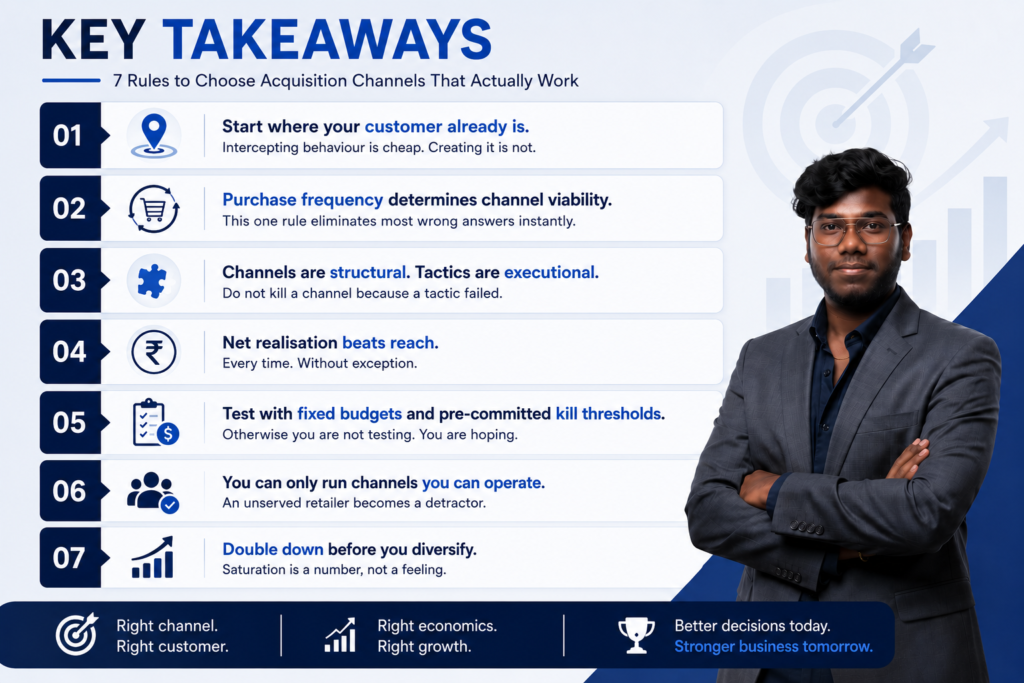
The key takeaways:
- Start where your customer already is. Intercepting behaviour is cheap. Creating it is not.
- Purchase frequency determines channel viability. This one rule eliminates most wrong answers instantly.
- Channels are structural. Tactics are executional. Do not kill a channel because a tactic failed.
- Net realisation beats reach. Every time. Without exception.
- Test with fixed budgets and pre-committed kill thresholds. Otherwise you are not testing. You are hoping.
- You can only run channels you can operate. An unserved retailer becomes a detractor.
- Double down before you diversify. Saturation is a number, not a feeling.
The Indian market — and South Tamil Nadu specifically — rewards founders who understand this. A market growing toward Rs. 57,850 crore by 2032, where the top 5 players collectively account for approximately 35% of the total market share, has room for regional operators who choose their routes deliberately.
The channels are not the moat. The discipline of choosing them is.
Score your channels this week. Not next quarter. The compounding starts the day you say your first honest no.
I write about what building an FMCG brand in South Tamil Nadu actually costs — the distribution decisions, the compliance realities, and the channel mistakes that don’t make it into pitch decks.
If you found this framework useful, three ways to go deeper:
→ Read next: The Real Cost Structure of a Packaged Water Business in Tamil Nadu — the unit economics breakdown most founders discover too late.
→ See it in practice: Everything in this guide is drawn from building Sparow packaged drinking water brand serving South Tamil Nadu. If you’re evaluating a partnership, distribution opportunity, or investment in the regional FMCG space, the operating story is on the Sparow website.
→ Talk directly: I speak with founders, distributors, and investors working on South Indian FMCG distribution. If that’s you, get in touch — I read every message.
Brawin Rajadurai builds Sparow, a packaged drinking water brand serving South Tamil Nadu, and writes about distribution, unit economics, and regional FMCG strategy.
Enjoyed this? Get the next one by email.
Occasional, considered notes on brand and building. No noise.