How to Get Your First 100 Customers (Founder’s Playbook)
Most businesses don’t die because the product was bad.
They die because nobody bought it.
I learned this the hard way. When I started Sparow a packaged drinking water brand operating out of Tamilnadu, I had the plant, the FSSAI licence, the labels, the whole setup. What I did not have was a single paying customer. Figuring out how to get your first 100 customers turned out to be harder than every technical and regulatory hurdle combined.
Here’s the uncomfortable truth nobody tells first-time founders: your first hundred customers will not come from a marketing budget. They’ll come from you. Personally. One conversation at a time.
This guide is the playbook I wish someone had handed me on day one a complete Customer Acquisition Strategy built from real operating experience in the Indian market, specifically Tamil Nadu, and from studying how founders across the country crossed the same line. No theory. No recycled Silicon Valley advice that falls apart the moment you’re standing in a Chennai warehouse at 6 AM.
Let’s get into it.
Table of Contents
Why the First 100 Customers Are the Hardest — and the Most Valuable
Zero to 100 is a completely different game from 100 to 10,000.
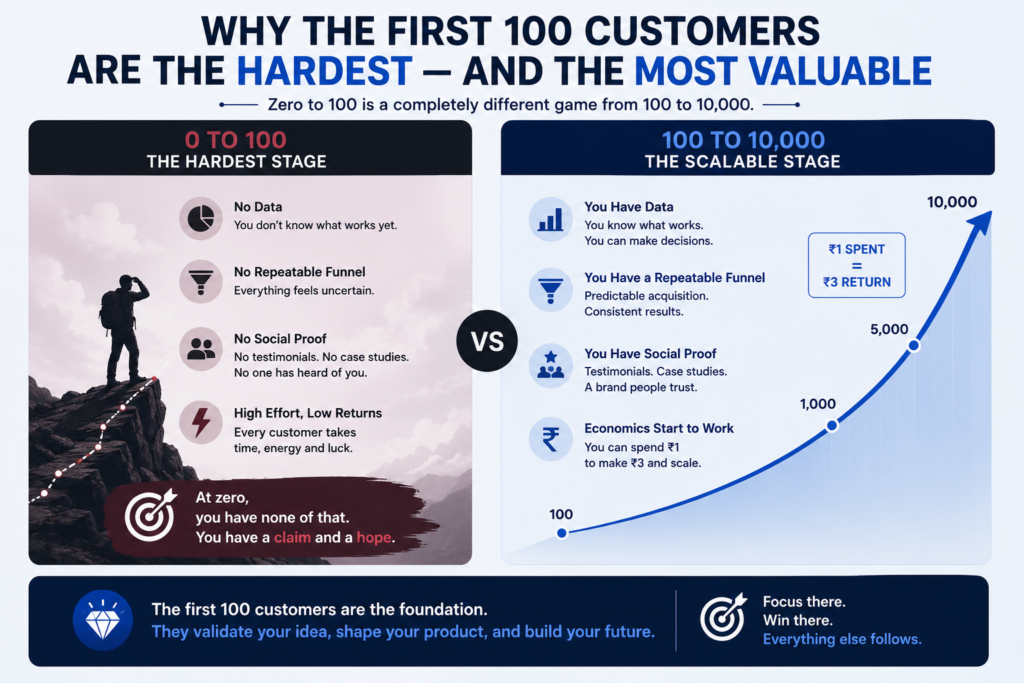
At 10,000 customers, you have data. You have a repeatable funnel. You have testimonials, case studies, and a brand people have heard of. You can spend ₹1 to make ₹3 and just keep spending.
At zero, you have none of that. You have a claim and a hope.
The Trust Deficit Problem
Nobody wants to be your first customer. This is not personal — it’s rational.
Your prospect is asking a simple question: if this were any good, wouldn’t someone else have bought it already? That’s the trust deficit, and it’s the single biggest obstacle in early customer acquisition.
Every one of the first 100 customers is a small act of faith. Your job is to make that faith cheap — low risk, easy to reverse, backed by your personal reputation.
Why These 100 Are Worth More Than the Next 1,000
Here’s what most founders miss. The first 100 aren’t just revenue. They’re your R&D department, your sales team, and your credibility engine.
- They tell you what’s broken before it costs you lakhs to fix at scale.
- They generate the testimonials that make customer 101 through 500 dramatically easier.
- They reveal your actual ideal customer profile, which is almost never the one you wrote in your pitch deck.
- They prove product-market fit — or prove you don’t have it yet, which is equally valuable information.
Paul Graham’s advice to Y Combinator founders has become almost a cliché, but it stays true because it works: do things that don’t scale. The first 100 customers are earned, not acquired.
The Math Nobody Runs
Most early founders obsess over customer acquisition cost while ignoring the denominator.
If you spend ₹50,000 and get 100 customers, your CAC is ₹500. Fine. But if 70 of those 100 churn in month two, your real CAC on the retained base is ₹1,667. Suddenly your unit economics look very different.
This is why retention isn’t a “later” problem. We’ll come back to this in Step 12.
Before You Chase Customers: Get These 3 Things Right
You cannot outrun a bad foundation with hustle. Fix these three first.
Define Your Ideal Customer Profile
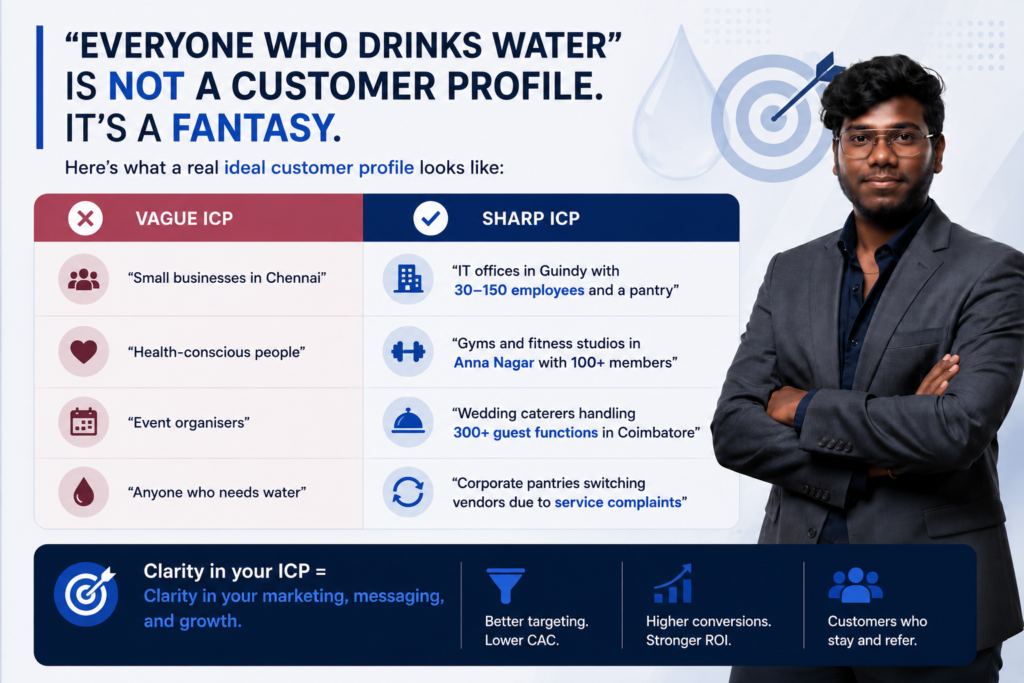
“Everyone who drinks water” is not a customer profile. It’s a fantasy.
When I started Sparow, I told myself the market was everyone in Tamil Nadu. That’s roughly 7.6 crore people. Sounds great. It’s actually useless — because you cannot design a sales conversation for 7.6 crore people.
The narrower you go, the faster you sell.
Here’s what a real ideal customer profile looks like:
| Vague ICP | Sharp ICP |
|---|---|
| “Small businesses in Chennai” | “IT offices in Guindy with 30–150 employees and a pantry” |
| “Health-conscious people” | “Gyms and fitness studios in Anna Nagar with 100+ members” |
| “Event organisers” | “Wedding caterers handling 300+ guest functions in Coimbatore” |
| “Anyone who needs water” | “Corporate pantries switching vendors due to service complaints” |
See the difference? The right column tells you exactly who to call, what to say, and where to find them.
How to build yours in one afternoon:
- List every customer type who could theoretically buy.
- Score each on three axes: urgency of need, ability to pay, ease of reach.
- Pick the highest scorer. Not the biggest market — the reachable one.
- Write one sentence: “My customer is a ___ who struggles with ___ and currently solves it by ___.”
- Go find twenty of them. If you can’t find twenty in a week, your ICP is wrong or unreachable.
Sharpen Your Value Proposition
Your value proposition is not what your product does. It’s what changes in your customer’s life.
Nobody buys packaged drinking water. They buy not having to worry about whether the office water is safe. They buy not getting a complaint from an employee. They buy the vendor who actually delivers on time during monsoon.
Test your value proposition against this filter:
- Specific: Does it name a real, felt problem?
- Differentiated: Could your competitor say the exact same sentence? If yes, rewrite it.
- Provable: Can you back it with something a stranger would believe?
A weak value prop: “High quality purified water at affordable prices.”
A strong one: “BIS-certified 20-litre cans delivered before 9 AM, every single day — or that day is free.”
The second one is a promise with teeth. It’s also risky, which is exactly why it’s credible.
Choose Your Beachhead Market
A beachhead is the smallest market you can completely dominate.
The logic is simple. Winning 40% of one Chennai neighbourhood is worth far more than winning 0.1% of Tamil Nadu. Concentration creates word of mouth. Dispersion creates nothing.
When you’re dense in one area, three things happen automatically:
- Your delivery costs drop because routes get efficient.
- Your customers start seeing each other use you — social proof compounds.
- Referrals become geographically convenient, so people actually make them.
Pick a beachhead using these criteria:
- You can physically or digitally reach the whole market.
- The customers talk to each other.
- You can serve them well without stretching operations.
- There’s a credible reason you’d win here specifically.
For Sparow, that meant picking specific industrial and IT corridors rather than spraying across the district. For a SaaS founder, it might mean one vertical — say, dental clinics — rather than “SMBs.”
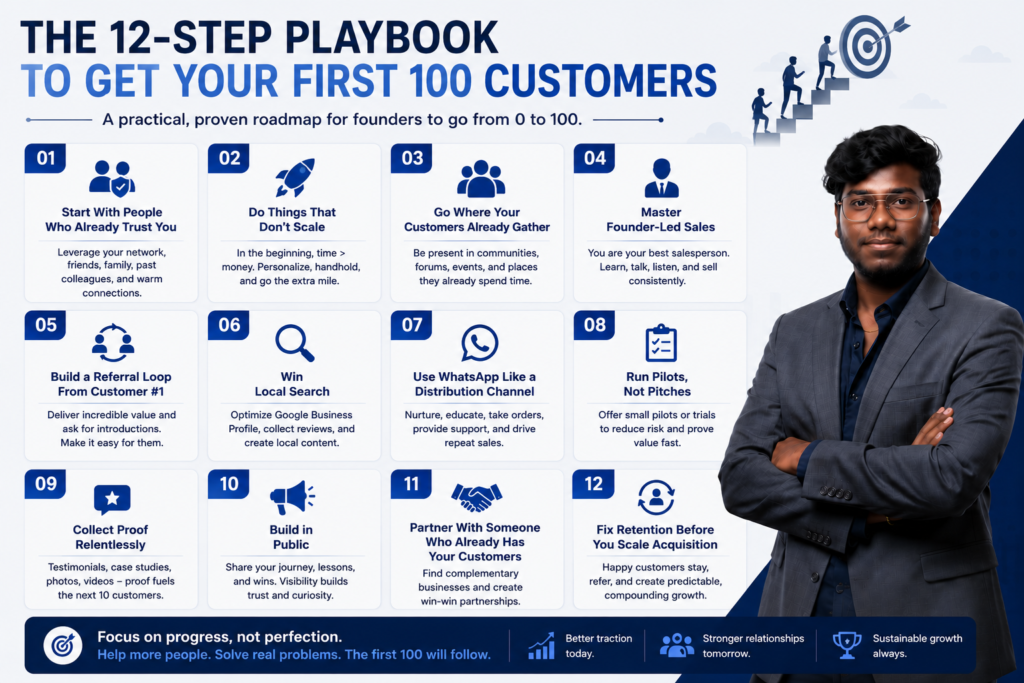
The 12-Step Playbook to Get Your First 100 Customers
This is the core of it. Work these in roughly this order.
Step 1: Start With People Who Already Trust You
Your network is not “cheating.” It’s your unfair advantage, and every successful founder used it.
The trust deficit I mentioned earlier? Your existing contacts have already cleared it. They know you’re not going to disappear with their money. That’s worth more than any ad.
How to work your network without being that guy:
Make a list. Every former colleague, classmate, family friend, vendor, and acquaintance. Aim for 100 names. It’ll feel awkward. Do it anyway.
Then sort them into three buckets:
- Buyers: people who could genuinely use what you sell
- Connectors: people who know buyers
- Amplifiers: people with an audience
Reach out individually. Not a broadcast. Not a forward. A message that shows you thought about them specifically.
Here’s the framing that works:
“Hi Karthik — I’ve started a packaged drinking water brand focused on reliable morning delivery for offices. I’m not asking you to buy anything. I’m trying to understand if the reliability problem is real for your office. Do you have 10 minutes this week?”
Notice: no pitch. Just a question. The pitch comes later, and it comes easier.
Realistically, from 100 warm contacts you’ll get somewhere between 5 and 15 first customers. That’s not 100 — but it’s the foundation the next 85 stand on.
Step 2: Do Things That Don’t Scale
Airbnb’s founders flew to New York and photographed listings themselves. Zappos bought shoes from retail stores to fulfil orders. Zoho’s early team built custom features for individual customers.
None of this scales. All of it works.
At the first-100 stage, unscalable is a feature, not a bug. You are buying learning and loyalty with effort, because you don’t yet have money to buy them with money.
Unscalable things that pay off:
- Personally delivering the first 20 orders yourself
- Calling every single customer after their first purchase
- Writing handwritten notes with early deliveries
- Onboarding customers over a video call instead of an email
- Fixing a customer’s problem at 11 PM because they’re one of your first ten
In my first month running Sparow, I rode along on deliveries. I heard complaints I would never have heard through a form. One conversation with a facilities manager taught me that the real pain wasn’t water quality at all — it was that vendors kept changing delivery timings without notice. That single insight reshaped the entire positioning.
You cannot get that from a survey.
Step 3: Go Where Your Customers Already Gather
Stop trying to build an audience. Borrow one.
Your first customers are already congregating somewhere — a WhatsApp group, a trade association, a LinkedIn community, a Reddit thread, a physical market, an industry expo. Your job is to show up there and be useful before you’re commercial.
Where Indian founders actually find early customers:
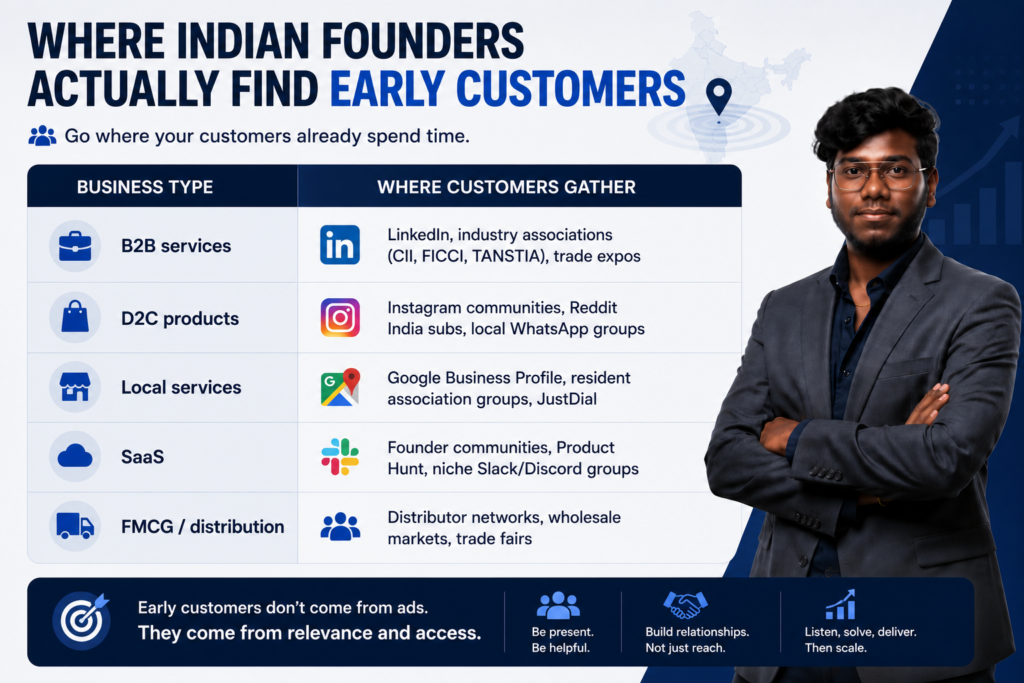
| Business Type | Where Customers Gather |
|---|---|
| B2B services | LinkedIn, industry associations (CII, FICCI, TANSTIA), trade expos |
| D2C products | Instagram communities, Reddit India subs, local WhatsApp groups |
| Local services | Google Business Profile, resident association groups, JustDial |
| SaaS | Founder communities, Product Hunt, niche Slack/Discord groups |
| FMCG / distribution | Distributor networks, wholesale markets, trade fairs |
The rule of engagement: give value for six weeks before you ask for anything. Answer questions. Share what you’re learning. Be the person who’s actually helpful.
When you finally mention what you do, nobody feels sold to. They feel like they discovered you.
Step 4: Master Founder-Led Sales
You are your best salesperson. Not because you’re skilled — you’re probably not — but because you care more than any hire ever will, and prospects can smell that.
Don’t hire a sales team before customer 100. You’d be outsourcing the most valuable learning in your entire business.
The founder-led sales conversation, structured:
- Ask, don’t tell. Spend the first 60% of the call understanding their situation. What do they use now? What annoys them about it? What did they try before?
- Reflect the problem back. “So if I understand right, the issue isn’t cost — it’s that when your vendor misses a delivery, you’re the one getting complaints. Is that fair?”
- Position, don’t pitch. Show only the part of your product that solves their stated problem. Ignore the rest.
- Make the ask small. Not “sign a contract.” Try “would you run us for two weeks and see?”
- Handle the real objection. It’s almost never price. It’s risk. Reduce the risk.
The most useful sentence in early sales: “What would have to be true for this to be an easy yes for you?”
They’ll tell you exactly what to fix.
Step 5: Build a Referral Loop From Customer #1
Word of mouth is not luck. It’s a system you design.
Most founders wait until they have “enough” customers to think about referrals. Wrong. Build the loop at customer one, when you have the most goodwill and the most attention to give.
The referral mechanics that work in India:
- Ask at the peak. The moment a customer expresses happiness is the moment to ask. Not a month later. Right then.
- Make the ask specific. “Do you know anyone?” gets nothing. “Do you know another facilities manager in this building who deals with the same delivery problem?” gets a name.
- Give them a reason to look good. People refer to feel helpful, not to earn ₹100. Frame it as them helping their friend, not helping you.
- Reward both sides. If you do incentivise, reward the referrer and the referred. One-sided referral schemes feel transactional.
- Close the loop. Tell the referrer what happened. “Your intro to Priya worked out — thank you.” They’ll refer again.
A tight referral loop can realistically source 20–35 of your first 100 customers. That’s a third of the job, done by people who aren’t on your payroll.
Step 6: Win Local Search
If you’re a local or regional business, this is the highest-ROI unpaid channel in India. Full stop.
Someone in your area is typing “water can supplier near me” or “packaged drinking water Chennai” right now. If you’re not in those results, you don’t exist to them.
Local SEO checklist for Indian businesses:
- Claim and fully complete your Google Business Profile
- Add real photos — plant, team, vehicles, product. Stock photos kill trust.
- List accurate hours, service areas, and phone number
- Get your first 10 reviews from real early customers (just ask — they’ll say yes)
- Respond to every review, especially negative ones
- Add your business to relevant Indian directories: JustDial, IndiaMART, Sulekha
- Ensure your name, address, and phone are identical everywhere
- Post updates weekly — Google rewards active profiles
- Add city and locality names naturally to your website copy
- Build a page for each area you serve, if you serve several
This takes a weekend and costs nothing. Most of your competitors haven’t done it properly. That’s your opening.
Step 7: Use WhatsApp Like a Distribution Channel
In India, WhatsApp is not a chat app. It’s the operating system of commerce.
Your customers are already there. They’ll respond to a WhatsApp message they’d never open as an email. Treat it as a primary channel, not an afterthought.
How to use WhatsApp Business properly:
- Set up a WhatsApp Business account with a catalogue, hours, and away messages
- Use the “click to WhatsApp” link everywhere — website, Google profile, business cards
- Create a broadcast list (not a group) for updates — groups annoy people, broadcasts don’t
- Respond fast. Sub-10-minute response times close deals that hour-long ones lose.
- Use it for order confirmation, delivery updates, and feedback collection
One caution: never add someone to a group without permission. It’s the fastest way to burn goodwill in the Indian market.
Step 8: Run Pilots, Not Pitches
The biggest barrier to your first 100 customers isn’t disinterest. It’s risk.
A pilot removes the risk. Instead of asking someone to commit, you’re asking them to test.
Structuring a pilot that converts:
| Element | Weak Pilot | Strong Pilot |
|---|---|---|
| Duration | “Try it out sometime” | “Two weeks, starting Monday” |
| Success metric | Undefined | “Zero missed deliveries” |
| Exit | Awkward | “If it doesn’t work, we stop. No invoice.” |
| Follow-up | Whenever | “I’ll call you on day 15” |
| Commitment | Vague | “If it works, we do a three-month agreement” |
The critical part is defining success upfront. If both sides agree what “working” means before you start, the conversion conversation at the end writes itself.
Pilots also give you something priceless: a customer who has already experienced the product before they’ve paid. Their objections evaporate.
Step 9: Collect Proof Relentlessly
Every customer you win is ammunition for winning the next one. Most founders waste it.
The proof stack, in order of power:
- Named case studies — a real customer, real numbers, real logo
- Video testimonials — 30 seconds beats 300 words
- Written testimonials with a name and photo — anonymous quotes are worthless
- Screenshots of real messages — surprisingly credible because they’re clearly unpolished
- Usage numbers — “42 offices across Chennai” beats “trusted by many”
- Certifications and licences — BIS, FSSAI, ISO where relevant. In regulated categories these are non-negotiable trust signals.
When to ask: immediately after a moment of delight. A customer who just said “you guys are great” will say yes to a testimonial request within the same hour. Ask a week later and they’ve moved on.
How to ask so they say yes: do the work for them. Draft the testimonial yourself and ask them to edit it. Send three specific questions instead of “say something nice.” Record the call and pull the quote.
This is straight EEAT thinking, and it applies to sales as much as it does to Google. Experience, expertise, and trustworthiness are what convert strangers.
Step 10: Build in Public
Share the journey, not just the product.
Nobody wants to read your advertisement. Everyone wants to read about a real person building something real and occasionally screwing it up.
What to share:
- What you learned this week
- A decision you’re wrestling with
- A number — revenue, customers, a failure rate
- A mistake and what it cost you
- Behind the scenes of the operation
Where it works in India: LinkedIn is dramatically underrated for this. The Indian LinkedIn audience is enormous, engaged, and full of exactly the founders, investors, and business owners who might become customers or connectors.
I’ve watched founders in Chennai and Bengaluru build genuine businesses off nothing but consistent, honest LinkedIn posting. Not viral posts. Consistent ones.
The compounding is slow, then sudden. Month one, nobody cares. Month six, people you’ve never met are messaging you asking to buy.
Step 11: Partner With Someone Who Already Has Your Customers
Why build an audience for two years when someone already spent ten years building one?
Find businesses that serve your exact customer but sell something different. There’s no competition, only overlap.
Partnership plays that work:
| Your Business | Natural Partner |
|---|---|
| Packaged drinking water | Office pantry suppliers, facility management firms, event caterers |
| Accounting SaaS | CA firms, business registration consultants |
| Interior design | Real estate brokers, architects |
| Fitness coaching | Gyms, nutritionists, corporate HR teams |
| B2B logistics | Packaging suppliers, e-commerce enablers |
How to make the ask: don’t lead with revenue share. Lead with “I think I can make your customers happier.” Offer to do the work. Make it zero effort for them.
One good distribution partner can deliver more of your first 100 customers than three months of cold outreach.
Step 12: Fix Retention Before You Scale Acquisition
This is the step everyone skips, and it’s the one that determines whether you have a business or a treadmill.
If you’re losing customers as fast as you’re winning them, getting to 100 is meaningless. You’ll just be running to stand still, and every rupee of acquisition spend evaporates.
Ask yourself before scaling:
- What percentage of customers are still here after 90 days?
- Do customers buy again without being chased?
- Would customers be genuinely annoyed if you shut down tomorrow?
- What’s the actual reason people leave? (Ask them. Every single one.)
The exit interview is the most undervalued tool in early business. When a customer churns, call them. Not to save them — that ship has sailed. To learn.
Nine out of ten times, they’ll tell you something you didn’t know. Fix it before you spend money attracting people who’ll leave for the same reason.
Sean Ellis’s product-market fit test is a good rough gauge: survey your customers and ask how disappointed they’d be if your product disappeared. If under 40% say “very disappointed,” you have a retention problem, not an acquisition problem.
Channel Comparison: Which One Should You Pick First?
You cannot do all twelve steps at once. Your Customer Acquisition Strategy at this stage is really just a channel decision — so here’s how the main options stack up for a founder starting from zero in India.
| Channel | Cost | Time to First Customer | Scalability | Best For |
|---|---|---|---|---|
| Personal network | ₹0 | Days | Low | Everyone, always start here |
| Founder-led sales | ₹0 (your time) | 1–3 weeks | Low | B2B, high-ticket |
| Referrals | ₹0–low | 2–6 weeks | Medium | Service businesses, local |
| Local SEO / GBP | ₹0 | 3–8 weeks | High | Local & regional businesses |
| ₹0–low | Days | Medium | Indian D2C, local services | |
| Communities | ₹0 | 4–10 weeks | Medium | SaaS, niche products |
| Build in public | ₹0 | 8–16 weeks | High | Personal brands, B2B |
| Partnerships | ₹0–revshare | 4–12 weeks | High | Distribution-heavy models |
| Paid ads | ₹₹₹ | Days | High | Only after PMF is proven |
| Cold email | Low | 2–8 weeks | Medium | B2B with clear ICP |
The founders who figure out how to get your first 100 customers fastest aren’t running ten channels. They’re running two, properly.
The honest recommendation: pick two. One that gives fast feedback (network, founder-led sales) and one that compounds slowly (local SEO, build in public). Ignore the rest until 100.
The Tamil Nadu Advantage: Playing Your Home Ground
If you’re working out how to get your first 100 customers in Tamil Nadu, you have structural advantages most founders never use.
Trust Travels Through Networks Here
Tamil Nadu’s business culture is relationship-dense. Trade associations, community networks, and family business connections carry real weight. A warm introduction here doesn’t just open a door — it often closes the deal.
This cuts both ways. Your reputation moves fast, in both directions. Deliver badly once and the same network that could have made you will unmake you. Deliver well and referrals arrive without asking.
The Ecosystem Actually Exists Now
Chennai and Coimbatore have real startup infrastructure. TANSIM (Tamil Nadu Startup and Innovation Mission) runs founder programmes and connects early ventures to mentors and investors. The IIT Madras Incubation Cell has produced companies that scaled globally.
Zoho, built out of Chennai and Tenkasi, is the definitive proof that world-class businesses can be built here — and Zoho’s early years are a masterclass in exactly the founder-led, unscalable customer acquisition described above. Freshworks followed a similar path from Chennai to a Nasdaq listing.
These aren’t just inspiration. They’re evidence you can use in sales conversations.
Practical Local Levers
These levers won’t get your first 100 customers on their own. Used together, they remove friction from every conversation you have.
- MSME registration (Udyam): free, fast, and it unlocks procurement preferences and credit schemes. Many corporate and government buyers prefer or require registered MSME vendors.
- Startup India recognition: simplifies compliance and adds credibility on your website.
- Trade associations: TANSTIA, CII Southern Region, and district chambers hold events where your customers physically show up.
- Bilingual marketing: English-only marketing leaves money on the table. Tamil-language WhatsApp messages and local content convert noticeably better outside metro pockets.
- Local trade fairs: underrated. A stall at a district-level trade fair can generate more qualified conversations in two days than a month of cold calling.
The Density Play
Tamil Nadu’s industrial clusters are geographically tight. Tiruppur for textiles. Coimbatore for engineering. Chennai for IT and auto. Sivakasi for printing and fireworks.
If your customer sits in one of those clusters, you can physically visit twenty prospects in a single day. That’s a compounding advantage no digital channel matches at this stage.
How to Get Your First 100 Customers Without Spending on Ads
Let’s address this directly, because it’s the question most first-time founders are really asking.
You do not need an ad budget to reach 100 customers. In most cases, ads at this stage actively hurt you.
Why ads are wrong for the first 100:
- You don’t know your message yet. Ads amplify a message. If the message is wrong, you’re just paying to be wrong faster.
- You don’t know your ICP yet. Targeting requires knowing who to target. You’re guessing.
- You have no conversion infrastructure. Traffic without a functioning funnel is just noise.
- You learn nothing. A click tells you nothing. A conversation tells you everything.
- The economics are brutal at low volume. You have no data to optimise with, so you’ll pay the beginner’s tax on every impression.
The zero-budget stack that actually works:
- Personal network outreach (Step 1)
- Founder-led sales conversations (Step 4)
- A properly set up Google Business Profile (Step 6)
- WhatsApp Business as a channel (Step 7)
- Two-week pilots to kill risk objections (Step 8)
- Systematic referral asks (Step 5)
- Consistent LinkedIn posting (Step 10)
That’s the entire playbook. Total cost: your time and roughly ₹0 in media spend.
Start advertising when you can answer these three questions with data, not opinion:
- Who exactly is my best customer?
- What message makes them convert?
- What’s my retention rate at 90 days?
Until then, ads are a tax on impatience.
Real Numbers: What Your First 100 Customers Actually Look Like
Here’s a realistic breakdown of how to get your first 100 customers by source, based on what actually happens to bootstrapped Indian founders.
| Source | Typical Contribution | Effort Level |
|---|---|---|
| Personal network | 10–15 | Low |
| Founder-led outreach | 25–35 | Very high |
| Referrals from early customers | 20–35 | Medium |
| Local search / GBP | 10–20 | Medium (front-loaded) |
| Communities & partnerships | 10–20 | Medium |
| Inbound from content | 5–15 | High, slow |
Realistic timeline: 4 to 9 months for most bootstrapped businesses. Faster if you’re B2C and low-ticket. Slower if you’re B2B and enterprise.
If someone tells you they got 100 customers in three weeks, one of three things is true: they had an existing audience, they’re counting free signups as customers, or they’re not telling the truth.
Conversion reality check. Plan your outreach volume backwards:
- 100 cold outreaches → ~20 responses → ~8 conversations → ~2–3 customers
- 10 warm introductions → ~7 conversations → ~3–4 customers
That maths tells you something important: one warm intro is worth roughly twenty cold emails. Spend your energy accordingly.
7 Mistakes That Kill Early Traction
I’ve made most of these. Learn them cheaper than I did. Every one of these will slow down how fast you get your first 100 customers. I’ve made most of them — learn them cheaper than I did.
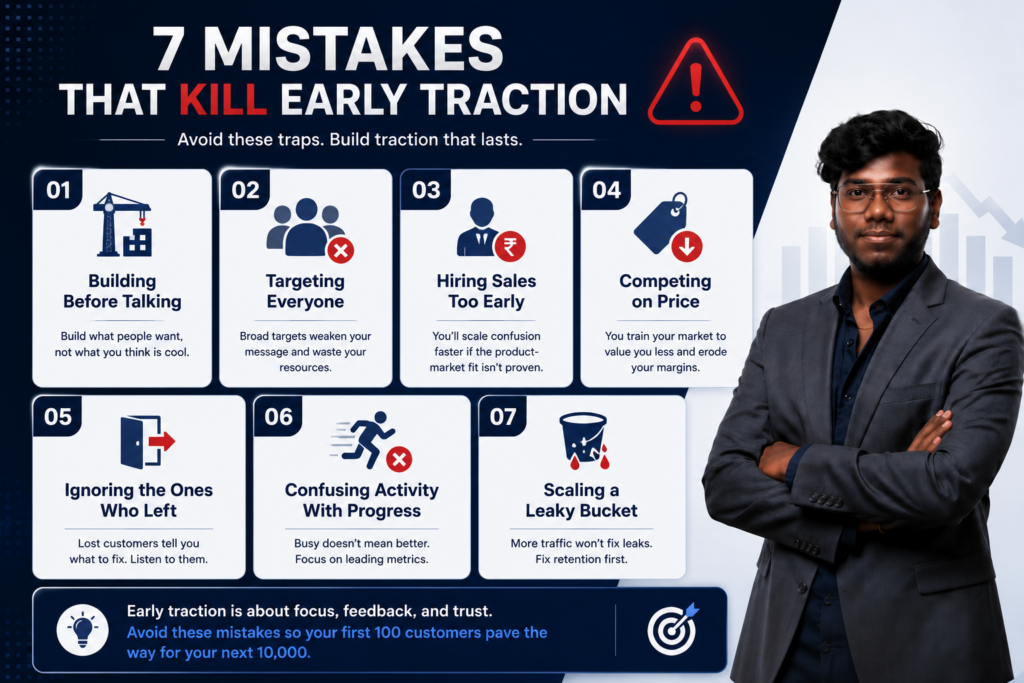
1. Building Before Talking
Six months in a room building a perfect product, then discovering nobody wanted it. The most expensive mistake in business, and the most common.
Fix: talk to twenty potential customers before you build anything substantial.
2. Targeting Everyone
A broad market feels safe. It’s the opposite. You cannot craft a message for everyone, so your message lands with no one.
Fix: pick a beachhead so narrow it makes you uncomfortable.
3. Hiring Sales Too Early
You outsource the learning, the hire fails because they have no proof to sell with, and you conclude the market is bad.
Fix: founder sells until 100. No exceptions.
4. Competing on Price
The cheapest option attracts the least loyal customers. They’ll leave the moment someone undercuts you, and they complain the most.
Fix: compete on reliability, service, or specificity. Price is the last refuge of undifferentiated products.
5. Ignoring the Ones Who Left
Churned customers hold the most valuable information in your business, and almost nobody calls them.
Fix: every churn gets a phone call. Every single one.
6. Confusing Activity With Progress
Posting daily, redesigning the logo, attending events, tweaking the website. It feels like work. It generates zero customers.
Fix: measure conversations started and pilots run. Not tasks completed.
7. Scaling a Leaky Bucket
Pouring acquisition effort into a business with bad retention. You’ll exhaust yourself and your capital.
Fix: retention first. Always.
Your 90-Day Plan to Get Your First 100 Customers
Enough theory. Here’s what to do starting Monday.
Days 1–30: Foundation and First 10
Week 1
- Write your ideal customer profile in one sentence
- List 100 people in your network across buyers, connectors, amplifiers
- Set up your Google Business Profile completely
- Set up WhatsApp Business with a catalogue
Week 2
- Reach out to 30 network contacts individually
- Book 10 discovery conversations
- Draft your two-week pilot structure
Week 3–4
- Run 15+ discovery conversations
- Convert 5–10 into pilots or first purchases
- Deliver personally. Ride along. Watch everything.
- Write down every objection you hear, verbatim
Target: 5–10 customers
Days 31–60: Systemise and Reach 40
Week 5–6
- Rewrite your value proposition using the exact words customers used
- Ask every happy customer for a testimonial and one referral
- Publish your first 4 LinkedIn posts about what you’re learning
- Join 3 communities where your customers gather
Week 7–8
- Convert referrals into conversations
- Identify and approach 3 potential distribution partners
- Get your first 10 Google reviews
- Do your first churn call if anyone has left
Target: 30–40 cumulative customers
Days 61–90: Compound to 100
Week 9–10
- Build one written case study with real numbers
- Double down on whichever channel produced the most customers
- Kill whichever channel produced the fewest
- Formalise the referral ask into your delivery process
Week 11–12
- Run the retention check: 90-day survival rate, repeat purchase rate
- Fix the top churn reason before doing anything else
- Only now consider a small paid test
- Review your unit economics honestly
Target: 70–100 cumulative customers
If you hit 100 by day 90, you’re moving fast — but remember, how to get your first 100 customers matters far less than whether they stay.
Final Thoughts
Here’s what I’d tell myself on day one of Sparow.
Knowing how to get your first 100 customers is not about finding a clever growth hack. There isn’t one. It’s about doing unglamorous work with unusual consistency — having the conversation, delivering the order yourself, calling the customer who left, asking for the referral when it’s awkward.
The founders who win the first 100 are rarely the smartest ones. They’re the ones who stayed in the conversation longest.
The takeaways worth remembering:
- Narrow beats broad. A tiny market you dominate beats a huge one you touch.
- Founder-led sales isn’t a phase to survive. It’s where you learn your business.
- Every early customer is three assets: revenue, R&D, and referral.
- Trust is your bottleneck, not awareness. Reduce risk, don’t increase reach.
- Retention before acquisition. Always.
- In Tamil Nadu and across India, relationships and reputation still move faster than any ad.
Your first 100 customers are out there right now, dealing with the problem you solve, using something worse than what you built.
They just don’t know you exist yet.
Go tell them. One conversation at a time.
FAQs
1. How do you get your first 100 customers?
Start with your existing network, since those people have already cleared the trust barrier. Define one narrow ideal customer profile, then sell personally through founder-led conversations rather than scaling too early. Offer low-risk pilots instead of contracts, and ask every satisfied customer for a referral at the moment they express happiness. Layer in local SEO and WhatsApp for Indian markets. Most bootstrapped founders reach 100 in four to nine months using a mix of network, direct outreach, and referrals.
2. How long does it take to get your first 100 customers?
For most bootstrapped businesses in India, four to nine months is realistic. Low-ticket B2C moves faster because purchase decisions are quick and volume is higher. B2B and enterprise take longer, sometimes twelve months or more, because sales cycles involve multiple approvals. What matters more than speed is retention — 100 customers who stay beats 300 who churn. If you’re not at 100 within a year, examine whether your ideal customer profile is too broad or your outreach volume too low.
3. Do I need paid ads to get my first customers?
No, and ads usually hurt at this stage. Advertising amplifies a message, but before 100 customers you don’t yet know which message works or who your best customer really is. You’d be paying to guess. Ads also teach you nothing — a click gives you no insight, while a conversation gives you everything. Use your network, founder-led sales, referrals, Google Business Profile, and WhatsApp instead. Start advertising only once you know your ideal customer, your converting message, and your 90-day retention rate.
4. Should founders do sales themselves?
Yes, until at least customer 100. You are not the best salesperson because of skill — you’re the best because you care more and prospects sense that. More importantly, founder-led sales is where you learn what your business actually is. Every objection, every hesitation, every reason someone said no is data you cannot get secondhand. Hiring salespeople before 100 outsources the most valuable learning in your company, and the hire usually fails anyway because they have no proof or case studies to sell with.
5. How do I get customers for a new business in Tamil Nadu?
Use the density. Tamil Nadu’s industrial clusters — Chennai for IT and auto, Coimbatore for engineering, Tiruppur for textiles — let you physically visit twenty prospects in a day. Tap trade associations like TANSTIA and district chambers where your customers gather. Register for Udyam MSME status to unlock procurement preference with corporate and government buyers. Market bilingually; Tamil-language WhatsApp messaging converts better outside metro pockets. Above all, use warm introductions — Tamil Nadu’s business culture is relationship-dense, and a good intro often closes the deal outright.
6. What is the cheapest way to get customers?
Referrals and your personal network — both effectively free. A referred customer converts at several times the rate of a cold one and typically stays longer, because trust transfers with the introduction. The trick is systemising the ask: request referrals at the exact moment a customer expresses satisfaction, make the ask specific rather than generic, and close the loop by telling the referrer what happened. After referrals, a properly optimised Google Business Profile is the highest-ROI free channel for any local or regional Indian business.
7. What is a good customer acquisition cost for a startup?
There’s no universal number, but the working rule is that lifetime value should be at least three times acquisition cost. Below that, you’re buying revenue rather than building a business. The bigger mistake early founders make is calculating CAC on gross customers instead of retained ones. If you acquire 100 at ₹500 each but 70 churn in month two, your real CAC on the retained base is ₹1,667. Always measure CAC against customers who stay, not customers who sign up.
8. How narrow should my target market be?
Narrower than feels comfortable. “Small businesses in Chennai” is not a market — it’s a category. “IT offices in Guindy with 30 to 150 employees and a pantry” is a market, because it tells you exactly who to call and what to say. A narrow beachhead creates density, and density creates word of mouth, efficient operations, and convenient referrals. Winning 40% of one neighbourhood is worth vastly more than 0.1% of a state. You can always widen later. You cannot un-blur a fuzzy message.
9. What if I have no network to start with?
Then borrow someone else’s. Join the communities where your customers already gather — trade associations, LinkedIn groups, industry WhatsApp groups, local chambers. Spend six weeks being genuinely useful before mentioning what you sell. Simultaneously, build in public: post consistently about what you’re learning and the problems you’re solving. It compounds slowly, then suddenly. Also pursue distribution partnerships with businesses that serve your customer but sell something different — one good partner can deliver more early customers than months of cold outreach.
10. How do I get testimonials when I have no customers yet?
Trade value for proof. Offer your first few users a free or discounted pilot in exchange for honest feedback and, if they’re happy, a testimonial. Structure it as a two-week trial with a defined success metric so both sides know what “working” means. Ask for the testimonial immediately after a moment of delight, not weeks later. Make it effortless: draft it yourself and let them edit, or send three specific questions instead of asking them to “say something nice.” Named testimonials with photos beat anonymous quotes every time.
CTA
Before you go — two things worth doing.
I write about building real businesses in India: what works, what wastes your money, and what I’m learning running Sparow on the ground in Tamilnadu. No theory. No recycled advice.
Get the next one in your inbox. Subscribe to the newsletter and I’ll send you one honest, useful breakdown every week — customer acquisition, operations, pricing, and the parts of founding nobody puts on LinkedIn. Free, always.
If you’re building something in Tamilnadu and this helped, reply to the newsletter and tell me what you’re working on. I read every one.
- 7 Ways Referral Marketing as an Acquisition Channel Drives Growth in India
- The Ultimate Customer Acquisition Strategy For B2B vs B2C
- LTV to CAC Ratio Explained: The Ultimate Metric for Growth
- Customer Acquisition Funnel Explained: Your Path to Growth
- Organic Customer Acquisition Strategies: 12 Proven Methods
Brawin Rajadurai | Founder Of Sparow | Business Developer | Brand Builder
Enjoyed this? Get the next one by email.
Occasional, considered notes on brand and building. No noise.