LTV to CAC Ratio Explained: The Ultimate Metric for Growth
Every business owner wants to scale profitably. Many founders end up burning cash on marketing campaigns that never return their investment. This is the ultimate pain point for growing businesses across India.Getting the LTV to CAC ratio explained properly is your ticket out of this trap. This single metric reveals whether your business model is sustainable or destined to fail. If you spend more to acquire a customer than they bring in over their lifetime, your business is losing money.
Today we will dive deep into this crucial topic. We will look at exactly how to measure your marketing efficiency. By the end of this guide, you will have the LTV to CAC ratio explained in a way that directly applies to your daily operations.Table of Contents
What is the LTV to CAC Ratio?
The LTV to CAC ratio is a primary indicator of a company’s health. It compares the lifetime value of a customer against the total cost of acquiring that exact customer. Investors and founders use it to gauge business viability.
LTV stands for Lifetime Value. CAC stands for Customer Acquisition Cost. When you put them together, you get a clear picture of your return on investment.
Having the LTV to CAC ratio explained clearly helps you answer one vital question. Is my marketing actually generating sustainable profit?
Why Getting the LTV to CAC Ratio Explained is Crucial
You cannot steer a ship blindfolded. Marketing without tracking this ratio is exactly like driving with your eyes closed. You might be moving fast, but you are likely heading for a crash.
When you have the LTV to CAC ratio explained and integrated into your dashboards, you make better decisions. You know exactly how much you can afford to spend on Meta Ads or WhatsApp campaigns. You can confidently scale your ad spend without fear of bankruptcy.
Furthermore, it highlights issues with customer retention. A terrible ratio might not mean your ads are bad. It could mean your product quality is causing customers to leave after one purchase.
How to Calculate Customer Lifetime Value (LTV)
Before we combine the metrics, we must understand the individual parts. Customer Lifetime Value predicts the net profit attributed to the entire future relationship with a customer. It tells you what a customer is worth.
To calculate LTV, you need three key pieces of data. You need the average purchase value, the average purchase frequency rate, and the average customer lifespan. You multiply these figures together.
For instance, if a customer spends ₹500 every month for 24 months, their raw LTV is ₹12,000. It is crucial to multiply this by your gross margin to find the actual profit. Revenue is vanity, but profit is reality.
Understanding Customer Acquisition Cost (CAC)
Customer Acquisition Cost is the total expense incurred to gain a new customer. It includes everything from ad spend to sales team salaries. Many businesses make the mistake of only counting direct ad spend.
To find your true CAC, add up all sales and marketing costs over a specific period. Then, divide that total by the number of new customers acquired in that same period. Do not leave out software costs, agency fees, or creative production expenses.
Getting your CAC accurate is half the battle when getting the LTV to CAC ratio explained. A highly accurate CAC prevents nasty financial surprises at the end of the fiscal year.
The LTV to CAC Ratio Explained: The Exact Formula
Now we bring it all together. The formula is incredibly straightforward once you have your two core numbers.
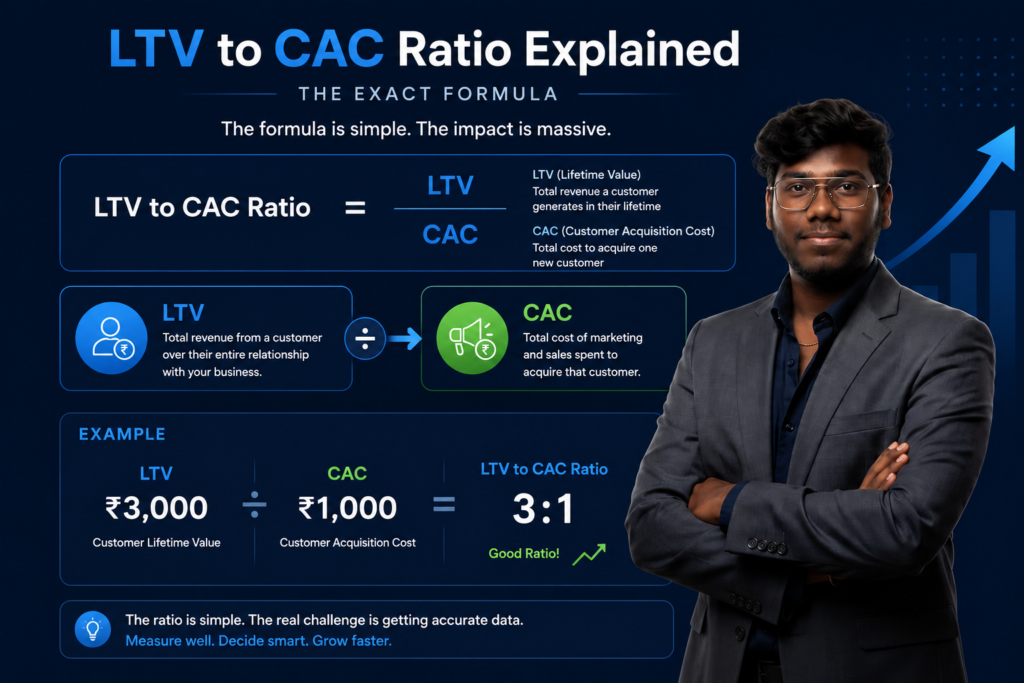
LTV to CAC Ratio = LTV / CAC
For example, let us say your customer lifetime value is ₹3,000. Your cost to acquire a customer is ₹1,000. Your ratio is 3:1.
Whenever you see the LTV to CAC ratio explained in financial textbooks, it always comes back to this simple division. The complexity lies in gathering accurate data, not in the math itself.
What is a Good LTV to CAC Ratio?
Different industries have slightly different benchmarks. However, a general consensus exists across the business world. Here is a breakdown of what the numbers actually mean for your operations.
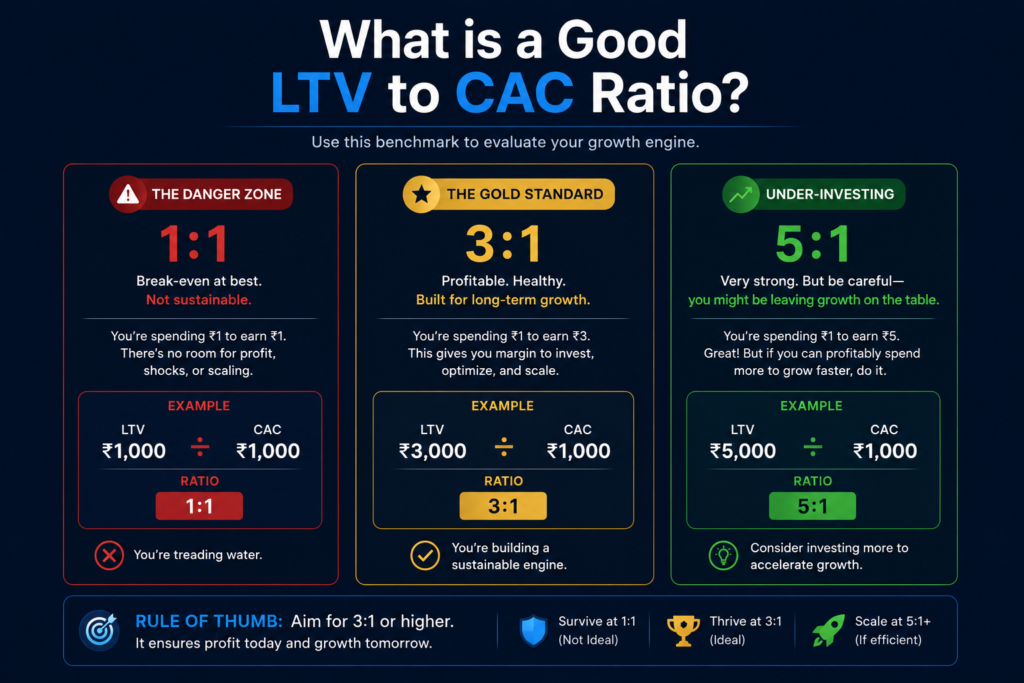
The 1:1 Ratio (Danger Zone)
If your ratio is 1:1, you are losing money. You spend exactly what you earn back from the customer. Once you factor in operational costs, you are in the red.
The 3:1 Ratio (The Gold Standard)
A 3:1 ratio is considered the sweet spot for most businesses. You generate three times the value of what you spent to acquire the customer. This leaves plenty of room for overhead expenses and reinvestment.
The 5:1 Ratio (Under-investing)
You might think a 5:1 ratio is amazing. However, having the LTV to CAC ratio explained properly means understanding missed opportunities. A ratio this high often means you are under-spending on marketing and missing out on aggressive market share growth.
Applying the Ratio to the Indian Market
The Indian market presents unique challenges and opportunities. Consumer behavior in regions like Tamil Nadu relies heavily on trust and local connection. Price sensitivity is a major factor for customer retention.
When scaling a business in India, your acquisition channels look different. You might rely heavily on WhatsApp API marketing and hyper-local Meta Ads. Tracking the exact cost of these channels is vital for an accurate CAC.
Having the LTV to CAC ratio explained in an Indian context means focusing heavily on retention. Earning loyalty in Tamil Nadu can lead to decades of repeat purchases. This naturally drives your LTV through the roof.
Case Study: Sparow Packaged Drinking Water
Let us look at a practical example from a local brand. Sparow Packaged drinking Water is our brand focused on serving the southern corridors of Tamil Nadu. Understanding the balance between acquisition costs and customer lifetime value is central to our strategy.
Initially, a brand might consider launching with a premium hexagonal bottle design. However, this raises production costs and is impractical for the local market. By pivoting to a standard round PET bottle, Sparow Packaged drinking Water keeps product costs incredibly low.
This smart product decision improves gross margins directly. Higher margins mean a higher actual LTV per customer. When combined with localized WhatsApp marketing to generate repeat local delivery orders, the LTV to CAC ratio becomes incredibly healthy.
How to Improve Your LTV to CAC Ratio
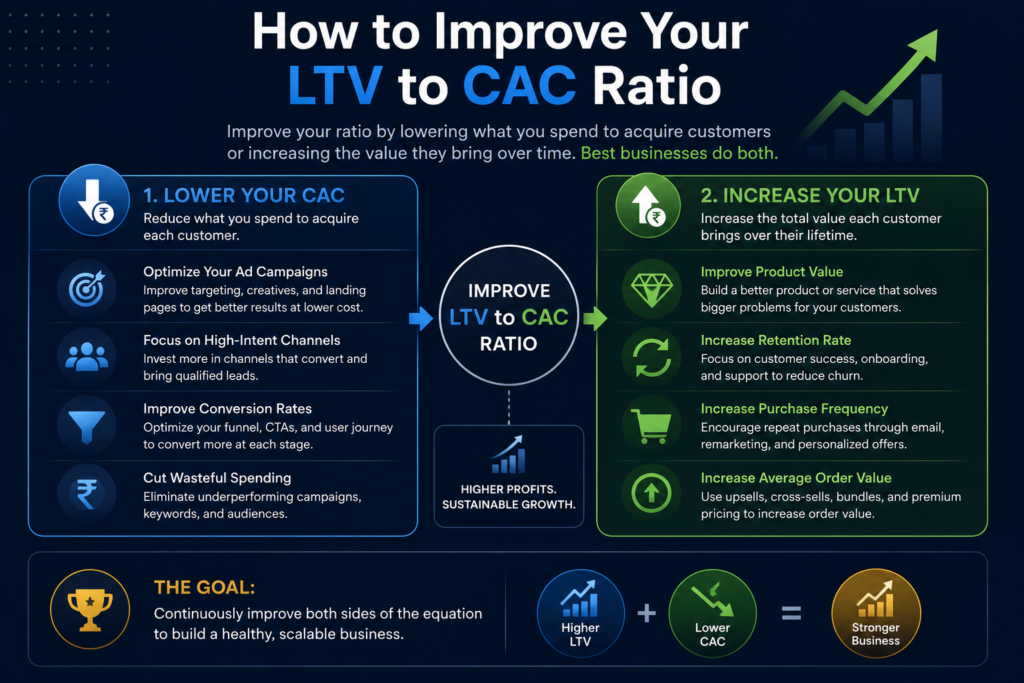
If your ratio is sitting at 1.5:1 or 2:1, you need to take action. You can attack the problem from two different angles. You must either lower your acquisition costs or increase your customer lifetime value.
The best businesses do both simultaneously. They optimize their ad campaigns while improving their core product offering. Here is the LTV to CAC ratio explained through actionable improvement strategies.
Strategies to Lower CAC
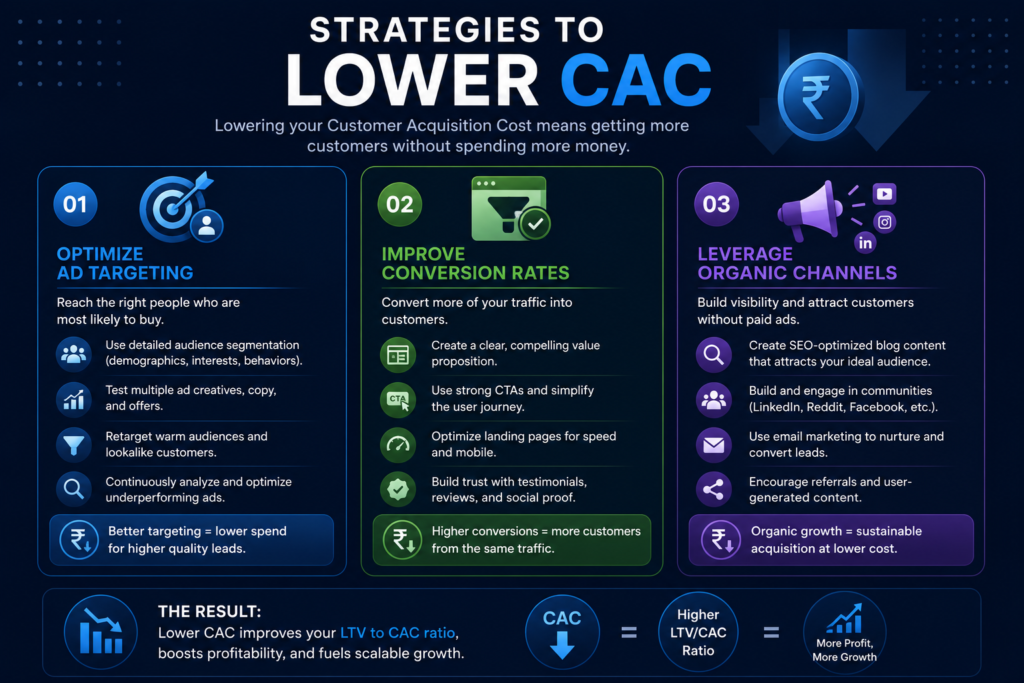
Lowering your CAC requires tight control over your marketing channels. You cannot afford to waste ad spend on audiences that do not convert.
Scaling a local brand like Sparow Packaged drinking Water teaches you that tracking numbers is only half the journey. The real challenge is executing campaigns that consistently convert Tamil Nadu buyers into loyal returning customers.
If you are finding it difficult to balance your daily ad spend with actual revenue, it might be time to rethink your foundation. I am always here to help you navigate these roadblocks. You can explore our business resources and refine your customer acquisition strategy by visiting our support page for step by step guidance.
- Optimize Ad Targeting: Use better lookalike audiences on Meta Ads to reach people who actually want your product.
- Improve Conversion Rates: Fix your landing pages. A faster, cleaner website converts more visitors into buyers for the same ad spend.
- Leverage Organic Channels: Invest in SEO and content marketing. Organic traffic brings down your blended CAC significantly over time.
Tactics to Increase LTV
Increasing LTV is all about the customer experience post-purchase. You want them to buy more often and stay with you longer.
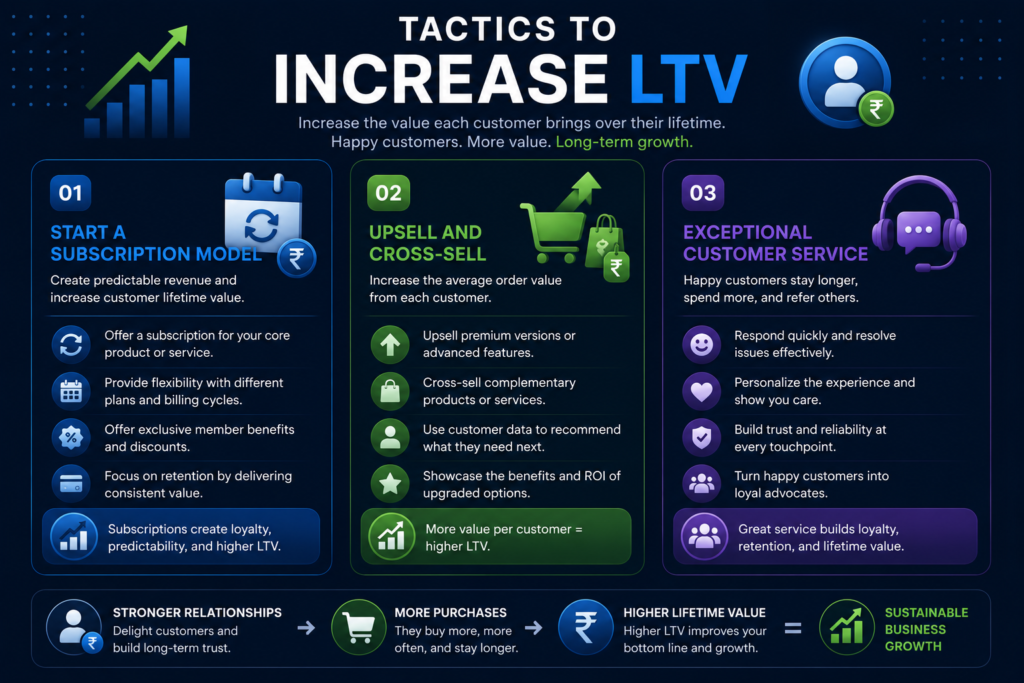
- Start a Subscription Model: Turn one time buyers into recurring revenue. This is highly effective for consumable goods like groceries or water.
- Upsell and Cross-sell: Offer complementary products during the checkout process. This increases the average order value instantly.
- Exceptional Customer Service: Respond to WhatsApp queries in minutes. A happy customer in Tamil Nadu will refer ten more friends to your business.
Common Mistakes in Measuring LTV and CAC
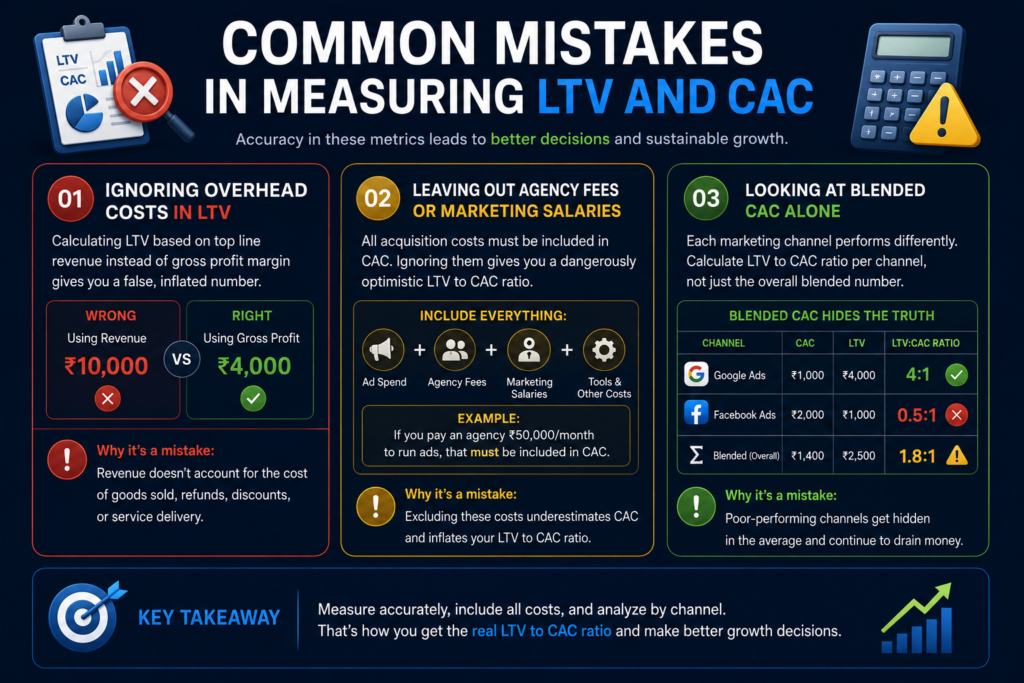
Even smart founders make errors when calculating these metrics. The most common mistake is ignoring overhead costs when calculating LTV. You must calculate LTV based on gross profit margin, not top line revenue.
Another massive error is leaving out agency fees or marketing salaries in your CAC calculation. If you pay an agency ₹50,000 a month to run ads, that must be included. Failing to do so gives you a dangerously optimistic LTV to CAC ratio.
Finally, do not look at blended CAC alone. Having the LTV to CAC ratio explained correctly means calculating it per marketing channel. Your Google Ads ratio might be 4:1 while your Facebook Ads ratio is 0.5:1.
Tracking LTV to CAC for E-commerce Success
For e-commerce operators, this metric is the lifeblood of your store. You can track this easily using platforms like Shopify or custom Google Sheets dashboards. The key is to review the numbers weekly.
When you launch new clean, minimalist product imagery, monitor how it affects conversion rates. Better imagery lowers CAC. This is why professional presentation is a massive competitive advantage.
Keep the LTV to CAC ratio explained and visible to your entire marketing team. When everyone understands the goal is profitable acquisition, your campaigns become much sharper.
Conclusion
Understanding the math behind your marketing is non-negotiable. Getting the LTV to CAC ratio explained and implemented will change how you run your business. It removes the guesswork from scaling and replaces it with cold, hard data.
Aim for that perfect 3:1 ratio. Lower your acquisition costs through sharp, targeted local marketing. Increase your customer lifetime value through incredible service and smart product design.
Whether you are running a digital agency or a physical business like Sparow Packaged drinking Water, the rules of profitability remain the same. Track your numbers, optimize your channels, and watch your business thrive in the competitive Indian landscape.
Frequently Asked Questions
1. What does the LTV to CAC ratio actually measure?
It measures the relationship between the lifetime value of a customer and the cost to acquire them. It tells you if your marketing efforts are generating a sustainable profit over time.
2. Is a higher LTV to CAC ratio always better?
Not always. A ratio of 5:1 or higher might indicate you are not spending enough on marketing. You could be missing out on valuable market share and faster growth.
3. How often should I calculate this ratio?
You should review your metrics at least monthly. E-commerce businesses should ideally track their blended CAC weekly to ensure ad campaigns are not burning cash unnecessarily.
4. Does the LTV to CAC ratio apply to physical product businesses?
Yes, absolutely. A physical product business must track this to ensure product margins cover marketing costs. It is highly relevant for local businesses in Tamil Nadu.
5. Should I calculate LTV based on revenue or profit?
You must always calculate LTV based on gross profit. Using gross revenue will give you a false sense of security and inflate your numbers dangerously.
6. How can I lower my CAC quickly?
The fastest way to lower CAC is to improve your website’s conversion rate. You can also utilize zero-cost organic channels and highly targeted WhatsApp API marketing.
7. What is a blended CAC?
Blended CAC takes your total marketing spend across all channels and divides it by total new customers. It includes organic customers who found you for free.
8. Why is customer retention so important for this ratio?
Retention directly increases your LTV. When a customer buys from you ten times instead of once, your LTV skyrockets without increasing your initial acquisition cost.
9. Can changing a product design affect my ratio?
Yes. Choosing cost effective packaging, like a standard round bottle instead of a premium custom shape, increases your profit margins. This directly improves your LTV.
10. Do I need expensive software to track this?
No. You can easily build a free tracking application or dashboard using Google Sheets to monitor your expenses and customer revenue.
Enjoyed this? Get the next one by email.
Occasional, considered notes on brand and building. No noise.