The Ultimate Customer Acquisition Strategy For B2B vs B2C
Growing a business from the ground up is exhausting. You pour endless hours into creating a fantastic product, yet you still struggle to get people to buy it. The pain point for most founders is spending marketing budgets blindly without understanding who is actually on the other side of the screen. Are you selling to a stressed procurement manager or a casual weekend shopper?
The answer to that question changes everything about how you market. Building a successful customer acquisition strategy for B2B vs B2C requires completely different approaches. What works for closing a corporate deal will absolutely fail when trying to sell an everyday retail product.
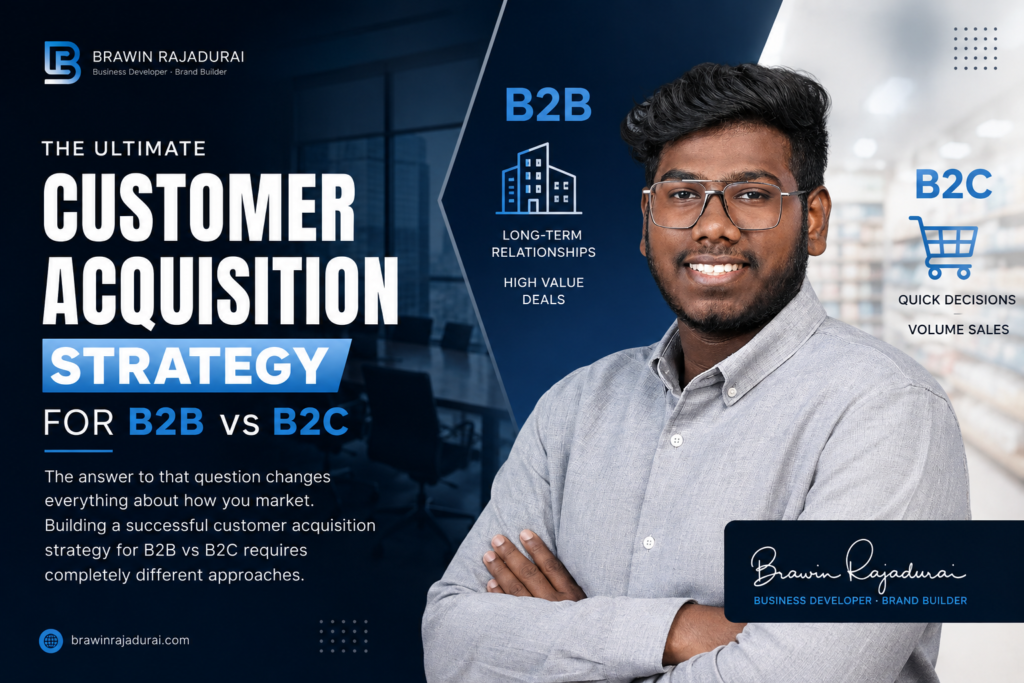
In this personal blog post, I will share the exact strategies you need to master both domains. As an entrepreneur operating in Tamil Nadu, I have seen exactly how these dynamics play out in the real world. Let us dive deep into building a customer acquisition strategy for B2B vs B2C that actually converts traffic into loyal revenue.
Table of Contents
Understanding the Core Marketing Divide
To succeed in today’s competitive Indian market, you must understand the fundamental divide between business buyers and everyday consumers. The mindset of your target audience dictates every single marketing move you make. A perfect customer acquisition strategy for B2B vs B2C respects these psychological boundaries.
Businesses do not buy products. People inside businesses buy products to solve highly specific corporate problems. On the other hand, everyday consumers buy products to feel good, save time, or fulfill a personal desire.
Understanding this divide helps you stop wasting money on the wrong advertising channels. It allows you to speak the exact language your buyer needs to hear. Let us break down these two distinct mindsets.
The Logical World of B2B Marketing
When you deal with Business to Business sales, logic rules the entire conversation. Buyers are looking for a clear Return on Investment before they even consider parting with their company budget. Your customer acquisition strategy for B2B vs B2C must prioritize hard data.
A B2B buyer wants to know how your service will increase their efficiency or lower their operating costs. They are accountable to their bosses and stakeholders. Therefore, your marketing content needs to provide them with the proof they need to justify the purchase internally.
You achieve this through whitepapers, detailed case studies, and in depth webinars. The goal is to build overwhelming authority and trust. If you can prove your value on paper, the B2B buyer will eventually sign the contract.
The Emotional Triggers in B2C Buying
Conversely, the Business to Consumer world is heavily driven by immediate emotional reactions. Consumers often buy things because a product makes them feel successful, attractive, or safe. A B2C customer acquisition strategy thrives on striking these emotional chords quickly.
When an individual shopper sees your advertisement, they are not usually calculating a long term financial return. They want to know if the product tastes good, looks great, or solves an immediate annoyance. Your visual branding and storytelling do the heavy lifting here.
This is why visual platforms like Instagram and YouTube are incredibly powerful for B2C brands. A bright image or a catchy video can trigger a spontaneous purchase within minutes. Emotion always outpaces logic in the retail checkout line.
Key Differences in the Sales Funnel
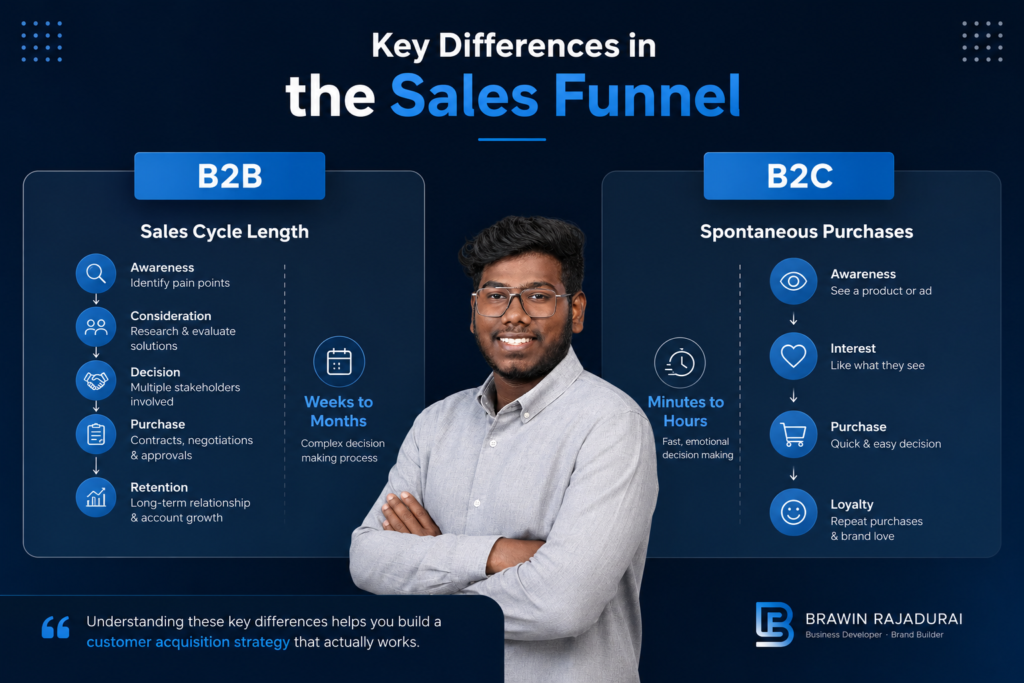
The journey a stranger takes to become a paying customer is called the sales funnel. When developing a customer acquisition strategy for B2B vs B2C, you will notice the funnel length varies drastically. You cannot rush a corporate buyer, and you should never slow down an eager retail shopper.
B2B funnels are notoriously long and complex. They require patience, nurturing, and continuous follow ups from your sales team. B2C funnels are often short, sweet, and highly automated.
Mapping out these funnels correctly prevents your marketing budget from leaking. Let us look at how time impacts both of these distinct buying journeys.
B2B Sales Cycle Length
In the B2B space, closing a deal can take anywhere from three months to over a year. Multiple decision makers are usually involved in the procurement process. Your customer acquisition strategy for B2B vs B2C must account for this extended timeline.
The initial stage involves heavy education through inbound marketing and organic search content. Once a lead enters your pipeline, your sales team must nurture them with personalized emails and product demonstrations. You are building a long term relationship, not just making a quick sale.
This extended cycle means you need robust CRM software to track every interaction. Patience is your greatest asset in B2B marketing. If you push for the sale too early, you will likely scare the corporate buyer away.
B2C Spontaneous Purchases
The B2C sales cycle is practically a sprint compared to the B2B marathon. A consumer might discover your brand, view a product, and make a purchase all within ten minutes. A customer acquisition strategy for B2B vs B2C must optimize for this rapid conversion speed.
Friction is the ultimate enemy of B2C sales. If your website takes too long to load or your checkout process is complicated, the shopper will simply leave. You need one click buying options and clear, urgent calls to action.
Retargeting ads are highly effective in this space. If someone abandons their shopping cart, a quick discount code sent via WhatsApp can immediately win them back. Speed and convenience are the pillars of consumer marketing.
Analyzing the Target Audience in India
India is a massive, diverse market with highly specific regional behaviors. As a business owner in Tamil Nadu, I know that localizing your message is non negotiable. A generic customer acquisition strategy for B2B vs B2C will get lost in the noise of this booming economy.
Whether you are targeting large corporations in metropolitan hubs or families in suburban areas, cultural context matters. People prefer to do business with brands that understand their daily reality. We must tailor our demographic targeting precisely.
Let us look at how audience targeting shifts depending on your business model. Both sectors require deep demographic analysis to succeed locally.
Targeting IT Parks and Corporations
Tamil Nadu is home to booming IT corridors, especially in Chennai and Coimbatore. These corporate hubs represent a massive opportunity for B2B vendors. Your customer acquisition strategy for B2B vs B2C must target the facilities managers and HR directors working inside these glass towers.
These professionals are incredibly busy and highly analytical. They value reliability, seamless invoicing, and stellar customer support over flashy advertising. Connecting with them requires professional networking on platforms like LinkedIn or attending industry specific trade shows.
When pitching to these corporate entities, localized case studies perform exceptionally well. Showing how you helped a similar local IT firm reduce costs builds instant credibility. They want proven partners, not unproven vendors.
Winning Over Tamil Nadu Households
When shifting to the B2C market, the focus moves to family units and individual lifestyle choices. The Tamil Nadu consumer is value conscious but highly loyal to trusted local brands. A successful customer acquisition strategy for B2B vs B2C here relies heavily on community trust.
Word of mouth is a powerful marketing engine in residential neighborhoods. Influencer marketing featuring local celebrities or regional micro influencers can instantly elevate your brand. Consumers want to see products being used by people who look and sound like them.
Additionally, localized social media marketing is vital. Running Facebook or Instagram ads in regional languages often yields a much lower customer acquisition cost. Speaking directly to the heart of the community builds lifelong brand loyalty.
The Financial Metrics That Actually Matter
You cannot improve what you do not measure. A robust customer acquisition strategy for B2B vs B2C relies on tracking specific financial metrics religiously. Without data, you are essentially gambling with your marketing budget.
Two metrics stand above the rest in both business models. Understanding how much it costs to get a customer and how much they spend over time dictates your profitability. Let us break down these vital numbers.
Customer Acquisition Cost (CAC)
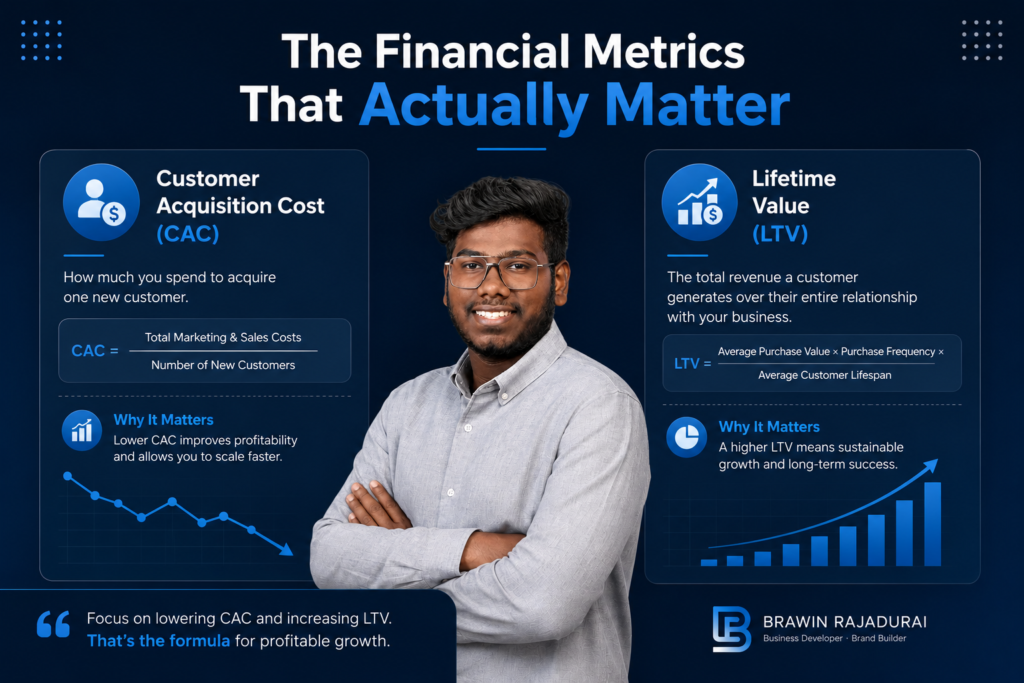
Customer Acquisition Cost is the total amount of money you spend on marketing and sales to acquire one new paying customer. Tracking this metric prevents you from spending more money than you are making. A healthy customer acquisition strategy for B2B vs B2C always keeps this number as low as possible.
In B2B scenarios, the CAC is naturally higher due to expensive sales teams and long nurturing campaigns. It is not uncommon to spend thousands of rupees to acquire a high value corporate client. However, this high upfront cost is justified by the massive contract size.
For B2C companies, the CAC must remain incredibly low. Because individual purchase values are smaller, you rely on high volume and cheap digital advertising clicks. If your Facebook ad costs outpace your retail profit margin, your business will quickly fail.
Lifetime Value (LTV)
Lifetime Value measures the total revenue a single customer will bring to your business over the duration of your relationship. A sustainable customer acquisition strategy for B2B vs B2C aims for an LTV to CAC ratio of at least 3 to 1. This means you make three times more than you spend to acquire the buyer.
In the B2B world, LTV is usually massive because contracts span multiple years. Retaining a corporate client is much cheaper than finding a new one. Therefore, exceptional customer service directly impacts your overall profitability.
For B2C brands, increasing LTV means encouraging repeat purchases. Loyalty programs, email newsletters, and seasonal discounts keep consumers coming back. The longer a consumer stays loyal to your brand, the higher their lifetime value becomes.
Crafting a Winning Customer Acquisition Strategy For B2B vs B2C
Now that we understand the theory, it is time to build a concrete action plan. Creating an effective customer acquisition strategy for B2B vs B2C requires a step by step methodical approach. You cannot skip stages if you want predictable, scalable revenue.
The best strategies are agile. They rely on testing small ideas, gathering data, and scaling what actually works. Let us walk through the fundamental steps every Indian business needs to take.
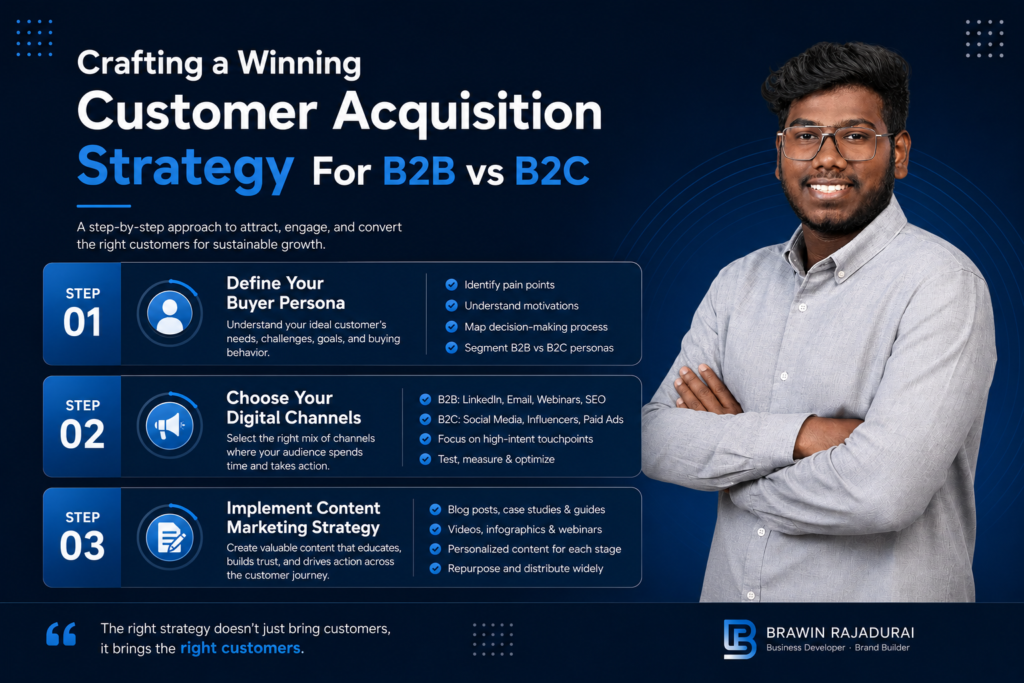
Step 1: Define Your Buyer Persona
Everything starts with knowing exactly who you are trying to reach. A buyer persona is a detailed, semi fictional representation of your ideal customer based on market research. A strong customer acquisition strategy for B2B vs B2C is built on hyper specific personas.
For a B2B persona, document their job title, daily frustrations, and the metrics they are judged on by their boss. For a B2C persona, document their age, hobbies, income bracket, and social media habits. The more detailed you get, the easier it becomes to write persuasive ad copy.
Never assume you know what your audience wants without doing actual research. Talk to your existing customers and ask them why they chose your product. Those real world answers will form the foundation of your entire marketing message.
Step 2: Choose Your Digital Channels
Not all social media platforms are created equal. Your customer acquisition strategy for B2B vs B2C will dictate where you spend your advertising budget. Being on every single platform is a waste of time and resources.
If you are targeting business professionals, LinkedIn and Google Search Ads are your primary battlegrounds. These platforms capture high intent users who are actively looking for industry solutions. Email marketing also remains a powerhouse for B2B lead generation.
For B2C companies, visual platforms like Meta Ads, Instagram Reels, and YouTube are essential. These channels allow you to showcase your product in daily life and trigger emotional responses. Go where your specific audience already spends their free time.
Step 3: Implement Content Marketing Strategy
Content is the fuel that powers modern organic search and social media engines. A solid customer acquisition strategy for B2B vs B2C must include producing high quality, helpful content regularly. This builds authority and drastically reduces your reliance on paid ads.
B2B content should be highly educational. Publish comprehensive blog posts, industry reports, and toolkits that help professionals do their jobs better. When you solve their small problems for free, they will trust you with their big paid problems.
B2C content should be entertaining and relatable. Short form vertical videos, user generated content, and lifestyle blogs work exceptionally well. Your goal is to make the consumer smile, learn something quick, or feel inspired to take action.
B2B Specific Tactics for Rapid Growth
If you are strictly focused on corporate clients, you need specialized tactics to penetrate complex organizations. Generic digital marketing rarely works when trying to secure high value contracts. A specialized customer acquisition strategy for B2B vs B2C separates the amateurs from the industry leaders.
You have to be proactive. Waiting for corporate buyers to stumble upon your website is a recipe for slow growth. You must hunt for these high value targets systematically.
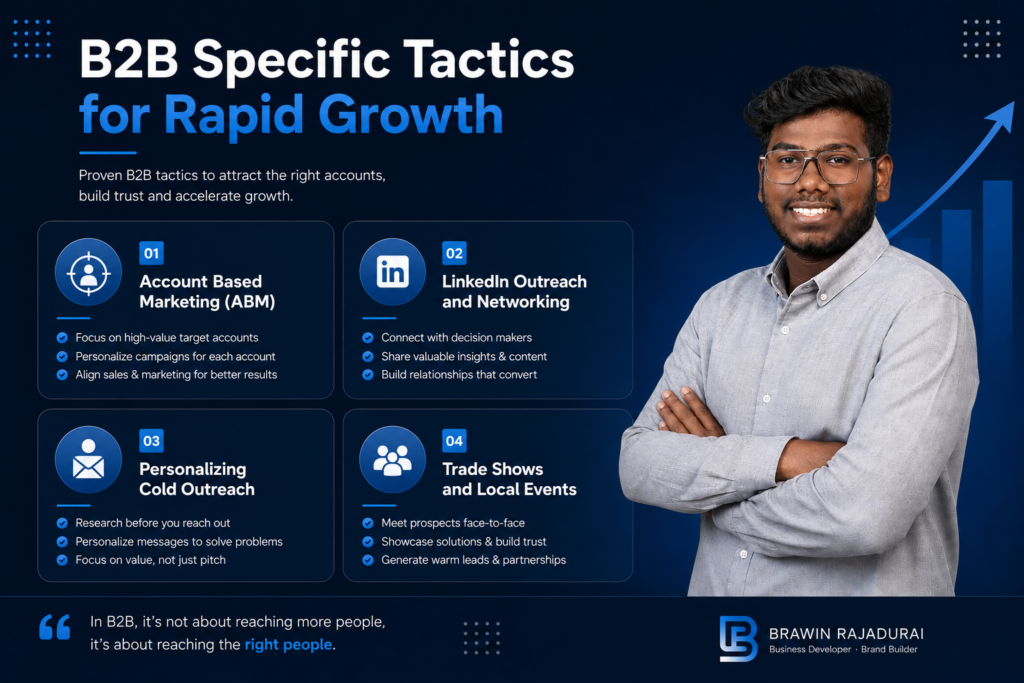
Here are the most effective B2B tactics working in the Indian market today.
Account Based Marketing (ABM)
Account Based Marketing is a highly targeted approach where you treat individual corporate prospects as their own separate markets. Instead of casting a wide net, your customer acquisition strategy for B2B vs B2C focuses intensely on a few dream clients. You tailor every piece of communication specifically for that one company.
For example, if you want to land a massive IT firm in Chennai, you create content specifically mentioning their unique industry challenges. You send personalized mailers to their executives and run targeted ads only to their IP addresses. It is highly resource intensive but yields incredible conversion rates.
ABM ensures absolute alignment between your marketing and sales departments. Everyone works together to close the big whale accounts.
LinkedIn Outreach and Networking
LinkedIn is the ultimate goldmine for B2B lead generation in India. It allows you to search for exact job titles and bypass traditional gatekeepers. A strong customer acquisition strategy for B2B vs B2C uses LinkedIn to build genuine professional relationships.
Do not just spam people with generic sales pitches in their direct messages. Share valuable industry insights on your feed and comment thoughtfully on your prospects posts. Build familiarity before you ever ask for a meeting.
Personalizing Cold Outreach
When you finally send a direct message, it must be highly personalized. Mention a recent achievement of their company or comment on an article they recently shared. If you show that you did your homework, your response rates will skyrocket.
Trade Shows and Local Events
Despite the digital revolution, face to face interactions remain incredibly powerful in the B2B world. Attending industry specific trade shows allows you to meet multiple decision makers in one room. Your customer acquisition strategy for B2B vs B2C should always include an offline networking budget.
Set up a professional booth, offer interactive product demos, and collect business cards meticulously. The real magic happens in the post event follow up. A quick email referencing a specific conversation you had at the event can easily kickstart the sales pipeline.
B2C Specific Tactics to Dominate the Market
Consumer marketing requires speed, flair, and mass visibility. If you are selling directly to the public, you have to stand out in a crowded digital feed. Your customer acquisition strategy for B2B vs B2C needs to be aggressive and creative.
You are competing for attention against entertaining videos, family updates, and breaking news. Your message must be impossible to ignore.
Let us explore the most potent tactics for capturing the everyday Indian consumer.
Influencer Marketing in Tamil Nadu
Partnering with local influencers is one of the fastest ways to build trust in a specific region. A local food blogger or lifestyle vlogger has already done the hard work of building an engaged audience. A smart customer acquisition strategy for B2B vs B2C leverages this existing trust.
Send your products to micro influencers who have highly engaged, niche followings. Authenticity is crucial here. Do not force them to read a stiff script. Let them review your product naturally in their own native language.
When an influencer genuinely recommends a product, it feels like advice from a friend. This significantly lowers consumer resistance and drives immediate website traffic.
Social Media Ads on Meta
Meta Ads remain the most robust advertising platform for reaching Indian consumers at scale. The targeting capabilities allow you to pinpoint users based on their specific interests and behaviors. An effective customer acquisition strategy for B2B vs B2C uses video ads to drive massive B2C awareness.
Focus on User Generated Content style videos. Ads that look like regular posts perform much better than highly polished corporate commercials. Show real people enjoying your product and highlighting its benefits.
Utilizing WhatsApp Business
In India, WhatsApp is not just a messaging app. It is a fundamental business tool. Integrating WhatsApp Business API into your marketing funnel allows you to send order updates, broadcast promotional offers, and provide instant customer support. It is the ultimate tool for reducing friction in the B2C buying journey.
Local SEO and Google Business Profiles
When consumers need something immediately, they turn to Google Search. If your business does not appear on the local map pack, you are losing money. A robust customer acquisition strategy for B2B vs B2C ensures your local SEO is flawless.
Claim and optimize your Google Business Profile with accurate hours, high quality photos, and relevant keywords. Encourage every happy customer to leave a glowing five star review. Search engines heavily favor businesses with consistent, positive local reviews.
How Sparow Packaged Drinking Water Bridges the Gap
As the founder of Sparow Packaged Drinking Water, I deal with the complexities of both markets daily. We operate out of Tamil Nadu, providing pristine drinking water to diverse clients. Navigating a customer acquisition strategy for B2B vs B2C is not just theory for me. It is my daily reality.
We quickly realized that our marketing tone had to shift depending on who we were calling. Selling water seems simple, but the procurement logic differs wildly between a massive office and a local household.
Here is exactly how Sparow tackles both sides of the market successfully.
Our B2B Approach for Corporate Clients
For our corporate clients, which include large IT parks and manufacturing units in Chennai, reliability is their only concern. Our customer acquisition strategy for B2B vs B2C focuses heavily on demonstrating our logistical supremacy. We do not talk about how refreshing the water is. We talk about our zero delay delivery guarantee.
We use direct outreach and LinkedIn to connect with facility managers. We provide them with detailed proposals highlighting our automated billing systems and bulk pricing discounts. By solving their administrative headaches, Sparow becomes their preferred vendor.
We also offer free initial trial weeks for large offices. Once a facility manager experiences our seamless service, the long term contract is practically guaranteed. Logic and reliability win the B2B water game.
Our B2C Approach for Retail Delivery
On the consumer side, Sparow delivers directly to homes and local retail shops. Here, our customer acquisition strategy for B2B vs B2C shifts entirely to health, purity, and family safety. Consumers want to know the water their children drink is absolutely pristine.
We utilize vibrant Instagram ads and localized WhatsApp broadcast campaigns to reach neighborhoods. Our messaging focuses on the rigorous purification process and the crisp taste of our product. We use emotional storytelling to highlight family wellness.
To reduce acquisition costs, we implemented a highly successful neighborhood referral program. When a household refers a neighbor to Sparow, both families receive a discount on their next monthly subscription. Word of mouth remains our strongest B2C growth engine.
Retention is the New Acquisition Strategy
Acquiring a new customer is expensive. Keeping an existing one is highly profitable. The ultimate secret to a sustainable customer acquisition strategy for B2B vs B2C is focusing obsessively on customer retention metrics.
A leaky bucket business model will eventually run out of funds. You cannot outspend poor customer service. You must build systems that delight buyers long after the initial sale is complete.
Let us look at how retention differs across the two business models.
Keeping B2B Clients Happy
Corporate clients churn when they feel ignored or when a service becomes unreliable. To retain them, your customer acquisition strategy for B2B vs B2C must transition into a stellar account management strategy. Assign dedicated account managers to your highest value clients.
Conduct quarterly business reviews to ensure they are getting maximum value from your product. Listen to their feedback and implement features they specifically request. If you make your B2B client look like a hero to their boss, they will never leave you.
Building B2C Brand Loyalty
Consumers have endless options, so you must stay top of mind constantly. A successful customer acquisition strategy for B2B vs B2C incorporates automated re engagement campaigns. Send personalized email newsletters with exclusive VIP discounts to your best shoppers.
Surprise and delight your consumers. A handwritten thank you note in a delivery box or a small freebie on their birthday creates incredible emotional loyalty. When consumers feel valued, they become vocal brand advocates on social media.
Common Pitfalls to Avoid
Even the most seasoned marketers make mistakes when scaling their businesses. However, some errors are universally fatal. When building your customer acquisition strategy for B2B vs B2C, you must actively avoid these common traps.
Forewarned is forearmed. Let us examine where most Indian startups lose their marketing budgets.
Wasting Budget on the Wrong Channels
The most common mistake is applying a B2C tactic to a B2B problem. Trying to sell complex industrial machinery through TikTok dances will only burn your cash. Your customer acquisition strategy for B2B vs B2C must align the platform strictly with the buyer persona.
Always follow the data. If a specific advertising channel is bringing in cheap clicks but zero actual sales, shut it down immediately. Do not fall in love with vanity metrics like page views or social media likes.
Ignoring Customer Feedback Loops
Your customers will explicitly tell you what is wrong with your product if you are willing to listen. Failing to establish proper customer feedback loops is a massive oversight. A great customer acquisition strategy for B2B vs B2C adapts constantly based on market reality.
Send out regular surveys and monitor your online reviews religiously. If multiple people complain about your complicated checkout process, fix it immediately. Ignoring market feedback is the fastest route to irrelevance.
Future Trends in Indian Customer Acquisition
The digital marketing landscape is shifting rapidly. What worked in 2023 is already becoming obsolete in 2026. To maintain a competitive customer acquisition strategy for B2B vs B2C, you must adapt to emerging technologies.
Indian consumers are becoming more digitally savvy and demand hyper personalized experiences. Businesses must level up their technical capabilities to survive.
Artificial Intelligence in Marketing
Artificial intelligence is no longer a buzzword. It is essential infrastructure. Modern customer acquisition strategy for B2B vs B2C relies on AI to analyze vast amounts of data and predict consumer behavior.
AI chatbots are now handling initial customer inquiries 24 hours a day. Predictive analytics tools are helping B2B sales teams identify which accounts are most likely to close this quarter. Embracing AI allows you to lower your acquisition costs dramatically while scaling your outreach.
Omnichannel Personalization
Buyers expect a seamless experience regardless of where they interact with your brand. An omnichannel approach ensures your messaging is consistent across your website, social media, and offline stores. A future proof customer acquisition strategy for B2B vs B2C creates one unified brand voice.
If a customer adds a product to their cart on a mobile app, that exact product should be waiting for them when they log in on their desktop. Personalization is no longer a luxury. It is the baseline expectation of the modern Indian buyer.
Conclusion
Mastering a customer acquisition strategy for B2B vs B2C is the most impactful skill an entrepreneur can develop. It requires a deep understanding of human psychology, rigorous data tracking, and constant adaptation. By recognizing the fundamental differences between logical corporate buyers and emotional retail consumers, you unlock sustainable business growth.
Remember to map your sales funnels accurately and choose your marketing channels wisely. Whether you are selling enterprise software or pure packaged drinking water like Sparow, the core principles remain the same. Track your metrics, obsess over customer retention, and never stop testing new ideas.
Now is the time to audit your current marketing efforts. Stop guessing and start strategizing. Implement these tactics today, and watch your local Tamil Nadu business dominate the market.
FAQs
1. What is the main difference in a customer acquisition strategy for B2B vs B2C?
The main difference lies in the buying motivation and the sales cycle length. B2B focuses on logic, ROI, and long term relationships involving multiple decision makers. B2C focuses on emotional appeal, rapid purchasing decisions, and mass brand visibility.
2. Why is customer acquisition cost (CAC) usually higher in B2B?
B2B CAC is higher because the sales cycle takes much longer to complete. It requires expensive assets like dedicated sales teams, highly targeted advertising, and complex software demonstrations. However, the high lifetime value of a corporate contract usually justifies this upfront expense.
3. Can one company use both B2B and B2C strategies simultaneously?
Yes, many companies operate in both spheres successfully. For example, Sparow Packaged Drinking Water uses B2B strategies to supply large corporate IT parks and B2C strategies to deliver water directly to local households. You just need separate marketing funnels for each audience.
4. Which social media platforms are best for B2B acquisition?
LinkedIn is currently the most powerful platform for B2B customer acquisition. It allows you to target specific job titles and industries directly. X (formerly Twitter) and Google Search Ads are also highly effective for reaching business professionals actively seeking solutions.
5. How important is local SEO for a B2C customer acquisition strategy?
Local SEO is absolutely critical for B2C businesses operating in specific regions like Tamil Nadu. Most consumers search for services “near me” on their phones. Optimizing your Google Business Profile ensures you capture this highly motivated local search traffic instantly.
6. What is Account Based Marketing (ABM)?
ABM is a highly focused B2B marketing strategy where a company treats an individual prospect like its own unique market. Marketing and sales teams collaborate to create highly personalized campaigns aimed at securing specific, high value corporate accounts rather than generating broad leads.
7. How can WhatsApp Business improve B2C customer acquisition in India?
WhatsApp Business allows companies to communicate directly with consumers on an app they already use daily. It speeds up the sales cycle by providing instant customer support, sending order updates, and broadcasting personalized discount offers directly to their phones.
8. What role does content marketing play in B2B strategies?
Content marketing establishes authority and trust in the B2B space. By publishing detailed whitepapers, case studies, and educational blogs, a company proves its expertise. This inbound strategy naturally attracts decision makers who are researching solutions for their corporate problems.
9. How do emotional triggers work in B2C marketing?
Consumers often make spontaneous purchasing decisions based on how a product makes them feel. Visual branding, relatable storytelling, and influencer endorsements trigger feelings of joy, status, or security. These emotional responses encourage rapid checkouts and lower the overall acquisition cost.
10. Why is calculating the LTV to CAC ratio so important?
The LTV to CAC ratio tells you if your business model is financially sustainable. If you spend more money acquiring a customer than they eventually spend with your business, you will go bankrupt. A healthy ratio ensures every marketing rupee spent yields a profitable long term return.
Enjoyed this? Get the next one by email.
Occasional, considered notes on brand and building. No noise.