Customer Acquisition Funnel Explained: Your Path to Growth
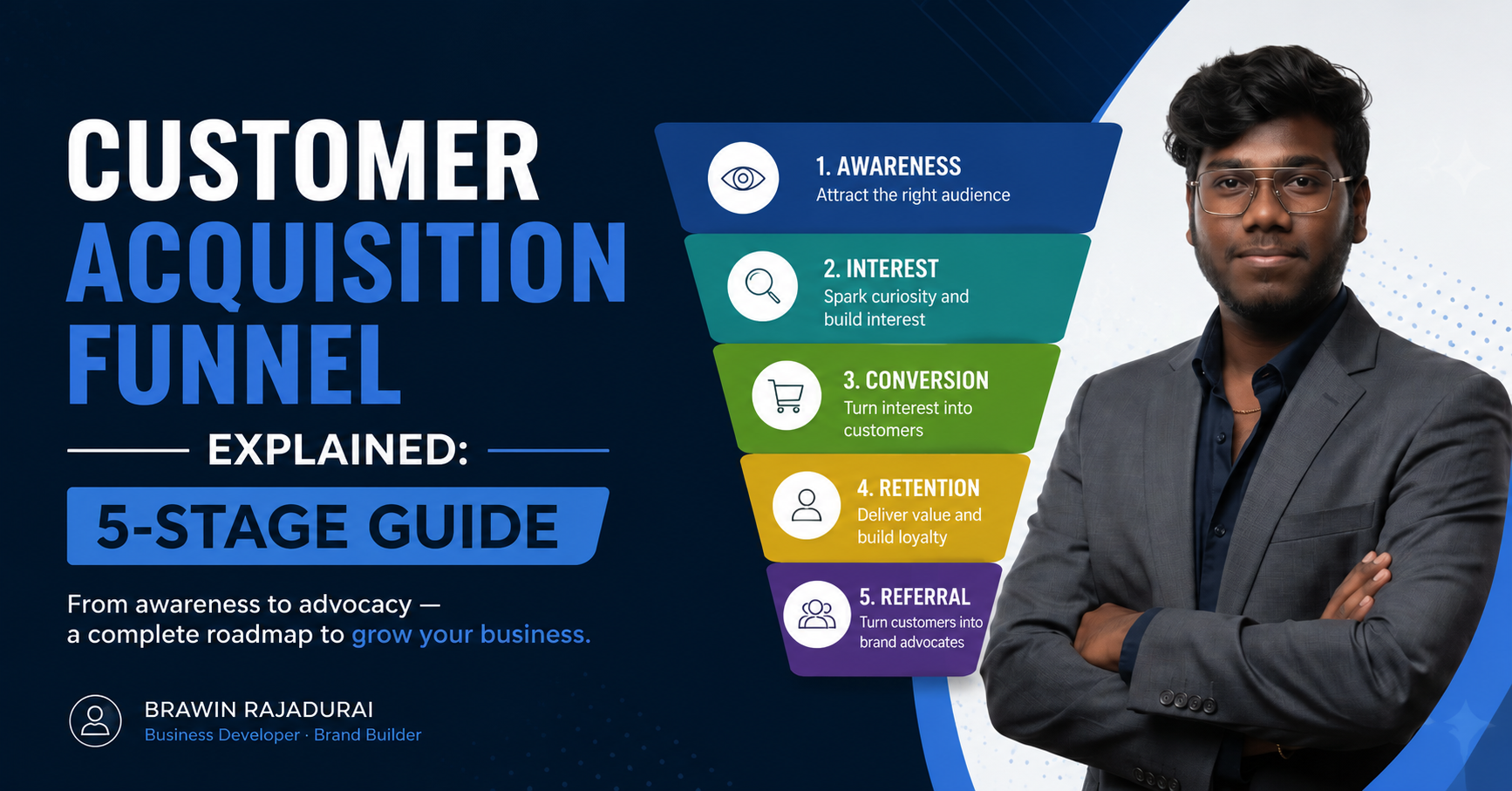
A customer acquisition funnel is the step-by-step path a person takes from first hearing about your business to becoming a paying customer, and often a repeat one. It usually has five stages: awareness, interest, conversion, retention, and referral. Each stage filters people closer to a purchase decision.
What Is a Customer Acquisition Funnel?
The customer acquisition funnel explained in plain terms is simply the journey a stranger takes to become a customer.
It is called a funnel because it is wide at the top and narrow at the bottom. Many people become aware of your business. Fewer show interest. Even fewer actually buy.
Think of it as a filter. At each stage, some people drop off and others move forward. Your job is to understand where they drop off and why.
The idea sounds simple, but most businesses lose money because they never map this journey clearly. They spend on marketing without knowing which stage is actually broken.
When I started building Sparow, our packaged drinking water brand in Tamil Nadu, this framework changed how I thought about growth. Water is a low-cost, everyday product, yet the funnel still applied. People had to notice us on a shelf, trust the brand, buy once, and then keep buying.
Understanding that path is the foundation of any real Customer Acquisition Strategy.
Table of Contents
Why the Funnel Matters for Every Business
The funnel matters because it turns a vague goal like “get more customers” into a clear set of problems you can actually solve.
Without a funnel, marketing feels like guesswork. You throw money at ads, social media, and offers, then hope something works.
With a funnel, you can ask better questions. Are people not aware of us? Are they aware but not interested? Are they interested but not buying?
Each of those is a different problem with a different solution. A business struggling with awareness needs more reach. A business struggling with conversion needs better trust and a smoother buying process.
This clarity saves money. It also saves time, because you stop fixing things that were never broken.
For a small brand like Sparow competing against established names, this focus mattered even more. We could not outspend larger companies, so we had to understand exactly where our funnel leaked and repair it cheaply.
The 5 Stages of the Customer Acquisition Funnel
Most acquisition funnels follow five core stages. Different companies use different labels, but the logic stays the same.
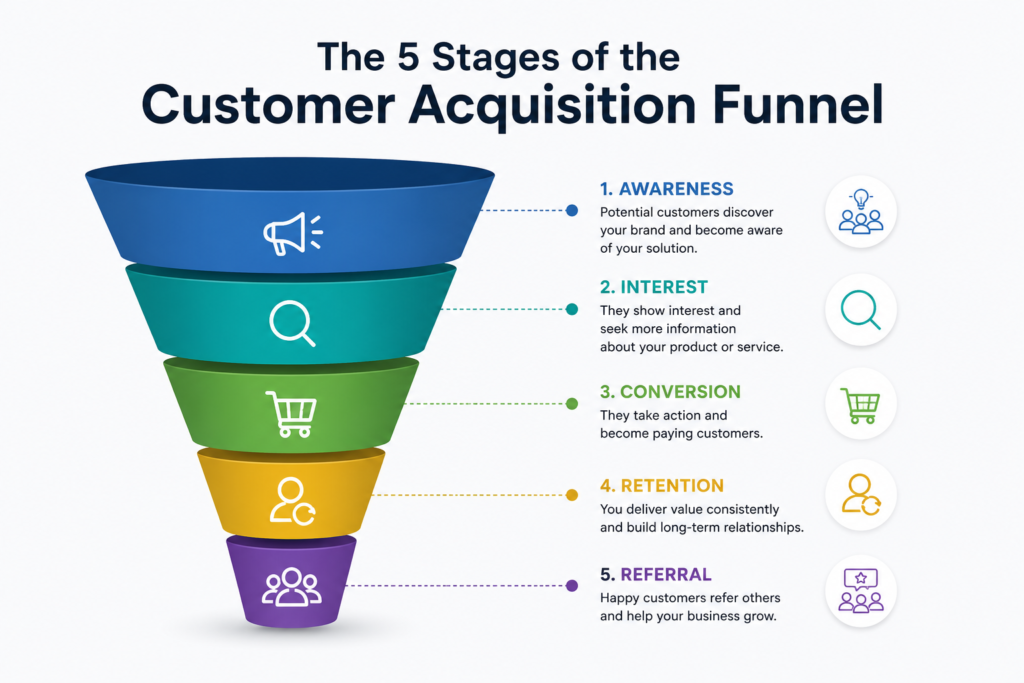
Here is the structure at a glance.
| Stage | What Happens | Customer Question |
|---|---|---|
| Awareness | People discover your brand | “Who are you?” |
| Interest | They learn more and compare | “Why should I care?” |
| Conversion | They make a purchase | “Is this worth it?” |
| Retention | They buy again | “Should I stay?” |
| Referral | They recommend you | “Who else should know?” |
The first three stages cover acquisition in the strict sense. The last two turn a one-time buyer into lasting value.
Skipping the last two stages is a common mistake. Acquiring a customer is expensive. Keeping them is where profit usually lives.
Let us walk through each stage with practical detail.
Stage 1: Awareness
Awareness is the top of the funnel, where a person first learns your business exists.
At this stage, people are not ready to buy. They are simply discovering you. Your goal is to be seen by the right audience, not to sell aggressively.
How Awareness Happens
Awareness is created through channels such as:
- Social media content and ads
- Search engines and blog articles
- Word of mouth and recommendations
- Retail shelf presence and packaging
- Local events, sampling, and partnerships
The right channel depends on your business. A software company might rely on search and content. A consumer product often depends on retail visibility and trust.
For Sparow, awareness in Tamil Nadu came largely from retail presence and distribution. If our bottle was not on the shelf where people looked, we simply did not exist to them. That physical visibility was our top of the funnel.
What to Measure Here
Track reach, impressions, website visits, and new followers. These numbers tell you how many people are entering the funnel.
A healthy top of the funnel is wide. If very few people know you exist, no amount of clever selling later will fix your growth.
Stage 2: Interest and Consideration
Consideration is the middle of the funnel, where interested people evaluate whether you are worth choosing.
Here, prospects compare you with alternatives. They read reviews, check prices, ask friends, and weigh trust. This is where most buying decisions are actually shaped.
How to Win the Consideration Stage
At this stage, your job is to build trust and answer questions. People rarely buy from a brand they do not understand or believe in.
Practical ways to strengthen consideration include:
- Clear, honest product information
- Social proof such as reviews and testimonials
- Helpful content that answers real questions
- Consistent branding that signals reliability
- Easy ways to try or sample the product
For a water brand, trust is everything. People are putting your product inside their body, so perceived safety and quality matter more than price alone. Certifications, clean packaging, and word of mouth all built that trust for Sparow.
A strong Customer Acquisition Strategy treats this stage as a trust-building exercise, not a hard sell.
The Role of Follow-Up
In many businesses, people do not buy on the first visit. They need reminders and nurturing.
Email, retargeting, and repeat exposure keep your brand in mind until the person is ready. Patience at this stage often separates growing brands from stalled ones.
Stage 3: Conversion
Conversion is the bottom of the funnel, where an interested prospect finally becomes a paying customer.
This is the moment the whole funnel was built for. Yet many businesses lose customers here through friction, confusion, or weak reassurance.
Reducing Friction at Checkout
Friction is anything that makes buying harder than it should be. Common examples include:
- A complicated checkout or ordering process
- Hidden costs revealed too late
- Lack of trusted payment options
- Poor mobile experience
- Weak return or refund clarity
Removing friction often lifts conversion more than any new marketing campaign. Sometimes the fastest growth comes from fixing the buying experience you already have.
Reassurance Closes the Gap
Even ready buyers hesitate at the last step. A small reassurance can tip them over.
Guarantees, clear pricing, easy contact, and honest answers reduce that final anxiety. The goal is to make saying yes feel safe and obvious.
For a product like packaged water, the first purchase is often small and low risk. That works in your favour, because the real value comes from turning that first bottle into a habit.
Stage 4: Retention
Retention is the stage where a first-time buyer becomes a repeat customer.
Acquiring a new customer usually costs far more than keeping an existing one. This is why retention is where sustainable profit is built.
Why Retention Beats Constant Acquisition
If your funnel only focuses on new customers, you are constantly refilling a leaking bucket. Every sale requires fresh spending.
Retention changes the math. A loyal customer buys again and again without new acquisition cost each time. Their lifetime value grows while your marketing cost stays flat.
For an everyday product, this is the whole game. Nobody builds a lasting water brand on one-time buyers. Success comes from becoming the default choice a household reorders without thinking.
How to Improve Retention
Focus on consistency and small positive experiences:
- Deliver reliable quality every single time
- Make reordering effortless
- Reward loyalty in simple, genuine ways
- Fix problems quickly and fairly
Consistency is underrated. For consumable products especially, a customer who is never disappointed rarely goes looking for alternatives.
Stage 5: Referral
Referral is the stage where happy customers bring you new ones.
This is the most cost-effective growth there is. A recommendation from a trusted person carries more weight than any advertisement.
Turning Customers Into Advocates
Referrals happen naturally when a product genuinely satisfies people. You can encourage them further by:
- Making the product easy to talk about
- Asking satisfied customers to share
- Creating simple referral incentives
- Delivering service worth mentioning
In markets where word of mouth is strong, referral can quietly become your biggest channel. Much of Sparow’s early growth in local markets came from repeat buyers recommending us to neighbours and shops. Trust spread person to person.
A referral loop effectively feeds back into the awareness stage. Your best customers become your top of funnel, which lowers your overall acquisition cost over time.
Key Metrics You Should Track
You cannot improve a funnel you do not measure. A few core metrics reveal the health of each stage.
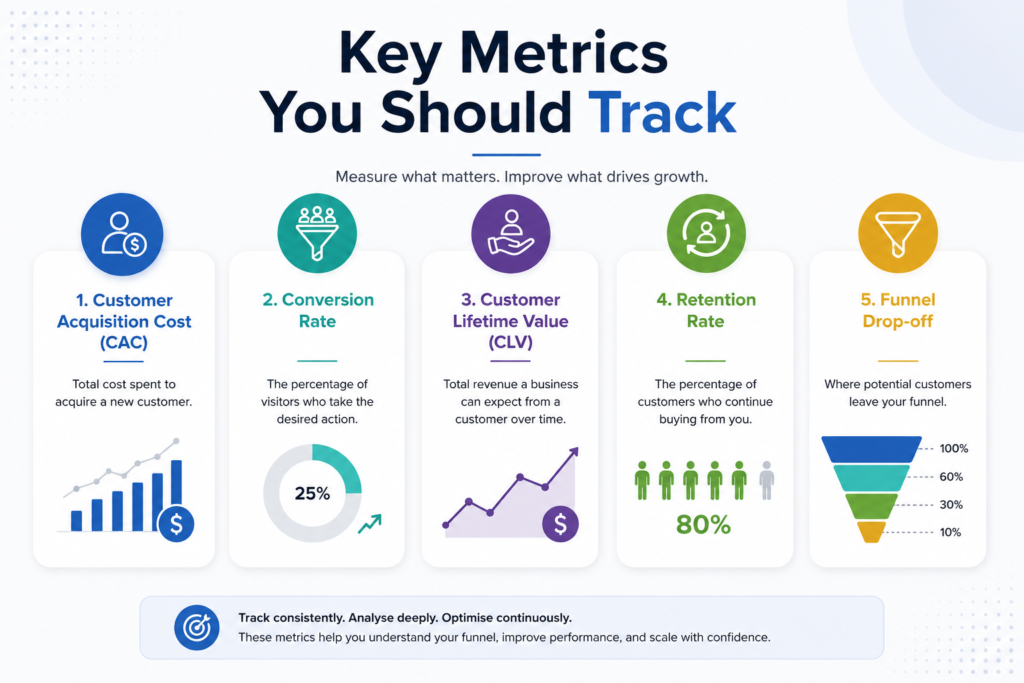
| Metric | What It Tells You |
|---|---|
| Customer Acquisition Cost (CAC) | How much you spend to gain one customer |
| Conversion Rate | Percentage of prospects who become buyers |
| Customer Lifetime Value (CLV) | Total value a customer brings over time |
| Retention Rate | Percentage of customers who buy again |
| Funnel Drop-off | Where and how many people leave each stage |
The relationship between CAC and CLV is especially important. If it costs more to acquire a customer than they are ever worth, the business cannot survive at scale.
A healthy business earns back its acquisition cost comfortably, then profits from retention and referral.
Track these numbers honestly. Vanity metrics like total followers feel good but rarely tell you whether the funnel actually works.
Common Funnel Leaks and How to Fix Them
A funnel leak is any stage where you lose more people than you should. Fixing leaks is usually cheaper than adding more traffic.
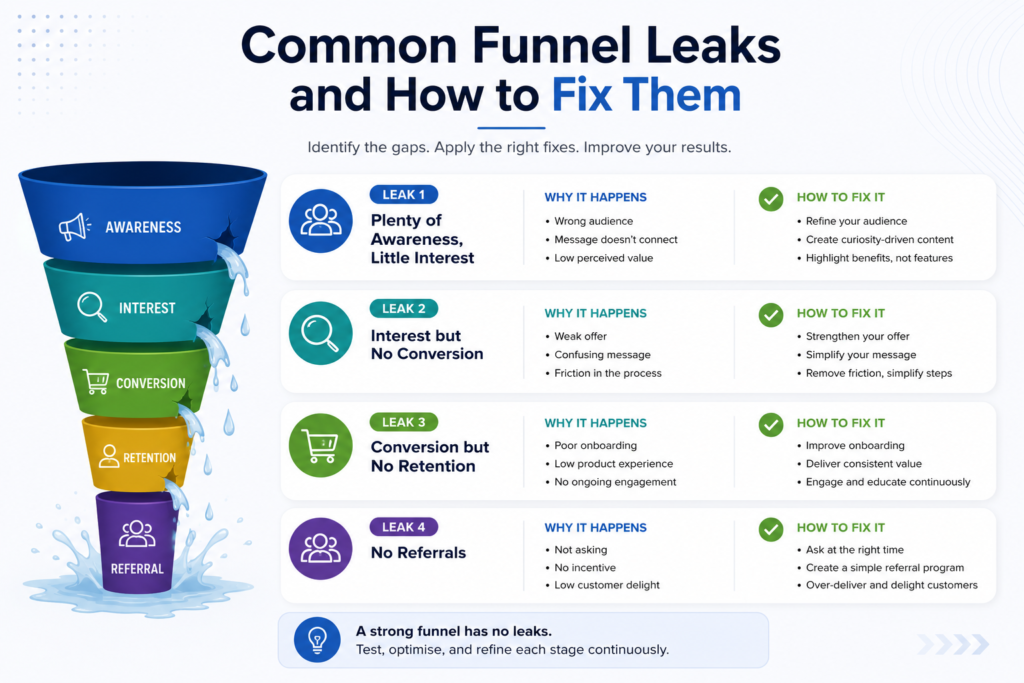
Here are the most common leaks and their practical fixes.
Leak 1: Plenty of Awareness, Little Interest
If many people see you but few engage, your message is unclear or your offer is not compelling.
Fix it by sharpening your value proposition. Explain plainly why someone should care.
Leak 2: Interest but No Conversion
If people show interest but do not buy, the problem is usually trust or friction.
Fix it by simplifying the buying process and adding reassurance like reviews and guarantees.
Leak 3: Conversion but No Retention
If customers buy once and disappear, the product or experience did not meet expectations.
Fix it by improving quality, consistency, and follow-up after purchase.
Leak 4: No Referrals
If satisfied customers never recommend you, you may simply not be asking or making it easy.
Fix it by inviting referrals and giving people a reason to share.
The key habit is diagnosis before spending. Find the leaking stage first, then repair it, rather than pouring more traffic into a broken funnel.
How to Build Your Own Acquisition Funnel
Building a funnel is less about tools and more about clear thinking. Follow these steps in order.
- Map the current journey. Write down how people actually find and buy from you today.
- Identify the stages. Match your reality to awareness, interest, conversion, retention, and referral.
- Measure each stage. Attach a simple number to every stage so you can see drop-off.
- Find the biggest leak. Focus on the stage losing the most people, not the easiest one to tweak.
- Fix one thing at a time. Change a single element, then measure whether it improved.
- Repeat continuously. A funnel is never finished. It is refined over time.
This slow, evidence-based approach beats chasing every new marketing trend. Most businesses do not need more tactics. They need to fix the stage that is quietly leaking money.
A disciplined Customer Acquisition Strategy is really just this loop repeated with patience.
B2B vs B2C Funnels
The five stages apply to both B2B and B2C businesses, but they behave differently.
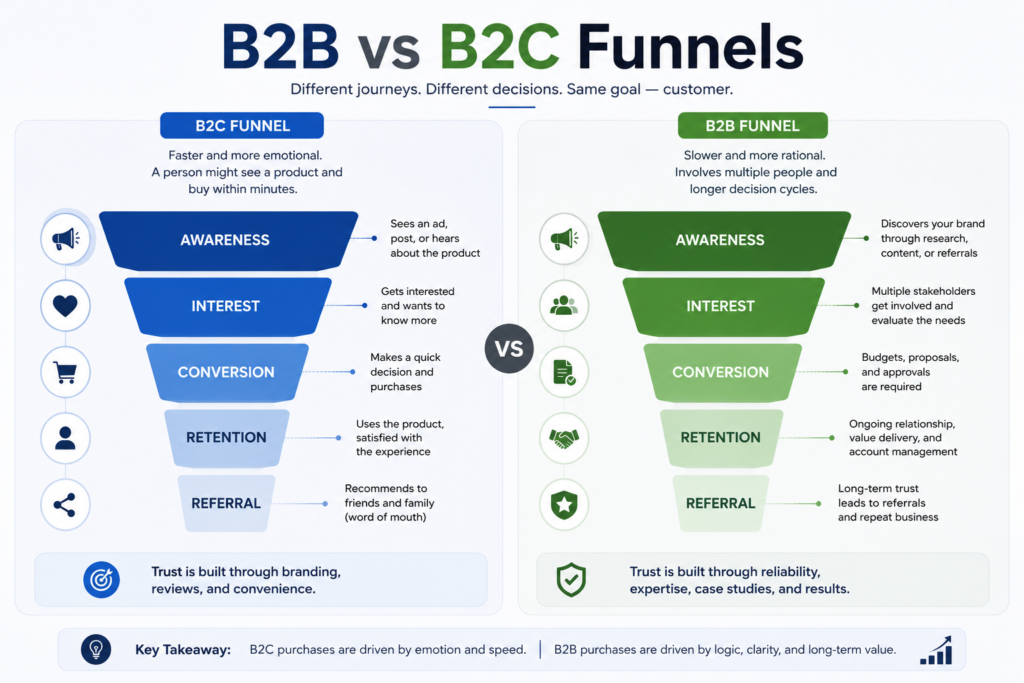
In B2C, funnels are usually faster and more emotional. A person might see a product and buy within minutes. Trust is built through branding, reviews, and convenience.
In B2B, funnels are slower and involve more people. Several stakeholders evaluate the purchase, budgets need approval, and the consideration stage can last weeks or months.
For Sparow, we work across both. Selling a bottle to an individual is a quick B2C decision. Selling to a distributor, office, or retailer is a longer B2B process built on relationships, reliability, and margins.
The lesson is simple. Keep the five-stage framework, but adjust the pace and depth of each stage to match how your buyers actually decide.
Frequently Asked Questions
What is a customer acquisition funnel in simple words?
A customer acquisition funnel is the path a person follows from first discovering your business to becoming a paying customer. It is shaped like a funnel because many people enter at the top through awareness, but only some reach the bottom and buy. Each stage filters prospects closer to a decision, helping you see exactly where you gain or lose potential customers.
What are the main stages of the acquisition funnel?
The customer acquisition funnel usually has five stages: awareness, interest, conversion, retention, and referral. Awareness is when people discover you. Interest is when they consider you. Conversion is the purchase. Retention turns them into repeat buyers. Referral turns happy customers into promoters. The first three stages cover acquisition, while retention and referral extend the value of each customer over time.
How is a marketing funnel different from a sales funnel?
The two overlap heavily and are often used together. A marketing funnel focuses on the earlier stages of awareness and interest, generating and nurturing potential customers. A sales funnel focuses more on the later stages of conversion, where prospects become buyers. In practice, both describe the same overall journey. The customer acquisition funnel is the complete picture that connects marketing and sales into one flow.
What is customer acquisition cost?
Customer acquisition cost, or CAC, is the total amount you spend to gain one new customer. You calculate it by dividing your acquisition spending by the number of customers acquired in that period. CAC matters because it must stay lower than the value a customer brings over their lifetime. If acquisition costs more than the customer is ever worth, the business loses money as it grows.
Why do customers drop off in the funnel?
Customers drop off for different reasons at each stage. Early on, unclear messaging fails to spark interest. In the middle, weak trust or too many alternatives stall the decision. Near conversion, friction like complicated checkout or hidden costs pushes people away. After buying, poor experience prevents repeat purchases. Identifying the specific stage where drop-off is highest is the fastest way to improve results.
How can small businesses improve their funnel cheaply?
Small businesses should focus on fixing leaks before spending on more traffic. Improving a checkout process, adding customer reviews, or following up after a sale often costs little but lifts results significantly. Retention and referrals are especially affordable, since keeping and delighting existing customers is far cheaper than acquiring new ones. Careful measurement helps small brands compete without large marketing budgets.
How long does it take a customer to move through the funnel?
It depends entirely on the product and the buyer. For low-cost everyday items, a customer may move from awareness to purchase in minutes. For expensive or business purchases, the journey can take weeks or months as multiple people evaluate the decision. The important thing is not speed but understanding your own typical timeline, so you can nurture prospects at the right pace.
Is retention part of customer acquisition?
Strictly speaking, acquisition ends at the first purchase. However, retention is usually included in the funnel because it determines whether acquisition was worthwhile. A customer who buys once and leaves rarely covers their acquisition cost. Retention turns that first sale into ongoing value and often into referrals, which lower future acquisition costs. This is why most modern funnels treat retention as an essential stage.
What metrics show if my funnel is healthy?
The most useful metrics are customer acquisition cost, conversion rate, customer lifetime value, retention rate, and stage-by-stage drop-off. Together they reveal whether you are acquiring customers profitably and keeping them. A healthy funnel shows lifetime value comfortably above acquisition cost, along with steady retention. Vanity metrics like follower counts feel encouraging but rarely indicate whether the funnel actually generates profitable customers.
Does the funnel apply to every type of business?
Yes, the five-stage funnel applies to almost every business, from software to retail to everyday consumer products. The stages stay the same, but the pace and channels differ. A fast consumer product funnel looks very different from a slow business-to-business one. The value of the framework is that it gives any business a clear way to diagnose exactly where customers are being gained or lost.
Conclusion
The customer acquisition funnel explained here is really a tool for clear thinking.
It breaks the messy work of growing a business into five understandable stages: awareness, interest, conversion, retention, and referral. Each stage is a specific problem you can measure and improve.
The businesses that grow steadily are rarely the ones with the biggest budgets. They are the ones that understand their funnel, find the leaking stage, and fix it patiently.
Building Sparow taught me that even a simple, everyday product lives or dies by this journey. Getting noticed, earning trust, converting the first sale, keeping the customer, and turning them into an advocate is the whole engine of growth.
Start by mapping your own funnel today. Find the one stage that is quietly costing you the most, and fix that first.
Ready to strengthen your own funnel? Explore more practical business guides on the blog, or read the in-depth Customer Acquisition Strategy resource to go deeper into each stage. If you want to talk through your specific growth challenges, reach out through the contact page and start the conversation.
Enjoyed this? Get the next one by email.
Occasional, considered notes on brand and building. No noise.