Organic Customer Acquisition Strategies: 12 Proven Methods
Most businesses in India start with the same assumption. Get the product ready, put money into ads, watch customers arrive.
Then the ad account burns through a month’s budget and the orders stop the moment you pause spending.
This is where founders start looking seriously at organic customer acquisition strategies, usually after they have already lost money learning why paid channels alone do not build a business.
This article covers what organic customer acquisition strategies are, why they behave differently in the Indian market, and twelve methods I have either used or studied closely enough to explain properly.
Table of Contents
1. What Organic Customer Acquisition Actually Means
Organic customer acquisition means gaining customers through channels where you do not pay a platform for each visit, click, or conversion.
You still spend. You spend time, effort, and often salary. What you do not spend is a per-unit fee to a middleman.
The distinction matters because of what happens when you stop.
The Switch Test
Here is a simple way to tell the difference between paid and organic channels.
Turn the channel off for thirty days. If customers stop arriving immediately, it was paid. If they keep trickling in, it was organic.
A Google Ads campaign fails this test instantly. A blog post that ranks for a question your customers ask does not. Neither does a retailer who recommends your product because he trusts you.
What Counts as Organic
The category is broader than most people think:
- Search engine visibility through content
- Word of mouth and customer referrals
- Community participation and reputation
- Partnerships and channel relationships
- Founder led sales and direct outreach
- Earned media and genuine press coverage
- Product design that encourages sharing
- Reviews and social proof
- Local presence and physical visibility
Notice that most of these depend on something existing before the channel works. A referral needs a satisfied customer. A ranking needs useful content. This is the core structural fact about organic customer acquisition strategies: they require inputs before they produce outputs, and the gap between the two is measured in months.
2. Why Organic Customer Acquisition Strategies Matter More in India
The Indian market has three characteristics that change the calculation.
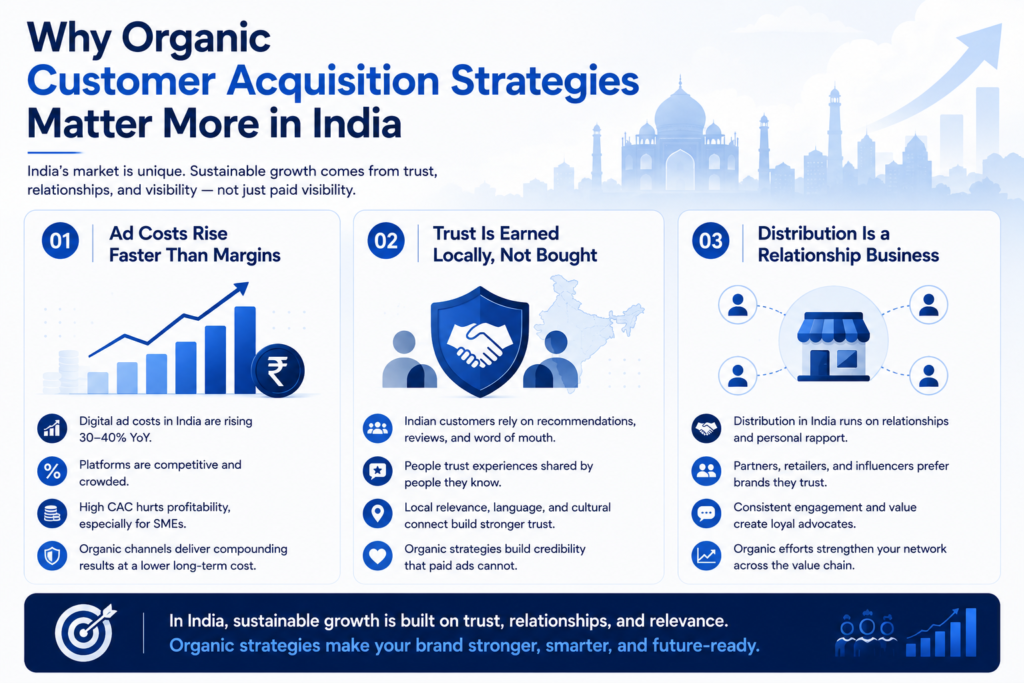
Ad Costs Rise Faster Than Margins
Digital advertising in India has grown steadily as a share of total ad spend, and as more businesses compete for the same inventory, cost per acquisition rises.
The problem for a small business is that your margins do not rise at the same rate. If your gross margin on a product is 25 percent and your customer acquisition cost climbs 40 percent year over year, the arithmetic stops working before your business does.
Trust Is Earned Locally, Not Bought
This is the part I find most underappreciated.
In most Indian categories, purchase decisions carry a trust component that advertising cannot manufacture. People ask their kirana owner. They ask a neighbour. They notice which brand the local restaurant uses.
An ad can create awareness. It rarely creates trust. Organic customer acquisition strategies work precisely because they are built on the channels where trust actually travels.
Distribution Is a Relationship Business
In FMCG especially, and this applies far beyond it, the person between you and the customer is a human being with his own incentives.
A distributor stocks what sells. A retailer recommends what does not cause him problems. These relationships are not purchasable at scale. They are built, one conversation at a time, and they are among the most durable organic customer acquisition strategies available to a physical products business in India.
3. The Economics Nobody Explains Properly
Let me lay out the numbers logic, because most articles skip this and it is the whole point.
Payback Period Is the Real Metric
Everyone talks about customer acquisition cost. Fewer people talk about how long it takes to earn that cost back.
If you spend ₹500 to acquire a customer who buys ₹200 of product per month at 30 percent margin, you earn ₹60 per month. Your payback period is roughly eight months.
For a business with limited working capital, an eight month payback is dangerous. You are financing your own growth out of a shrinking bank balance.
The Organic Curve Looks Different
Organic channels invert this shape.
| Paid Acquisition | Organic Acquisition | |
|---|---|---|
| Cost structure | Variable, per customer | Mostly fixed, upfront |
| Time to first result | Days | Months |
| Cost per customer over time | Rises | Falls |
| Stops when you stop paying | Yes | Slowly |
| Compounds | No | Yes |
| Predictability | High | Low, early on |
| Competitive moat | Weak | Strong |
The critical row is the third one. Paid CAC rises as you scale because you exhaust the cheapest audience first. Organic CAC falls as you scale because the fixed cost spreads across more customers.
The Trap in the Middle
Here is where founders get hurt.
Organic customer acquisition strategies take six to eighteen months to produce meaningful volume. Most businesses cannot survive eighteen months without revenue.
So you need paid or founder led sales to survive the gap while organic builds underneath. Treating this as an either-or decision is the mistake. It is a sequencing problem, and I will come back to it in section 7.
4. 12 Organic Customer Acquisition Strategies That Work
I have ordered these roughly by how quickly they produce results, not by how important they are.
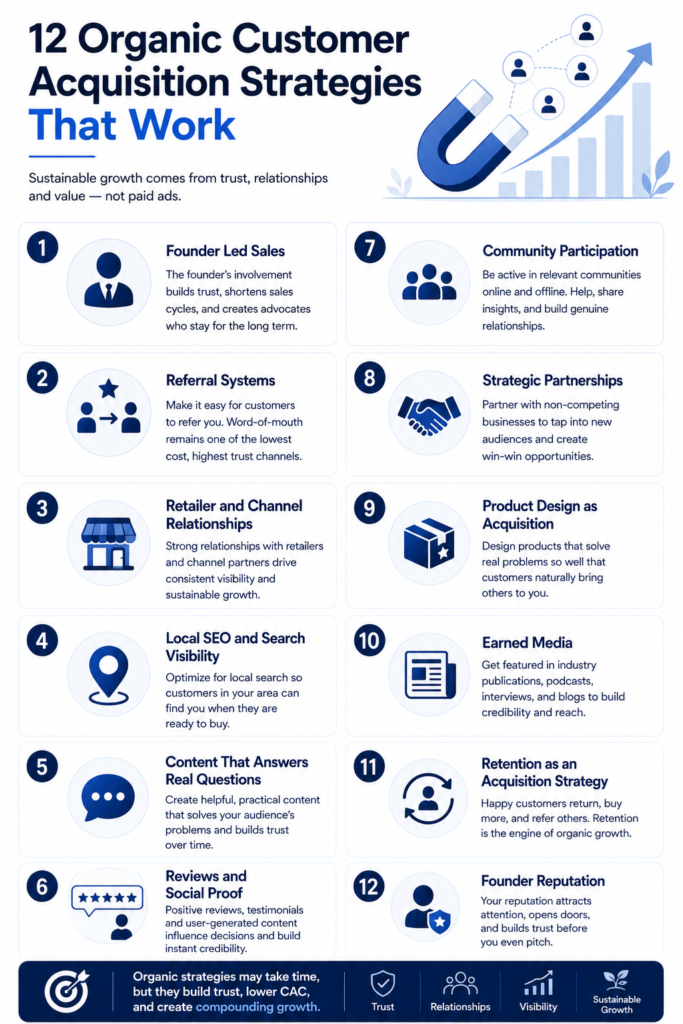
4.1 Founder Led Sales
The fastest organic channel is you, in a room, with a customer.
Every founder should personally sell to the first hundred customers. Not because it scales, but because it teaches you the objections, the language, and the actual reason people buy.
Why it works: No trust gap. You are the brand.
Timeline: Immediate.
Ceiling: Low. Bounded by your hours.
Best for: First 6 to 18 months, B2B, distribution led categories.
The output is not just revenue. It is the raw material for every other organic customer acquisition strategy you will run later. You cannot write useful content about objections you have never heard.
4.2 Referral Systems
A referral is a customer doing your selling for you.
Most businesses treat referrals as something that happens rather than something they build. That is the error.
How to build one:
- Identify your happiest customers. Not your biggest ones, your happiest.
- Ask them directly, by name, for a specific introduction.
- Make the referral easy. Give them the words.
- Close the loop. Tell them what happened.
- Thank them in a way that costs you something.
Note that step 2 says ask directly. A generic “refer a friend” banner produces almost nothing. A phone call asking “who else in your building would want this” produces referrals.
Why it works: Trust transfers with the recommendation.
Timeline: Weeks, once you have satisfied customers.
Ceiling: Medium to high.
4.3 Retailer and Channel Relationships
For any physical product, the person who stocks you is your acquisition channel.
This is the least glamorous and most reliable of the organic customer acquisition strategies for FMCG businesses in India.
What retailers actually care about:
- Does it sell, or does it sit?
- Do you deliver when you say you will?
- Is the margin fair?
- Will you take back damaged stock without an argument?
- Do you show up when there is a problem?
None of that is marketing. All of it is acquisition. A retailer who trusts you moves your product to eye level and answers “which one is good?” with your name.
At Sparow, this took me longer to accept than it should have. I kept looking for a message that would make retailers stock us. There was no message.
There was a delivery van that either arrived on Tuesday or did not. Once I understood that the channel relationship was the strategy, not a step before it, the approach changed completely.
This sits inside a broader framework I have written about separately in my Customer Acquisition Strategy guide, which covers how channel decisions connect to positioning, pricing, and retention.
4.4 Local SEO and Search Visibility
If someone in Coimbatore searches for a supplier in your category, you want to exist in that result.
For local businesses, this means:
- A complete Google Business Profile with real photos
- Consistent name, address, phone across every listing
- Genuine reviews, collected patiently, never bought
- Location relevant pages on your website
- Presence in local directories that actually get traffic
Timeline: 2 to 6 months for local, longer for competitive terms.
Cost: Low.
Why founders skip it: It is boring and produces nothing for the first sixty days.
4.5 Content That Answers Real Questions
This is the organic customer acquisition strategy most people get wrong, because they write for search engines instead of for buyers.
The method is simple. Write down every question a customer has asked you. Answer each one properly, in public, better than anyone else has.
What makes content work:
- It answers a question someone is actually typing
- It is more useful than the current top result
- It comes from experience, not from summarising other articles
- It sends the reader somewhere useful next
What makes content fail:
- Writing about topics your buyers do not search for
- Producing thin pages at volume
- Copying the structure of competitors without adding anything
- Abandoning it after eight weeks
Content is slow. Give it twelve months or do not start.
4.6 Reviews and Social Proof
Reviews are acquisition infrastructure. They work quietly, at the exact moment someone is deciding.
Build a system:
- Ask every satisfied customer, at the moment of satisfaction
- Make it a two tap process
- Respond to every review, especially negative ones
- Never incentivise, never fabricate
The response to a negative review is read by more prospective customers than the review itself. Handle it well and it becomes an asset.
4.7 Community Participation
Be present where your customers already gather.
For B2B, that means industry associations, trade groups, WhatsApp groups where your buyers talk. For consumer brands, it means local events, sponsorships that cost little, physical presence.
The rule is contribution before extraction. If you show up to sell, you will be ignored. If you show up to be useful for six months, people will ask what you do.
4.8 Strategic Partnerships
Find a business that already has your customer but sells them something different.
A water brand and a caterer. A bakery and an events company. A software product and a consultant who serves the same firms.
How to structure one:
- Start with a single, small, specific test
- Be clear about what each side gives and gets
- Make it easy for the partner to explain you
- Do not ask for exclusivity in the first conversation
Partnerships are among the highest leverage organic customer acquisition strategies available, because you borrow trust that took someone else years to build.
4.9 Product Design as Acquisition
Sometimes the product does the selling.
Packaging that is visible on a table. A design distinct enough to be recognised at a distance. A service so unusually good that people mention it unprompted.
This is not marketing budget. It is a decision made at the design stage that pays out for the life of the product.
4.10 Earned Media
Journalists need stories. If you have a genuine one, it costs nothing but effort.
The story is rarely your product. It is the market shift, the local angle, the founder’s decision, the problem nobody has covered. Pitch that. Mention the product in passing.
Local and trade press in Tamil Nadu is far more accessible than national media and often more useful, because it reaches the people who actually buy from you.
4.11 Retention as an Acquisition Strategy
This sounds like a contradiction. It is not.
A retained customer buys again without costing you anything to acquire twice. In effect, retention lowers your blended CAC across the base.
More importantly, a retained customer refers. An unretained one does not. Every referral system depends on retention working first.
If your repeat purchase rate is low, fix that before spending anything on acquisition. Filling a leaking bucket faster is not a strategy.
4.12 Founder Reputation
Over time, you become a channel.
If you write, speak, or teach consistently about what you know, people begin to associate the category with you. That association converts.
This is the slowest of all organic customer acquisition strategies. It takes years. But it is also the only one nobody can copy, because it is attached to a person.
5. A Field Case: What Sparow Taught Me About Acquisition
I run Sparow, a packaged drinking water brand in Tamil Nadu. Water is a useful category to learn acquisition in, because it strips away every comfortable illusion.
The product is functionally identical to competitors. The margins are thin. The buyer often does not choose the brand, the retailer does. There is no clever ad that fixes any of this.
What Did Not Work
I want to start here, because the failures were more instructive.
Broad awareness spending did nothing. A person standing at a shop counter does not recall an ad. He takes what is handed to him.
Talking about product quality did not work either. Every brand claims purity. FSSAI and BIS certification is a requirement, not a differentiator. Saying “our water is pure” is like a restaurant advertising that the food is edible.
Discounting to enter shelves worked exactly as long as the discount lasted.
What Actually Worked
Three things, all of them organic, none of them fast.
Delivery reliability. In a category where everyone claims the same product, the retailer’s actual problem is stockouts and unreliable supply. Showing up on schedule, every week, without being chased, turned out to be the entire differentiator. It is not a marketing message. It is an acquisition strategy executed through operations.
Problem handling without argument. When stock is damaged, most suppliers negotiate. We replaced it. The cost of that decision was small. The effect on retailer recommendation was disproportionate.
Founder presence at the counter. I went to shops myself, for much longer than was efficient. I heard the real objections, which were never about the water. They were about credit terms, about shelf space, about whether I would still exist in a year.
The Lesson I Would Generalise
In categories where the product cannot differentiate, the relationship is the product.
That reframing changed how I think about organic customer acquisition strategies generally. Acquisition is not always a marketing function. Sometimes it lives in operations, in logistics, in whether you pick up the phone.
I am still early in this. Sparow is not a large business and I am not going to pretend otherwise. But the pattern has held consistently enough that I would bet on it in other categories.
6. Paid vs Organic: The Honest Comparison
I am not against paid advertising. I am against using it as a substitute for having a business that works.
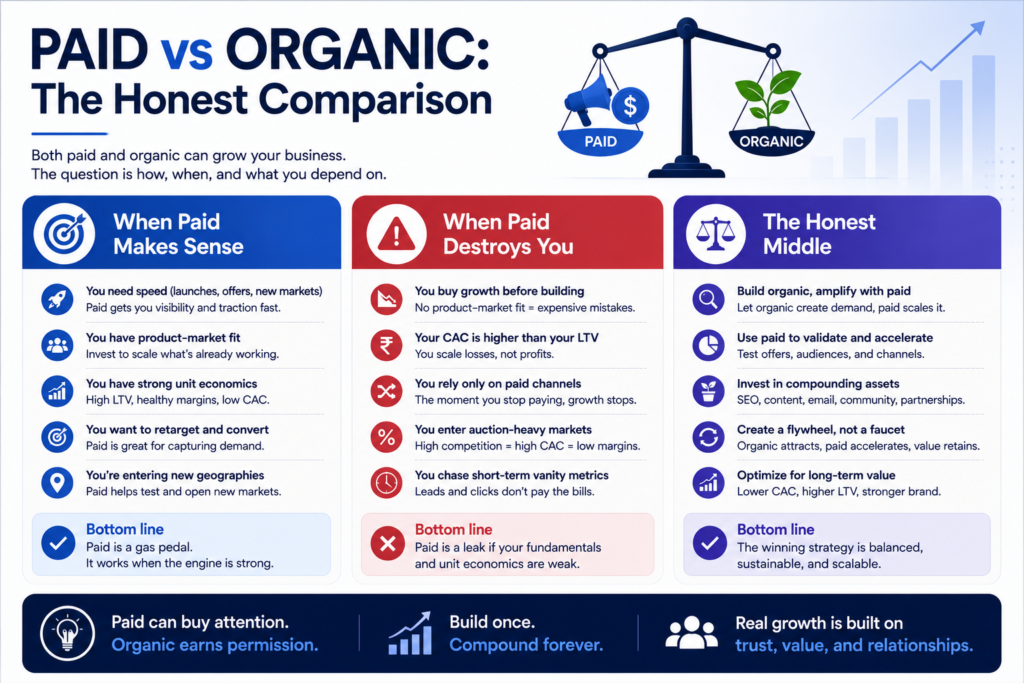
When Paid Makes Sense
- You have validated that people want the product
- Your unit economics support the CAC
- You need speed for a specific reason, like a launch window
- You are testing messaging quickly before committing to content
- Your payback period is under three months
When Paid Destroys You
- You are using it to compensate for a product people do not repeat on
- Your margins cannot absorb rising CPCs
- You have no retention, so every customer must be bought once
- You stop and revenue goes to zero, which means you never built anything
The Honest Middle
Most functioning businesses run both. Paid handles the immediate. Organic customer acquisition strategies build the base underneath, so that in year three you are not paying the same price per customer that you paid in year one.
The question is never paid or organic. It is what percentage of your revenue would survive if you turned the ads off tomorrow. If the answer is close to zero, you have a campaign, not a company.
7. How to Sequence Your Channels
Order matters more than selection. Here is the sequence I would follow.
Stage 1: Months 0 to 6
Do: Founder led sales. Talk to everyone. Sell manually.
Build: A record of every objection, every question, every reason people said no.
Ignore: SEO, content, brand, community. All of it is premature.
The goal of this stage is not revenue. It is learning what you are actually selling, which is usually not what you thought.
Stage 2: Months 6 to 12
Do: Retention. Referrals. Reviews.
Build: A repeat purchase habit and a systematic way of asking happy customers for introductions.
Start quietly: Content, based on the questions you collected in stage 1.
Stage 3: Months 12 to 24
Do: Content at consistent volume. Partnerships. Local search.
Build: Search visibility that took twelve months to earn.
Consider: Paid, now that you know your CAC tolerance and your retention holds.
Stage 4: Year 2 onward
Do: All of the above, plus founder reputation.
Build: The compounding layer. Content that ranks brings customers who refer, who leave reviews, which improves rankings.
This is the flywheel everyone talks about. It is real, but it only exists after roughly two years of unglamorous work.
8. Measuring Organic Customer Acquisition Strategies
You cannot manage what you do not measure, but organic resists measurement. Here is what to track anyway.
Metrics That Matter
| Metric | What It Tells You | Review Frequency |
|---|---|---|
| Blended CAC | Total spend ÷ total new customers | Monthly |
| Organic share of new customers | How dependent you are on paid | Monthly |
| Repeat purchase rate | Whether the product works | Monthly |
| Referral rate | Whether customers advocate | Quarterly |
| Branded search volume | Whether the brand is registering | Quarterly |
| Payback period | Whether you can afford growth | Monthly |
The Attribution Problem
Be honest about this. You will never know exactly which organic channel produced a customer.
Someone read an article, forgot it, saw the product at a shop, asked a friend, and bought. Which channel gets credit? All of them. None of them cleanly.
The practical answer is to stop trying to attribute perfectly and instead ask new customers one question: how did you hear about us? Imperfect data collected consistently beats perfect data you never gather.
The Metric I Would Watch Above All
Organic share of new customers, tracked monthly, over eighteen months.
If that number is rising, your organic customer acquisition strategies are working, regardless of what any individual channel report says.
9. Common Mistakes I See Repeatedly
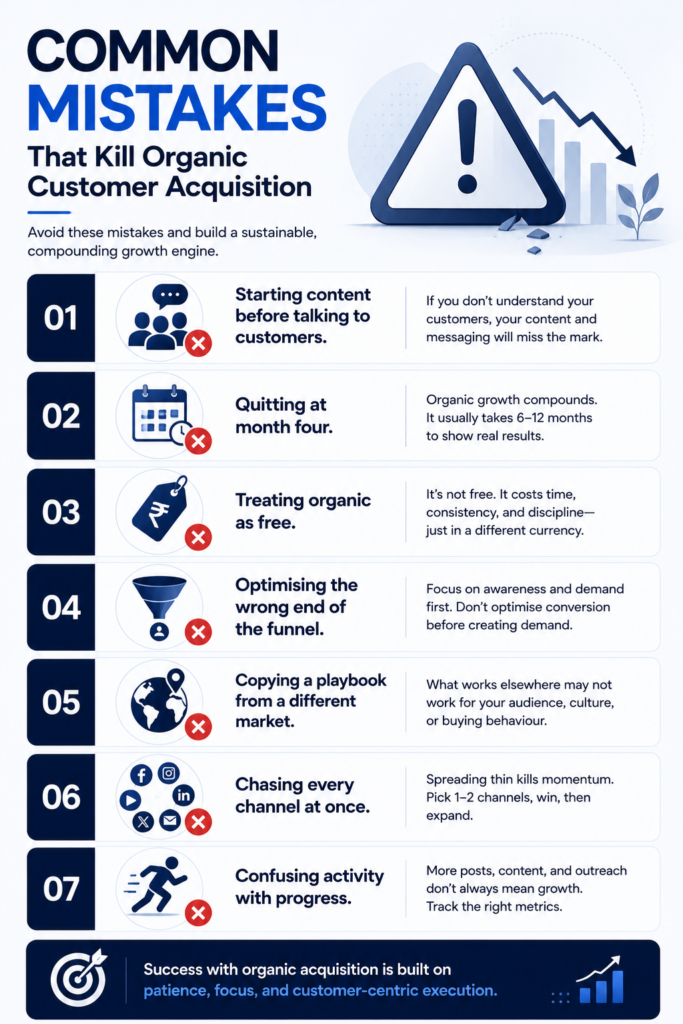
Starting content before talking to customers. You will write about the wrong things. Sell first.
Quitting at month four. Almost every organic channel produces nothing visible for the first quarter. The people who win are the ones who did not stop.
Treating organic as free. It costs time, which for a founder is the most expensive resource there is. Budget it honestly.
Optimising the wrong end of the funnel. If people do not repeat, more traffic just means more people discovering you are not good enough.
Copying a playbook from a different market. A SaaS growth model does not transfer to FMCG distribution in Tamil Nadu. The channels are different because the trust mechanisms are different.
Chasing every channel at once. Two channels done properly beat eight done badly. Every time.
Confusing activity with progress. Posting daily is not a strategy. Answering a question nobody else answered well is.
10. Where to Start This Month
If you take one thing from this article, take this sequence.
- This week: Call ten customers. Ask why they bought and what nearly stopped them. Write it down.
- This month: Ask your five happiest customers for one introduction each. By name. Directly.
- This month: Complete your Google Business Profile properly. Photos, hours, description, all of it.
- This quarter: Answer your three most common customer questions in public, properly.
- This quarter: Measure your repeat purchase rate. If it is low, stop everything else and fix it.
- This year: Pick two organic channels and commit to them for twelve months without evaluating them monthly.
None of this is clever. All of it works.
I am still working through this list myself. Sparow is a small brand in a crowded category, and there is no version of this where I claim to have solved it. What I can say is that every meaningful customer we have came from one of these channels, and none of them came from an ad.
The uncomfortable truth about organic customer acquisition strategies is that they are not hard to understand. They are hard to sustain. The advantage does not go to the founder who knows the most. It goes to the one who was still doing it in month fourteen.
FAQs
What are the best organic customer acquisition strategies for a new business?
For a business under six months old, founder led sales beats everything. Talk to customers directly, sell manually, and record every objection. Once you have a base of satisfied customers, layer in referrals and reviews. Content and search visibility should start around month six but will not produce meaningful volume for a year. The instinct to start with content is usually a way of avoiding the discomfort of selling.
How long do organic customer acquisition strategies take to work?
Referrals can produce results within weeks if you have satisfied customers. Local search takes two to six months. Content and search visibility typically take twelve to eighteen months to produce reliable volume. Founder reputation takes years. This is why most businesses need a bridge, whether paid ads or direct sales, to survive while organic channels build underneath.
Are organic customer acquisition strategies actually free?
No. They cost time, effort, and often salary, which for a small business is the scarcest resource available. What they avoid is a per-customer fee to an advertising platform. The correct comparison is not free versus paid, it is fixed cost versus variable cost. Organic costs are largely upfront and spread across every customer acquired afterwards, which is why cost per customer falls over time.
Can organic customer acquisition strategies work for FMCG brands in India?
Yes, and arguably better than in most categories. FMCG purchase decisions in India often route through a retailer’s recommendation, which advertising cannot buy. Reliable delivery, fair margins, and handling problems without argument are acquisition strategies executed through operations. In my experience with Sparow, these mattered far more than any messaging or awareness spending.
Should I stop paid ads and switch to organic customer acquisition strategies?
Rarely all at once. If your paid channel is profitable and your payback period is short, keep it running while you build organic underneath. The useful question is what percentage of revenue would survive if ads stopped tomorrow. If it is near zero, you have a dependency worth reducing, but reduce it gradually rather than by cutting the channel that currently pays your bills.
What is the single most underrated organic customer acquisition strategy?
Retention. It sounds like the opposite of acquisition, but a customer who buys repeatedly does not need acquiring twice, which lowers blended CAC across your whole base. More importantly, referrals only come from retained customers. If your repeat purchase rate is weak, every rupee spent on acquisition is filling a leaking bucket faster.
How do I measure organic customer acquisition strategies when attribution is unclear?
Accept that perfect attribution is impossible. Someone reads an article, forgets it, sees your product, asks a friend, and buys. Instead, ask every new customer one question: how did you hear about us? Then track organic share of new customers monthly over eighteen months. If that share rises, your organic channels work, regardless of what any individual report claims.
How many organic customer acquisition strategies should I run at once?
Two, done properly, for at least twelve months. The most common failure I see is founders spreading effort across six channels, producing mediocre work in all of them, then concluding that organic does not work. Every organic channel has a threshold below which it produces nothing. Half effort across many channels means crossing that threshold in none of them.
Do organic customer acquisition strategies work for B2B businesses?
Very well. B2B purchase cycles are long and trust dependent, which is exactly where organic performs best. Founder led sales, industry community participation, partnerships with firms serving your buyers, and genuinely useful content all compound in B2B. Paid ads struggle in B2B precisely because the decision involves multiple people over months, which no single click can influence.
What is the biggest mistake founders make with organic customer acquisition strategies?
Quitting at month four. Almost every organic channel produces nothing visible for the first quarter, which feels like failure but is simply the shape of the curve. The founders who win are not the ones with the best strategy. They are the ones still executing an ordinary strategy in month fourteen, when everyone who started alongside them has already moved on.
Enjoyed this? Get the next one by email.
Occasional, considered notes on brand and building. No noise.