How to Lower Customer Acquisition Cost: 12 Real Fixes
Most founders discover their acquisition problem the same way. The dashboard looks fine. Revenue is climbing. Then they open the bank statement and the profit is not there.
That gap between growth and profit almost always has one name: customer acquisition cost. And if you are running a business in India right now, the number has probably moved against you without you doing anything wrong.
Learning how to lower customer acquisition cost is no longer an optimisation exercise. For a lot of small businesses it has become a survival requirement.
This guide is written for founders, small business owners, and marketers operating in India. It covers the maths, the diagnosis, and twelve levers that actually move the number. It also covers the levers that most articles skip entirely, because most articles are written for software companies in San Francisco.
Lowering your acquisition cost is one half of the problem. The other half is knowing which channels you should be spending on in the first place, which I have covered separately in my customer acquisition strategy guide. This piece assumes you already have channels running and the economics have stopped working.
I run a packaged drinking water brand in Tamil Nadu called Sparow. A lot of what follows is shaped by what I have watched work and fail in a physical product business with real distribution, not just an ad account.
Quick Answer
To lower customer acquisition cost, first measure blended CAC across all channels instead of platform ROAS. Then fix funnel leaks before adding budget, shift spend from auction-priced channels to owned and referral channels, and raise retention so each customer is worth more. Lower CAC comes from better economics, not smaller budgets.
Table of Contents
What Customer Acquisition Cost Actually Means
Customer acquisition cost is the total amount you spend to turn a stranger into a paying customer.
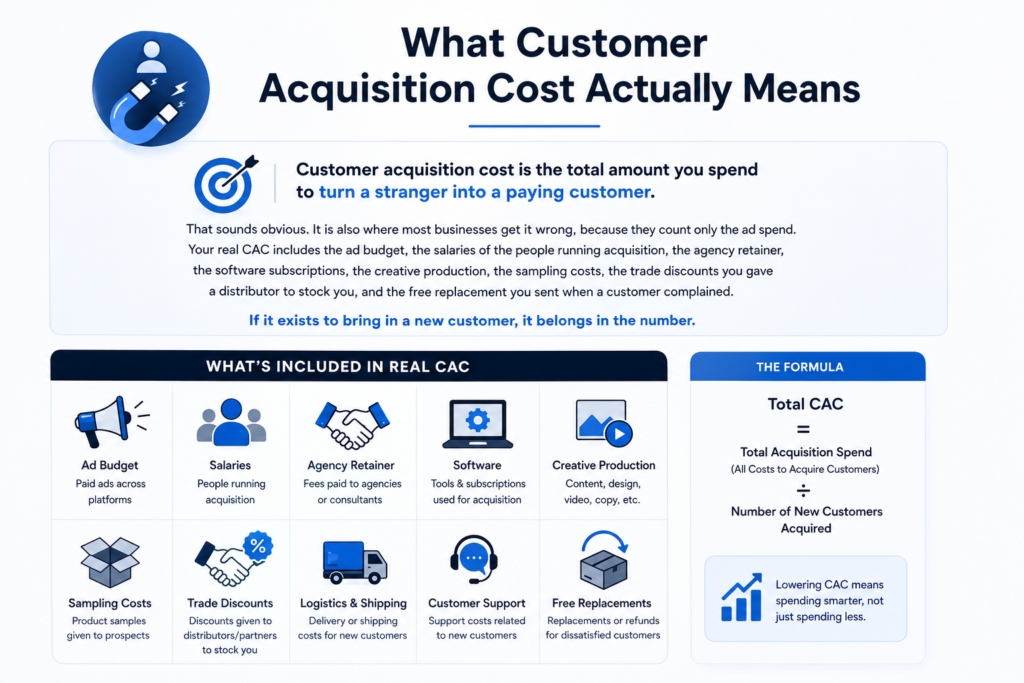
That sounds obvious. It is also where most businesses get it wrong, because they count only the ad spend.
Your real CAC includes the ad budget, the salaries of the people running acquisition, the agency retainer, the software subscriptions, the creative production, the sampling costs, the trade discounts you gave a distributor to stock you, and the free replacement you sent when a customer complained.
If it exists to bring in a new customer, it belongs in the number.
Customer acquisition cost vs cost per acquisition
These two get used interchangeably and they are not the same thing.
Cost per acquisition usually measures a single platform action. A lead, a signup, an add to cart. It is a campaign metric.
Customer acquisition cost measures the full journey from stranger to paying customer, across every channel, including the money that never touched an ad platform. It is a business metric.
A founder who optimises cost per acquisition and ignores customer acquisition cost will produce a beautiful dashboard and an ugly P&L.
The Customer Acquisition Cost Formula
The customer acquisition cost formula is deliberately simple.
CAC = Total sales and marketing spend in a period ÷ New customers acquired in that period
If you spent ₹4,00,000 across ads, salaries, and trade schemes in a month and acquired 500 new customers, your CAC is ₹800.
Three rules make this number honest.
Use the same time window for both sides. If you count this month’s spend against customers who were nurtured over three months, you will flatter yourself.
Count new customers only. Repeat buyers are not acquisition. They are retention, and mixing them in hides a broken funnel.
Include people costs. The salary of whoever runs your marketing is an acquisition cost. Leaving it out is the most common reason a business believes its unit economics work when they do not.
| Cost item | Include in CAC? |
|---|---|
| Meta and Google ad spend | Yes |
| Marketing team salaries | Yes |
| Agency or freelancer fees | Yes |
| Creative production | Yes |
| Trade discount to stock a new outlet | Yes |
| Free samples to new customers | Yes |
| Customer support for existing buyers | No |
| Loyalty programme for repeat buyers | No |
| Product development | No |
Why Customer Acquisition Cost Is Rising in India
Before you blame your campaigns, understand that the ground moved.
Meta CPMs in India are up roughly 40 to 60 percent since 2023, according to upGrowth’s 2026 D2C Performance Marketing Playbook. Over the same stretch, D2C customer acquisition costs moved from around ₹800 to ₹1,200 per customer in 2023, to ₹1,200 to ₹1,800 in 2024, and to ₹1,800 to ₹2,500 in 2025.
The reason is not mysterious. It is an auction with more bidders and the same inventory.
India now has over 800 funded D2C brands competing for broadly the same urban audience. Meanwhile India’s digital ad market grew 19 percent in 2025 to ₹71,621 crore, which is 59 percent of every advertising rupee spent in the country, according to Dentsu’s 2025 digital report.
More money chasing the same attention produces exactly one outcome. The price goes up.
There is a second force. Privacy changes across platforms weakened targeting precision. When targeting was sharp, an average ad could still find the right person. Now the audience is fuzzier, so more of your impressions land on people who were never going to buy. You pay for all of them.
The honest conclusion is uncomfortable. Part of your rising CAC is not a performance failure. It is a structural repricing of a channel you depend on.
Which is precisely why the answer to high customer acquisition cost is rarely “run better ads.” It is usually “depend less on the channel that is repricing.”<h2 id=”good-cac”>What Counts as a Good Customer Acquisition Cost</h2>
There is no universal good number. A ₹2,000 CAC is excellent if the customer is worth ₹40,000 and catastrophic if they are worth ₹1,500.
CAC only means something next to lifetime value.
Reported CAC ranges in Indian D2C
These are reported category ranges, useful as orientation rather than targets. Your category, city, and margin structure matter more than any benchmark.
Beauty and personal care sits at roughly ₹800 to ₹1,200 per customer. Food and wellness sits at roughly ₹400 to ₹800. Fashion sits at roughly ₹600 to ₹1,000.
For perspective on the drift, brands acquiring customers at ₹150 to ₹200 in 2021 are now paying ₹350 to ₹500 for equivalent customers in the same categories.
The CAC to LTV ratio
The CAC to LTV ratio is the ratio most founders should run their business on.
LTV ÷ CAC
A widely used rule of thumb in growth practice is a 3:1 ratio. Below 1:1 you lose money on every customer. Around 3:1 the business generally works. Far above 5:1 you are usually underinvesting in growth and leaving market share for a competitor.
Treat 3:1 as a compass, not a law. It is a heuristic that emerged from software businesses with high gross margins. If you sell a physical product at 30 percent gross margin, you need a wider ratio than a software company at 85 percent margin, because you have far less contribution left to cover the acquisition in the first place.
The CAC payback period
The CAC payback period asks a different and, for most small businesses, a more urgent question. Not “is this customer profitable eventually” but “when do I get my cash back.”
CAC payback = CAC ÷ monthly gross profit per customer
A commonly cited guardrail is a payback period under 12 months. For a small business without funding, that is far too generous. If you are running on your own cash, a payback beyond three or four months means you cannot grow without borrowing, regardless of how good the LTV to CAC ratio looks on paper.
This distinction matters more than almost anything else in this guide. A funded company optimises the ratio. A bootstrapped company optimises the payback. They lead to different decisions.
Diagnose Before You Fix: The Four Leaks
Here is where most CAC advice fails. It hands you a list of twenty tactics and no way to know which one is your problem.
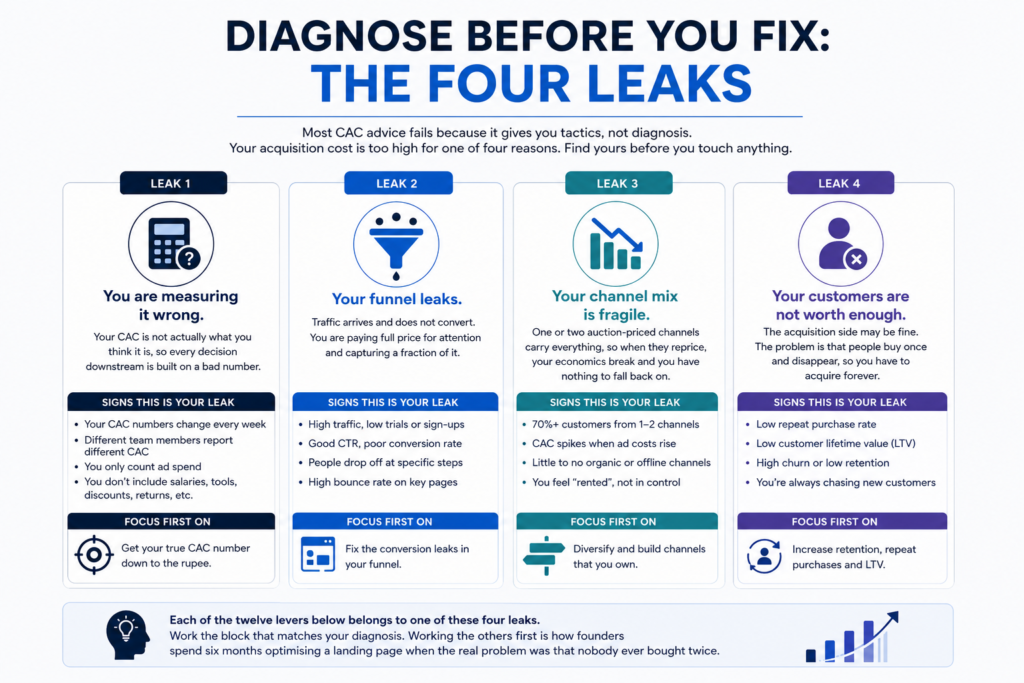
Your acquisition cost is too high for one of four reasons. Find yours before you touch anything.
Leak 1: You are measuring it wrong. Your CAC is not actually what you think it is, so every decision downstream is built on a bad number.
Leak 2: Your funnel leaks. Traffic arrives and does not convert. You are paying full price for attention and capturing a fraction of it.
Leak 3: Your channel mix is fragile. One or two auction-priced channels carry everything, so when they reprice, your economics break and you have nothing to fall back on.
Leak 4: Your customers are not worth enough. The acquisition side may be fine. The problem is that people buy once and disappear, so you have to acquire forever.
Each of the twelve levers below belongs to one of these four leaks. Work the block that matches your diagnosis. Working the others first is how founders spend six months optimising a landing page when the real problem was that nobody ever bought twice.
How to Lower Customer Acquisition Cost: The Twelve Levers
Each lever below belongs to one of the four leaks. Work the block that matches your diagnosis.
There is no single answer to how to lower customer acquisition cost, because the question is really four different questions wearing the same clothes.
Block 1: How to Lower Customer Acquisition Cost by Fixing the Maths First
You cannot reduce a number you are not measuring correctly.
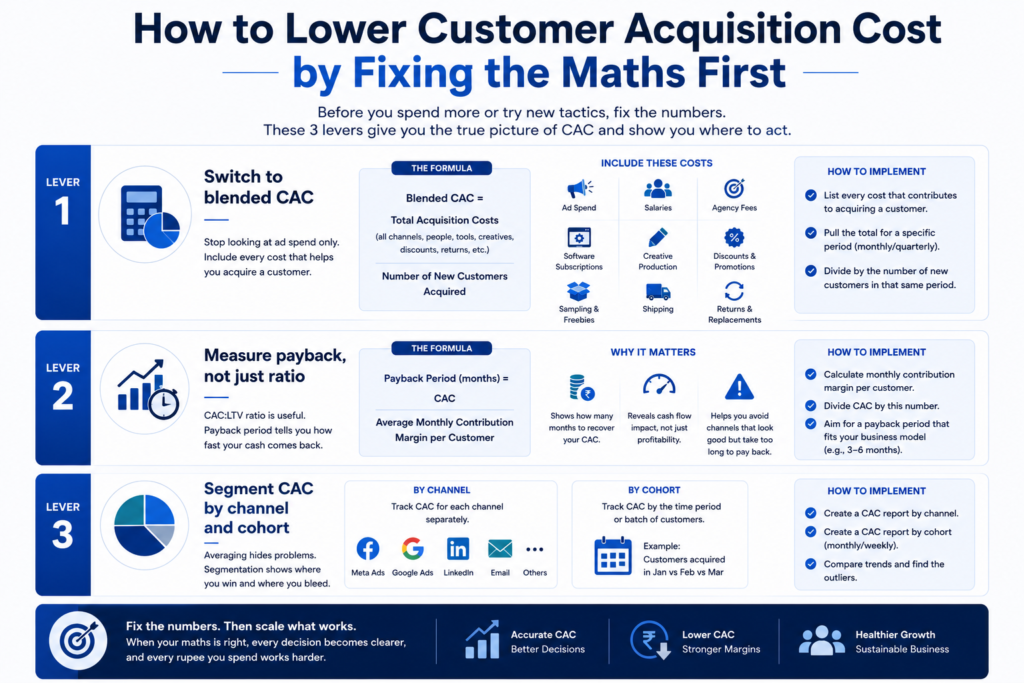
Lever 1: Switch to blended CAC
The first honest step in how to lower customer acquisition cost is knowing what it actually is.
Blended CAC is your total sales and marketing spend divided by total new customers, across every channel, with nothing excluded.
Platform ROAS tells you what Meta thinks it did. Blended CAC tells you what actually happened to your bank balance. When those two numbers disagree, the bank balance is right.
Marketing Efficiency Ratio, essentially blended CAC, has been replacing single-platform ROAS as the metric Indian D2C brands run on. Brands mixing in organic content, WhatsApp, and community growth typically report a blended CAC meaningfully below their paid CAC.
That gap is the entire point. A brand with a paid CAC of ₹2,000 and a blended CAC of ₹1,300 is not lucky. It has built channels that do not sit in an auction.
Calculate your blended CAC this week. For many founders, it is the first honest look at their acquisition economics they have ever had.
Lever 2: Measure payback, not just ratio
Recalculate every acquisition decision against the payback period rather than the ratio.
A channel with a ₹3,000 CAC and a two-month payback is better for a bootstrapped business than a channel with a ₹1,800 CAC and a fourteen-month payback, even though the second one looks cheaper.
Cash timing beats cost per customer when you are funding growth from your own operations.
Lever 3: Segment CAC by channel and cohort
An average CAC of ₹1,200 can be hiding a channel at ₹400 and a channel at ₹4,000.
Break the number down by channel, by city, and by month of acquisition. Almost every business that does this for the first time finds at least one channel that is quietly destroying the average, and at least one that deserves triple the budget.
You cannot reallocate what you cannot see.
How to Lower Customer Acquisition Cost When You Have No Data
Most small businesses reading this do not have twelve months of clean channel data. That is not a reason to skip the maths.
Start with one month, reconstructed from your bank statement rather than your dashboard. Total everything that went out to bring in customers. Count the new customers who came in. Divide.
The number will be rough. It will still be more useful than the number you currently believe, because it came from money that actually left your account.
You do not need perfect attribution to know how to lower customer acquisition cost. You need to know which channel is the worst, and a rough number tells you that.
Block 2: Fix the Funnel
If you send more traffic through a leaking funnel, you buy more leaks.
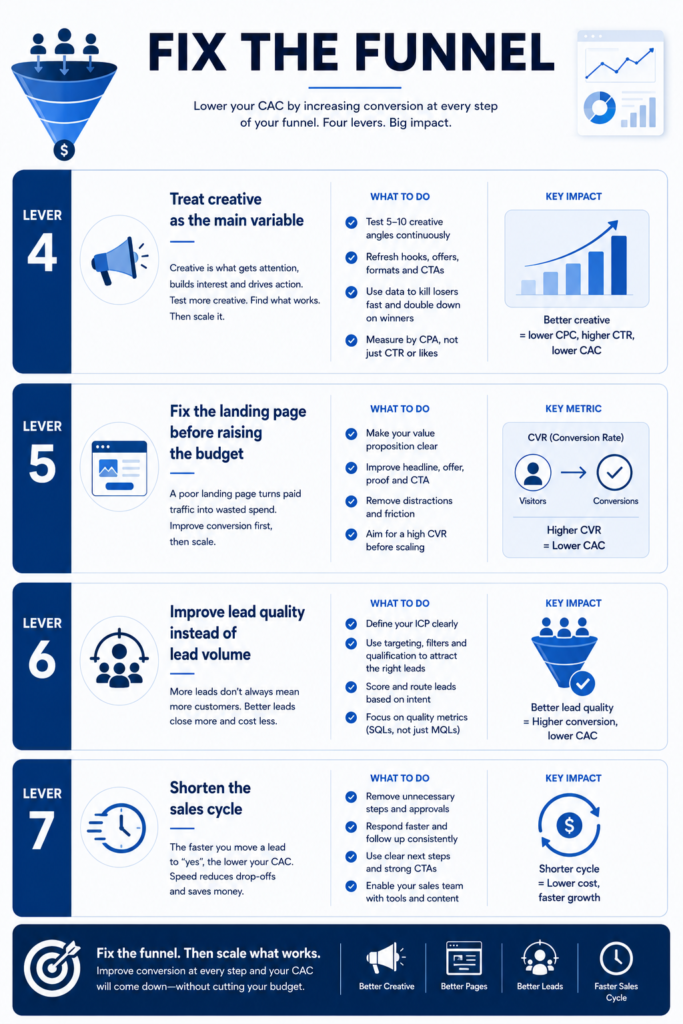
Lever 4: Treat creative as the main variable
When platform targeting was precise, the audience was the advantage. Now that targeting has weakened, creative carries the weight.
As targeting precision has reduced, creative quality has become the primary differentiator in Indian paid social, and the brands succeeding are not spending more but spending differently.
Practically, that means volume of creative tests rather than perfection of a single asset. Ten honest variations tested cheaply will beat one polished film, because you do not actually know which message lands until the market tells you.
Creative fatigue also arrives faster than most founders expect. An ad that worked for six weeks last year may work for two now.
Lever 5: Fix the landing page before raising the budget
This is the cheapest way to lower customer acquisition cost in this entire guide, and the most ignored.
If your landing page converts at 1 percent and you get it to 2 percent, you have halved your customer acquisition cost without touching your ad spend. No negotiation, no new channel, no additional budget.
Focus on the boring things. Load speed on a mid-range Android phone on a patchy connection, not on your laptop. One clear action above the fold. Price and delivery visible without scrolling. Trust signals that a cautious Indian buyer actually looks for, including reviews, a real address, and a working phone number.
Indian buyers are comparison-driven and value-conscious. They will open your ad, check your reviews, compare a competitor’s price, and abandon over ₹50 in shipping. Design for that person, not for an idealised one.
Lever 6: Improve lead quality instead of lead volume
More leads at worse quality raises your true CAC even when it lowers your cost per lead.
If your sales team spends three days chasing someone who was never going to buy, that time is an acquisition cost. It just does not appear in the ad account.
Add friction deliberately where it filters. A qualifying question, a visible price, a minimum order quantity. Every unqualified lead you refuse to generate is money you did not spend.
Lever 7: Shorten the sales cycle
Time is cost. A lead that takes forty days to close costs more than the same lead closed in ten, because your people were paid for those forty days.
Look for the single step where deals stall. Usually it is one thing: a quote that takes too long, an approval nobody chases, a sample that has to be shipped before anyone commits. Fixing one stall point often does more for CAC than any campaign change.
How to Lower Customer Acquisition Cost by Reducing Returns
A returned order is a customer you paid to acquire and then lost, plus the shipping both ways.
Indian ecommerce carries high return rates, particularly on cash on delivery. Every return means your real CAC is higher than your reported CAC, because the customer count in your denominator includes people who never actually stayed a customer.
Fix the causes rather than the symptom. Accurate product photography, honest sizing and quantity information, and clear delivery timelines all reduce returns.
This is one of the few levers that lowers your acquisition cost and raises your margin at the same time.
Block 3: How to Lower Customer Acquisition Cost Through Your Channel Mix
This is the block almost nobody writes about, and for a physical product business in India it is where the real money is.
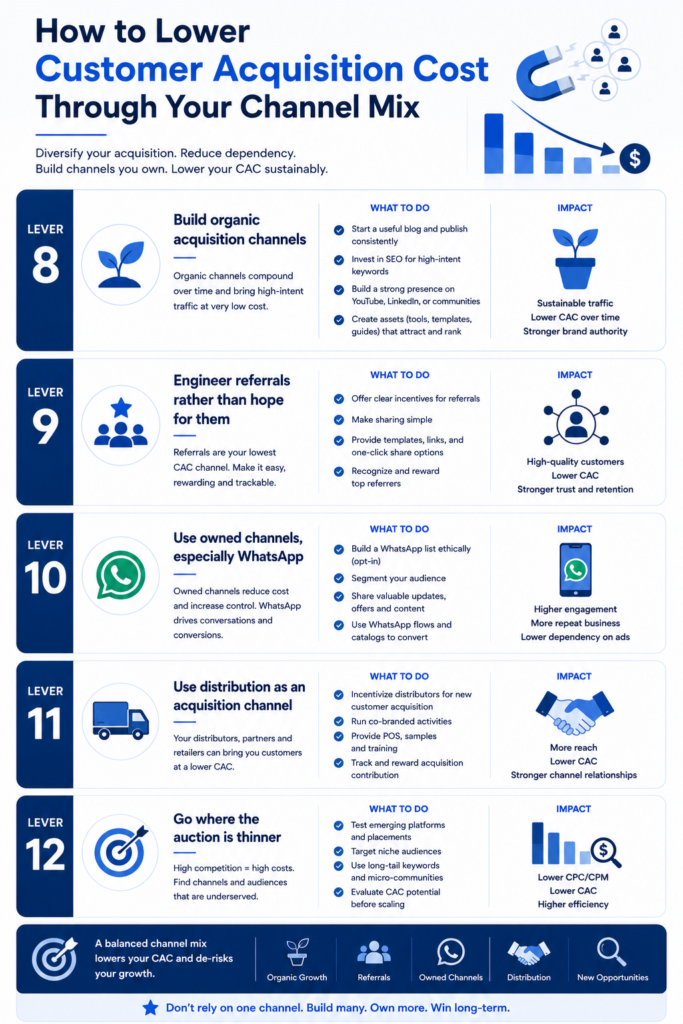
Every lever above optimises within a channel. These levers reduce your exposure to channels that reprice against you.
Where This Fits in Your Customer Acquisition Strategy
Every lever below changes the shape of your channel mix, which means every one of them is a customer acquisition strategy decision rather than a campaign decision.
That distinction matters. A campaign question asks how to make this month’s ads cheaper. A customer acquisition strategy question asks whether you should still be dependent on those ads at all in two years.
Most founders are asking the first question when their real problem is the second.
Lever 8: Build organic acquisition channels
Search and content have an unusual property. The cost is paid upfront and the returns compound, which is the exact opposite of paid media, where the returns stop the moment the spend stops.
An article that ranks brings you customers next year at no additional cost. An ad brings you customers only for as long as you keep paying.
The honest caveat is that this is slow. Organic acquisition takes six to twelve months to matter. It is not a solution to a cash crisis this quarter. It is how you make sure you are not in the same crisis in two years.
Start it while paid still works. Founders who start building organic channels only after their paid economics break have started roughly a year too late.
Lever 9: Engineer referrals rather than hope for them
A referred customer arrives pre-trusted. That trust does work your ads would otherwise have to pay for, which is why referral CAC is usually a fraction of paid CAC.
Most businesses treat referrals as a happy accident. They should be a system. Ask at the moment of satisfaction, not at a random point in a nurture sequence. Make the ask specific and easy. Make the reward worth a real customer’s attention rather than a token.
The constraint is honest: referrals scale with your customer base, so a small base produces a small trickle. It compounds, but it compounds from wherever you are.
How to Lower Customer Acquisition Cost With Local Partnerships
A partnership gives you access to someone else’s trust, and trust is the expensive part of acquisition.
The version that works for small businesses is unglamorous. A gym that stocks your product. A caterer who specifies your brand. A local business serving the same customer for a different need. You are not buying attention.
You are borrowing a relationship that already exists, and paying for it in margin or reciprocity rather than in CPMs. The constraint is that partnerships do not scale like ads. They are built one at a time. But each one holds, and none of them reprice against you overnight.
Lever 10: Use owned channels, especially WhatsApp
Anything you own, you do not rent. Your customer list, your WhatsApp contacts, your community.
WhatsApp is reported to run at 85 to 90 percent open rates against roughly 20 percent for email, at a cost in the range of ₹0.40 to ₹0.80 per message.
Compare that to the cost of reaching the same person through a paid impression and the case makes itself.
The discipline is not to abuse it. An owned channel stays valuable exactly as long as people want to be on it. Broadcast a promotion every second day and you have converted a low-cost asset into a mute button.
Lever 11: Use distribution as an acquisition channel
Here is the lever that a software-centric CAC article will never mention, and it is the one that matters most for FMCG, retail, and any physical product.
A shelf is an acquisition channel.
When a customer picks up a product in a store, that purchase had an acquisition cost. It was just paid as a trade margin, a stocking scheme, or a delivery cost rather than as a CPM. The cost is real. It simply does not appear in an ad dashboard, which is why so many product founders believe distribution is free and their ads are expensive when the truth is often reversed.
Treat your distribution cost with the same rigour as ad spend. Calculate cost per new customer acquired through a new outlet, including the trade scheme, the sampling, and the servicing. Then compare that number directly against your digital CAC.
For a lot of Indian product businesses, especially outside the metros, the answer is that a well chosen outlet acquires customers cheaper than Meta does, and keeps acquiring them after the scheme ends. An outlet that stocks you continues to produce customers with no further spend. An ad does not.
The other advantage is that distribution is not an auction. Your competitor cannot outbid you for a shelf in real time.
Lever 12: Go where the auction is thinner
Cost follows competition. Competition concentrates in the same places.
Around 60 percent of new online shoppers in India now come from Tier 2 and Tier 3 cities. Attention there is generally cheaper than in the metros, for the simple reason that fewer brands are bidding for it.
The same logic applies to channel choice. Regional language creative, local partnerships, category-adjacent collaborations, and offline presence in a specific district all share a property: fewer competitors bidding.
You do not lower customer acquisition cost by outbidding everyone in the most crowded auction. You lower it by finding the rooms they have not entered yet.
Everything in this block is about reducing exposure rather than optimising within a channel. That distinction only holds if your channel mix was chosen deliberately to begin with. If you are still working out which channels suit your category and margin structure, the customer acquisition strategy guide covers that decision in depth, and it is worth settling before you spend another quarter optimising a channel you should not be in.
Block 4: Fix the Denominator
There are two ways to fix a ratio. Most founders only ever try one.
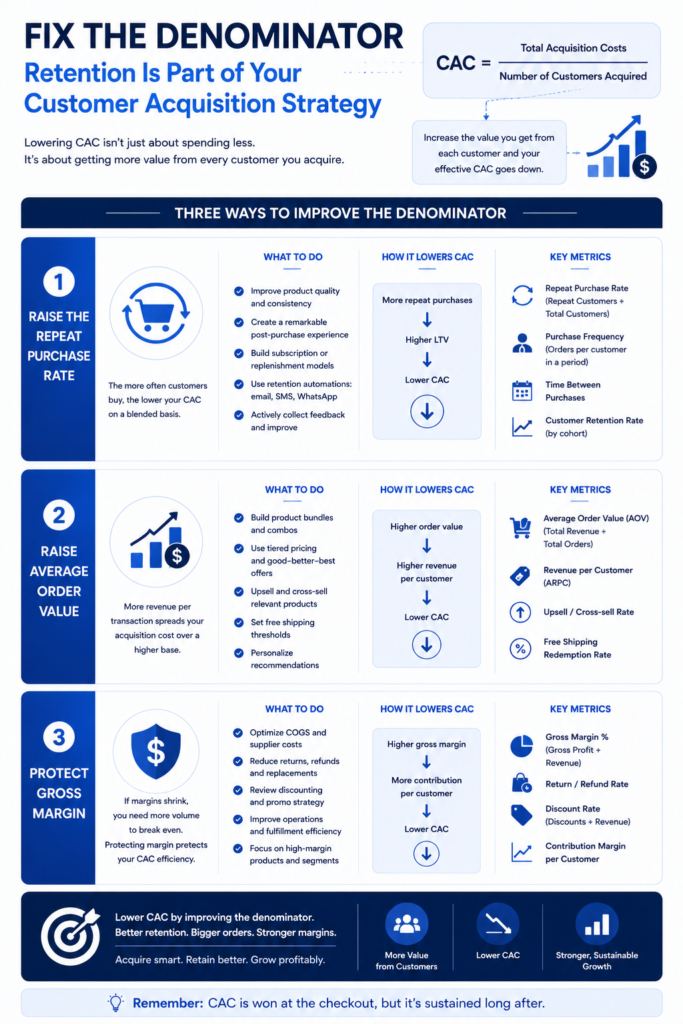
If your CAC is ₹1,500 and your customer is worth ₹2,000, you can fight to push the ₹1,500 down. Or you can make the customer worth ₹6,000.
The second is usually easier and it is almost always more durable, because your competitors can copy your ads far faster than they can copy your product experience.
Retention Is Part of Your Customer Acquisition Strategy
Retention gets filed under customer success and acquisition gets filed under marketing. In practice they are one system.
Your customer acquisition strategy is only affordable if your customers stay long enough to pay for it. A brand with excellent channels and a 15 percent repeat rate has a worse acquisition position than a brand with mediocre channels and a 60 percent repeat rate.
Raise the repeat purchase rate
For a consumable product, the repeat purchase rate is the whole business.
If a customer buys once, you must acquire forever, and you are permanently exposed to whatever the ad auction decides to charge. If a customer buys monthly for two years, your original acquisition cost gets divided across twenty-four purchases and stops mattering.
A brand paying a rising CAC while its repeat purchase rate stays at 15 percent is running faster on a treadmill that is speeding up. That is exactly the right image.
Replenishment reminders, subscription options, and simple loyalty structures work here. For consumables, the reminder is often the entire mechanism. People do not stop buying because they were dissatisfied. They stop because they forgot.
Raise average order value
Selling more per transaction lowers CAC as a percentage of revenue without acquiring anyone new.
Bundles, larger pack sizes, and relevant cross-sells all work. The rule is that the addition should genuinely serve the customer. An upsell that feels like a trick costs you the repeat purchase, and the repeat purchase was worth more than the upsell.
Protect gross margin
This one is invisible on marketing dashboards and it is decisive.
Every rupee of margin you give away in a discount is a rupee that no longer funds acquisition. Two businesses with an identical ₹1,000 CAC are in completely different situations if one runs at 45 percent gross margin and the other has discounted its way to 20 percent.
Discounting to acquire customers is borrowing from the same pocket you are trying to fill. Worse, it selects for price-driven buyers who leave for the next discount, which raises your long-run CAC while appearing to lower it today.
What I Learned Building Sparow
Sparow is a packaged drinking water brand operating in Tamil Nadu. I am not going to put numbers here that I have not published, so take this as observation rather than evidence.
Three things changed how I think about acquisition cost.
Nobody told me how to lower customer acquisition cost in a category where the customer decides in three seconds at a shelf.
The cheapest customer was the one standing in front of the product. In a category like drinking water, purchase decisions happen at the shelf, in seconds, with almost no research. A campaign explaining why our water is good has to travel a long way to reach someone who was not thinking about water. A well placed outlet reaches them at the exact moment they are. The acquisition cost of that second path, measured honestly with all the trade costs included, has consistently been the one that made more sense.
Retention is not a marketing function in a consumable category. Our repeat purchase rate is decided by whether the bottle was in stock, whether it was cold, and whether it arrived when it was promised. Those are operations problems. But they set our lifetime value, and lifetime value sets whether any acquisition cost is affordable. The most useful acquisition work I have done was fixing a supply gap, not writing an ad.
Trust in this category is not built by advertising. It is built by consistency and by compliance being visibly in order. Water is a category where a customer’s real question is whether it is safe. No amount of creative answers that. Standards, certification, and a product that never varies do, and they lower acquisition cost by removing the objection you would otherwise have to pay to overcome.
None of this is unique to water. It generalises to most physical product businesses in India, and it is precisely the part that a CAC playbook written for software will never tell you
How to Lower Customer Acquisition Cost in a Low Margin Category
Most CAC advice assumes you have margin to work with. A lot of Indian businesses do not. If you sell at 20 to 30 percent gross margin, your acquisition budget per customer is small before you start, and half the levers in this guide are unavailable to you.
You cannot outspend anyone. You cannot afford a long payback.
Three things change in a low margin category.
Payback becomes the only metric that matters. A twelve month payback that a funded software company treats as healthy will bankrupt you. Work to weeks, not quarters.
Volume and frequency replace ticket size. You are not going to raise average order value much on a commodity. You raise the number of times the same customer buys.
Distribution beats advertising almost every time. When contribution per unit is measured in rupees, a CPM-priced channel simply cannot pay for itself. The shelf can.
Knowing how to lower customer acquisition cost in a low margin business is mostly about accepting which levers are not for you, and going hard on the two or three that are.
What Not to Do
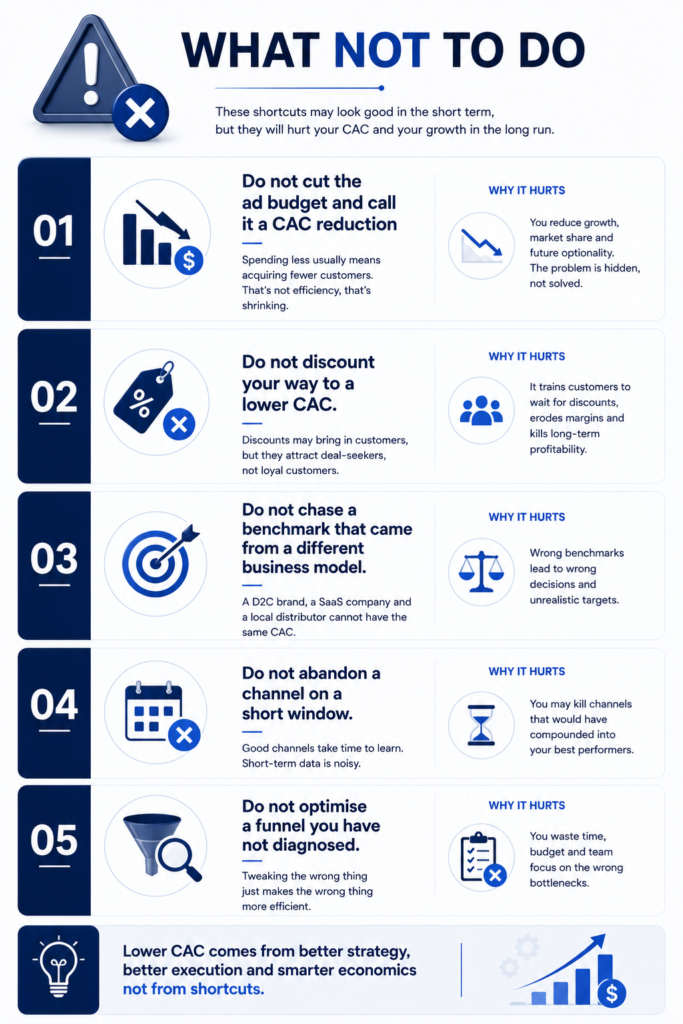
Do not cut the ad budget and call it a CAC reduction. Spending less is not lowering acquisition cost. If your CAC is ₹2,000 and you halve the budget, your CAC is still ₹2,000. You just have fewer customers. This is the single most common confusion on this topic.
Do not discount your way to a lower CAC. It works for one quarter, trains your market to wait for offers, and selects for customers who will not stay.
Do not chase a benchmark that came from a different business model. A 3:1 ratio from a software company does not transfer to a 30 percent margin product business.
Do not abandon a channel on a short window. Some channels, particularly organic and referral, look terrible for six months and then carry the business. Judging them on a monthly report kills them before they compound.
Do not optimise a funnel you have not diagnosed. Six months of landing page tests will not fix a retention problem.
A 90 Day Sequence
If you want a practical order of operations for how to lower customer acquisition cost, this is the one I would follow.
Weeks 1 to 2: Get an honest number. Calculate blended CAC with every cost included. Segment it by channel. Calculate your payback period. Expect to be unpleasantly surprised, and treat that surprise as the most valuable output of the quarter.
Weeks 3 to 6: Take the cheap wins. Fix the landing page. Cut the worst channel. Kill the offers producing volume at negative contribution. These require no new budget and they usually pay for the rest of the programme.
Weeks 5 to 12: Fix the denominator. Build the repeat purchase mechanism. Set up the reminder flow. Fix the operational failure that is quietly costing you retention. This has the longest payoff and should start before the quick wins are finished.
Weeks 6 to 12 and beyond: Reduce your exposure. Start the organic channel. Build the referral system. Test the thinner auction. None of these will show a return inside 90 days. All of them are why you will not be reading this article again in two years.
Ongoing: Re-measure. CAC is not a project. It is a number you watch the way you watch cash.
Frequently Asked Questions
What is a good customer acquisition cost?
There is no universal figure, because a good CAC is defined entirely by lifetime value. A ₹3,000 CAC is healthy for a customer worth ₹30,000 and fatal for one worth ₹2,500. Use two tests instead of a benchmark. First, LTV divided by CAC, where roughly 3:1 is a common orientation point. Second, the payback period, which matters more if you are bootstrapped. If you are funding growth from your own cash, a payback under three to four months is a far more useful target than any industry average.
How do I calculate customer acquisition cost?
Divide your total sales and marketing spend for a period by the number of new customers acquired in that same period. The accuracy depends entirely on what you include. Count ad spend, salaries, agency fees, creative costs, software, samples, and trade schemes. Exclude anything spent on existing customers, since that is retention. Use the same time window on both sides of the equation and count only genuinely new customers. Most businesses that add salaries to the calculation for the first time find their real CAC is significantly higher than they believed.
Why is my customer acquisition cost increasing?
Some of it is likely not your fault. Meta CPMs in India have risen roughly 40 to 60 percent since 2023, with D2C CAC moving from around ₹800 to ₹1,200 in 2023 to ₹1,800 to ₹2,500 in 2025. Over 800 funded D2C brands are now bidding for broadly the same audience. More bidders and flat inventory means a higher price. Privacy changes have also weakened targeting, so more of your spend reaches people who will not buy. The response is not better bidding. It is reducing how much of your acquisition depends on an auction at all.
What is blended CAC and why does it matter?
Blended CAC is total sales and marketing spend divided by total new customers across every channel, with nothing excluded. It matters because platform ROAS reports what one ad account believes it achieved, while blended CAC reports what happened to your money. The gap between your paid CAC and your blended CAC is a direct measure of how much work your non-auction channels are doing. Marketing Efficiency Ratio, which is essentially this idea, has been replacing single-platform ROAS among Indian D2C brands for exactly this reason.
How to lower customer acquisition cost without ads?
Three levers work without any ad spend. Fix conversion, since doubling your landing page conversion rate halves your CAC at identical spend. Engineer referrals by asking at the moment of satisfaction rather than at a random point. Build owned channels, particularly WhatsApp, which reports open rates of 85 to 90 percent at roughly ₹0.40 to ₹0.80 per message. For physical products, add a fourth: treat distribution as an acquisition channel and measure its cost per new customer honestly against your digital CAC.
What is the CAC payback period and what should mine be?
CAC payback period is your CAC divided by the monthly gross profit a customer generates. It answers when you get your cash back, rather than whether the customer is eventually profitable. A commonly cited guardrail is under 12 months, but that assumes external funding. If you are running on your own cash, a payback beyond three or four months means you cannot grow without borrowing, no matter how attractive your LTV to CAC ratio looks on a slide.
Does lowering CAC mean spending less on marketing?
No, and this confusion causes real damage. Cutting your budget in half does not lower your customer acquisition cost. It gives you the same CAC and fewer customers. Lowering CAC means acquiring each customer more efficiently, which can involve spending the same amount or more while getting more customers per rupee. A business that halves its CAC and doubles its budget is winning. A business that halves its budget and keeps its CAC is shrinking.
How does retention lower customer acquisition cost?
Strictly, retention does not lower CAC. It changes what CAC you can afford, which matters more. If a customer buys once, your acquisition cost is carried by a single transaction. If they buy monthly for two years, the same cost is spread across twenty-four purchases and stops being a constraint. A brand with rising CAC and a 15 percent repeat purchase rate is running faster on a speeding treadmill. For consumable products, the repeat rate is usually the highest-leverage number in the business.
What is a good CAC to LTV ratio in India?
The widely cited target is 3:1, meaning each customer returns three times what you paid to acquire them. Treat that as a compass rather than a rule. It originated in software businesses with gross margins around 80 to 90 percent. If you sell a physical product at 30 percent gross margin, you need a wider ratio, because far less of each rupee is available to cover the acquisition. Calculate what ratio your own margin structure actually requires instead of adopting a number from a different business model.
How to lower customer acquisition cost for a small business in India?
For most Indian small businesses, raising LTV. CAC is partly set by an auction you do not control, so your influence over it is capped. LTV is set by your product, your operations, and your customer experience, all of which you control completely. It is also more durable, since a competitor can copy your ad creative in a week but cannot easily copy a product people keep coming back to. Fix the obvious CAC leaks, then put your real effort into making each customer worth more.
Conclusion
The businesses that figure out how to lower customer acquisition cost are rarely the ones that found a clever campaign trick. They are the ones that stopped treating acquisition as a marketing problem.
Three things carry most of the outcome.
Measure honestly. Blended CAC, segmented by channel, with every cost included, and payback measured alongside the ratio. Most CAC problems are partly measurement problems.
Reduce your exposure. Every rupee of acquisition that depends on an auction is a rupee whose price your competitors get to raise. Organic, referral, owned channels, and distribution are not just cheaper. They are yours.
Fix the denominator. You will always have less control over what a customer costs than over what a customer is worth. Retention, order value, and margin are where a small business actually wins this.
There is no trick to any of this. How to lower customer acquisition cost is a question with an unsatisfying answer: measure honestly, stop depending on channels that reprice against you, and make each customer worth more than the last one.
Ad costs in India are not going back to 2021. That is not a temporary condition to wait out. It is the operating environment, and the businesses building for it now are the ones that will still be here when the ones buying growth run out of money to buy it with.
Start with the honest number. Everything useful follows from that.
If this was useful, the natural next step is the customer acquisition strategy guide, which covers channel selection and the acquisition system itself, and the business growth guide, which covers what to do once the economics work.
I write about business development, brand building, and what actually happens when you run a product business in India. If you want more of it, subscribe and I will send new work as it goes up.
If you are working through your own acquisition economics and want to compare notes, get in touch. I am always interested in how this plays out in categories other than my own.
Enjoyed this? Get the next one by email.
Occasional, considered notes on brand and building. No noise.