Customer Acquisition vs Retention: 7 Truths Every Business Owner Should Know
Most business owners I speak to in Tamil Nadu have the same quiet worry. They are spending more on marketing than last year, and selling roughly the same amount.
Nothing is broken. But nothing is compounding either.
Usually the issue is not the ad creative or the sales team. It is that the business has never honestly answered the customer acquisition vs retention question. Money flows toward finding new buyers while the buyers already on the books slowly drift away.
This article is my attempt to make that decision clear. Not with slogans, but with the actual reasoning and the actual arithmetic.
I run through where each strategy genuinely wins, where the popular advice is misleading, and how a small business in Coimbatore or Madurai can decide the split without hiring an analytics team.
A quick note before we begin. This article is about the balance between the two. If you have already decided that acquisition is where your business needs to focus right now, and you want the tactical detail on channels, costing, and execution, my breakdown of Customer Acquisition Strategy covers that ground properly. Come back here when you need to decide how much of your budget it deserves.
Table of Contents
1. What Customer Acquisition vs Retention Actually Means
Both terms get used loosely. Let me define them tightly, because the definitions carry the whole argument.
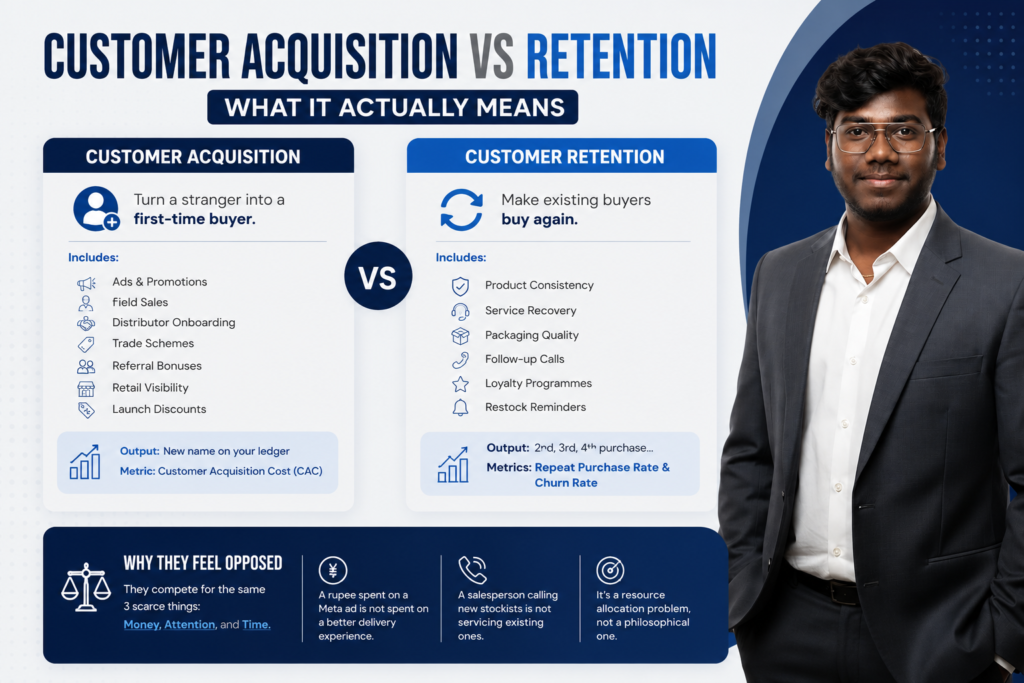
Customer acquisition
Customer acquisition is everything you do to turn a stranger into a first time buyer. Ads, field sales, distributor onboarding, trade schemes, referral bonuses, retail visibility, launch discounts.
The output is a new name on your ledger. The cost of producing that name is your customer acquisition cost.
Customer retention
Customer retention is everything you do to make an existing buyer buy again. Product consistency, service recovery, packaging quality, follow up calls, loyalty programmes, restock reminders.
The output is a second, third, and fourth purchase. The measure is your repeat purchase rate and its mirror image, your churn rate.
Why they feel opposed
They compete for the same three scarce things: money, attention, and time.
A rupee spent on a Meta ad is not spent on a better delivery experience. A salesperson calling new stockists is not servicing existing ones. That is the real tension, and it is a resource allocation problem rather than a philosophical one.
2. The Answer Most Articles Get Wrong
Search this topic and you will read the same line everywhere. Retention is five to twenty five times cheaper than acquisition. Therefore focus on retention.
I want to be careful here. That claim is widely repeated, and the underlying idea has real merit, but it gets applied without thought.
Here is what the claim quietly assumes:
- You already have enough customers to retain
- Your customers have a genuine reason to buy again
- Your product is one people repurchase at all
- Your market is not expanding faster than you are
Break any one of those assumptions and the advice inverts.
A new masala brand with 400 customers cannot retain its way to relevance. A wedding photography studio in Chennai cannot retain a customer who marries once. A brand entering a growing category that ignores acquisition simply hands the market to a competitor.
So the honest answer to customer acquisition vs retention is uncomfortable but useful: it depends on your stage, your category, and your repurchase cycle. The rest of this article makes that answer concrete.
3. Understanding Customer Acquisition Cost
You cannot compare two things until you can price one of them.
How to calculate customer acquisition cost
Take all money spent to win new customers in a period. Divide by the number of new customers won in that period.
CAC = Total acquisition spend ÷ New customers acquiredInclude everything honestly. Ad spend, agency fees, the salary share of the sales team doing new business, sampling costs, launch discounts, distributor margin on introductory schemes.
An illustrative example
Say a Coimbatore based snack brand spends the following in a month to open new retail counters:
| Line item | Amount (₹) |
|---|---|
| Field sales salary (new accounts) | 60,000 |
| Introductory trade scheme | 45,000 |
| Sampling and POS material | 20,000 |
| Digital ads for pull demand | 25,000 |
| Total acquisition spend | 1,50,000 |
They open 50 new retail counters. CAC per counter is ₹3,000.
That number means nothing on its own. It only becomes meaningful next to what a counter is worth over its life.
Why CAC rises over time
This is the part most owners feel but cannot name.
Your first customers are the easy ones. They were already looking for what you sell. As you keep spending, you reach people who are less interested, less convinced, and harder to persuade.
The cost per additional customer climbs. Meanwhile competitors bid for the same attention, pushing ad costs up further.
Acquisition, left alone, gets more expensive. That single fact drives most of what follows.
4. Understanding Customer Retention and Its Real Cost
Retention is often described as free. It is not.
What retention actually costs
Retention costs show up as:
- Better product quality, which cuts margin
- Service and support staff
- Loyalty discounts and points
- Delivery reliability, which costs logistics money
- Follow up calls, WhatsApp campaigns, restock nudges
- Fixing mistakes at your own expense
I see this clearly in Sparow packaged drinking water brand I work on. Water is a category where the product is functionally identical across brands. There is no flavour to win on and no feature to advertise. What people actually repurchase for is availability, seal integrity, and a can that arrives when it was promised.
Every rupee of retention spend there goes into logistics reliability and quality checks, not into marketing. The costs are real, but they are fixed costs that serve 500 customers or 5,000 equally well.
The reason retention still looks cheap is that these costs are usually fixed or semi fixed, while acquisition costs are almost entirely variable and rising.
A good WhatsApp broadcast system costs roughly the same whether you have 500 customers or 5,000. A Meta ad budget scales linearly with every new customer you want.
Measuring retention properly
Two numbers matter.
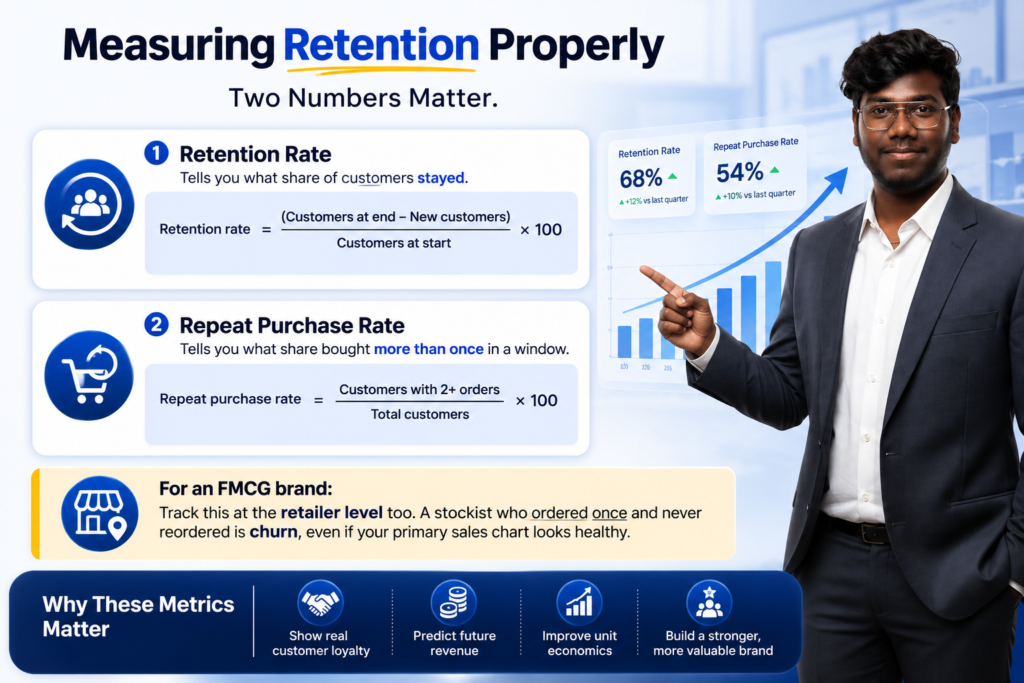
Retention rate tells you what share of customers stayed.
Retention rate = (Customers at end − New customers) ÷ Customers at start × 100Repeat purchase rate tells you what share bought more than once in a window.
Repeat purchase rate = Customers with 2+ orders ÷ Total customers × 100For an FMCG brand, track this at the retailer level too. A stockist who ordered once and never reordered is churn, even if your primary sales chart looks healthy.
5. The Math: Why Retention Compounds and Acquisition Does Not
This section is the core of the customer acquisition vs retention debate. Please read it slowly, because the arithmetic makes the argument better than any adjective could.
Customer lifetime value
LTV = Average order value × Purchase frequency per year × Average customer lifespan × Contribution margin %Now watch what a small retention improvement does.
Illustrative scenario A: 60% retention
A D2C brand in Chennai sells a ₹800 product. Customers buy 3 times a year. Contribution margin is 40%. Annual retention is 60%, so average lifespan is roughly 2.5 years.
LTV = 800 × 3 × 2.5 × 0.40 = ₹2,400At a CAC of ₹800, the LTV to CAC ratio is 3:1. Workable.
Illustrative scenario B: 75% retention
Same product. Same margin. Same frequency. Only retention improves to 75%, so average lifespan rises to 4 years.
LTV = 800 × 3 × 4 × 0.40 = ₹3,840The LTV to CAC ratio jumps to 4.8:1. A 15 point retention gain produced a 60% jump in customer value with zero change to price or ad spend.
Why acquisition cannot do this
To get the same 60% lift through acquisition, you would need to cut CAC from ₹800 to ₹500. In a market where ad auctions are getting more crowded every quarter, that is very hard.
Retention improvements multiply. Acquisition improvements add. That is the structural asymmetry.
The payback period lens
Payback period = CAC ÷ Contribution margin per orderIn scenario A, each order yields ₹320 margin. A ₹800 CAC pays back in 2.5 orders, roughly ten months.
If your retention is weak, most customers churn before month ten. You are paying to acquire customers who never repay the cost of acquiring them.
This is how businesses grow revenue and lose money simultaneously. It is depressingly common.
6. When Acquisition Should Win
I do not want this article to become another retention sermon. There are clear conditions where acquisition deserves the larger share.

You are early and small
Below a few hundred customers, you have no meaningful base to retain. You also have no data. Retention work at this stage optimises a curve you cannot yet see.
Acquire first. Learn what customers actually want. Then retain.
Your category is expanding fast
If a new category is opening in Tamil Nadu, millet based foods, EV servicing, quick commerce, the land grab matters. Market share captured early becomes a defensive asset later.
Retention on a small base while a competitor takes the market is a slow way to lose.
Your product has a long or single purchase cycle
Wedding services, home construction, solar installation, bridal jewellery. A customer may buy once in a decade or once in a lifetime.
Here retention takes a different form: referral. You are not retaining the customer, you are retaining their goodwill so they send others. But new revenue still comes from acquisition.
Your churn is structural, not fixable
A coaching centre for class 12 students loses every customer annually by design. That is not churn to fix. That is the business model.
Your CAC is genuinely low
If a channel reliably delivers customers below LTV with a short payback, feed it. Do not artificially throttle a working acquisition engine out of theoretical loyalty to retention.
If most of these conditions describe your business, acquisition deserves the larger share of your budget, and the next question becomes an execution one. Which channels, at what cost, in what order. That is a full topic on its own, and I have written a separate Customer Acquisition Strategy guide that works through channel selection and costing for Indian SMBs step by step.
For now, hold that thought. Because the conditions where retention wins are just as clear, and most businesses misread which side they are actually on.
7. When Retention Should Win
The opposite conditions.
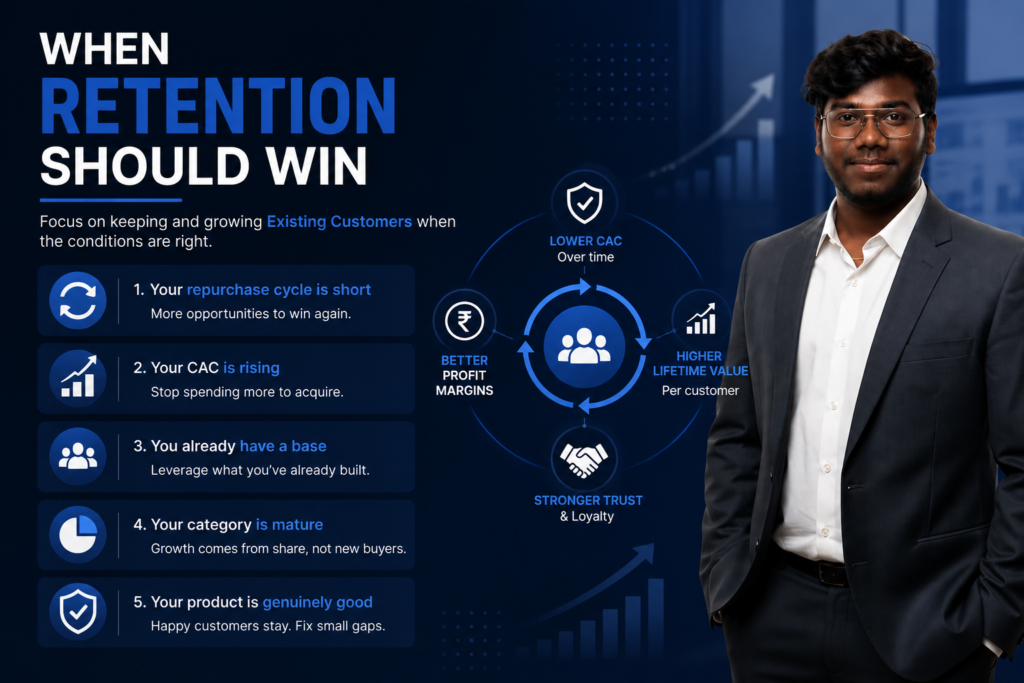
Your repurchase cycle is short
Groceries, personal care, snacks, tea, spices, supplements. If a customer could buy monthly and buys twice a year, retention is your single biggest hidden revenue source.
Packaged drinking water sits at the far end of this spectrum. A household or an office reorders weekly, sometimes more often. Running Sparow, that short cycle means a single lost customer is not one lost sale, it is fifty lost sales a year.
When the repurchase cycle is that tight, retention is not a marketing function. It is an operations function.
Your CAC is rising quarter over quarter
Check this. Pull three quarters of spend and new customers. If CAC has moved up 20% or more while conversion stayed flat, your acquisition engine is fatiguing. Retention is the cheaper next rupee.
You already have a base
Above a few thousand customers, small retention gains produce large absolute revenue. A 5 point retention improvement on 10,000 customers is worth more than 200 new acquisitions in most models.
Your category is mature
Established FMCG categories, standard services, commodity distribution. Growth here comes from share of wallet, not new wallets.
Your product is genuinely good
This one matters more than any tactic. Retention work on a mediocre product is expensive theatre. If people do not want to buy again, no loyalty programme fixes it.
Fix the product first. Then run retention.
8. Customer Acquisition vs Retention in FMCG and Distribution
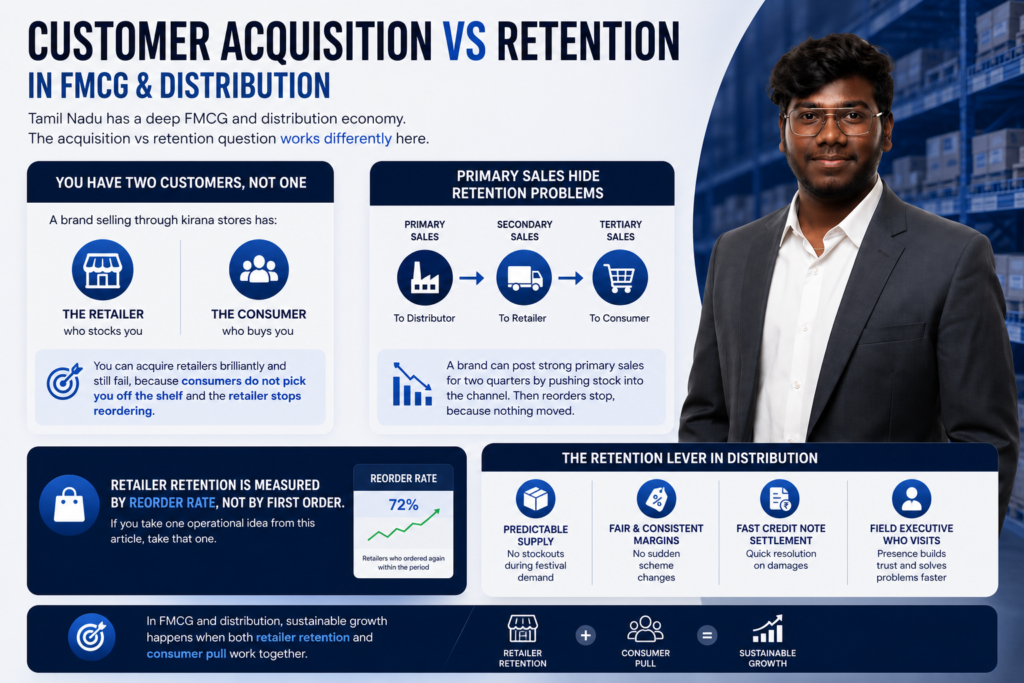
Tamil Nadu has a deep FMCG and distribution economy, and the acquisition vs retention question works differently here. Worth treating separately.
You have two customers, not one
A brand selling through kirana stores has:
- The retailer, who stocks you
- The consumer, who buys you
You can acquire retailers brilliantly and still fail, because consumers do not pick you off the shelf and the retailer stops reordering.
Primary sales hide retention problems
Primary sales are what you sell to the distributor. Secondary sales are what the distributor sells to retailers. Tertiary is what consumers actually buy.
A brand can post strong primary sales for two quarters by pushing stock into the channel. Then reorders stop, because nothing moved.
Retailer retention is measured by reorder rate, not by first order. If you take one operational idea from this article, take that one.
The retention lever in distribution
For retailers, retention comes down to:
- Predictable supply, no stockouts during festival demand
- Fair and consistent margins, no sudden scheme changes
- Fast credit note settlement on damages
- A field executive who actually visits
None of that is glamorous. All of it decides whether you get reordered.
This is the whole game in packaged drinking water. With Sparow, the retailer does not reorder because of a scheme. They reorder because the delivery arrived on the day it was supposed to, the shrink wrap was intact, and the previous batch sold through without a single customer complaint.
Miss any one of those and the retailer quietly switches to whichever brand shows up next week. In a commodity category, reliability is the only moat there is.
The retention lever for consumers
- Consistent taste, texture, and quality batch to batch
- Packaging that survives Tamil Nadu humidity and transit
- Availability at the same store next month
- Price stability that does not punish loyalty
A note on regional brands
Look at how established Tamil Nadu food brands have grown. The pattern is repetition and reliability over years, not a single viral campaign. Presence, consistency, and trust compound. That is retention operating at brand level.
9. A Practical Framework for Splitting Your Budget
Here is a usable rule set. Adjust it, do not worship it.
Step 1: Find your stage
| Stage | Customer base | Suggested split (Acquisition : Retention) |
|---|---|---|
| Validation | Under 500 | 80 : 20 |
| Early growth | 500 to 5,000 | 70 : 30 |
| Scaling | 5,000 to 50,000 | 50 : 50 |
| Mature | Above 50,000 | 30 : 70 |
Step 2: Adjust for repurchase cycle
- Buys monthly or more often: shift 15 points toward retention
- Buys once a year: shift 15 points toward acquisition
- Buys once in a lifetime: shift 25 points toward acquisition and referral
Step 3: Adjust for CAC trend
- CAC rising over three quarters: shift 10 points toward retention
- CAC stable or falling with headroom: shift 10 points toward acquisition
Step 4: Apply the health check
Before spending anything on acquisition, confirm:
- LTV to CAC is above 3:1
- Payback period is under 12 months
- Repeat purchase rate is above 20%
If any of these fail, stop acquiring and fix retention first. Acquiring into a leaking bucket converts marketing budget into losses at scale.
10. Retention Tactics That Work for Indian SMBs
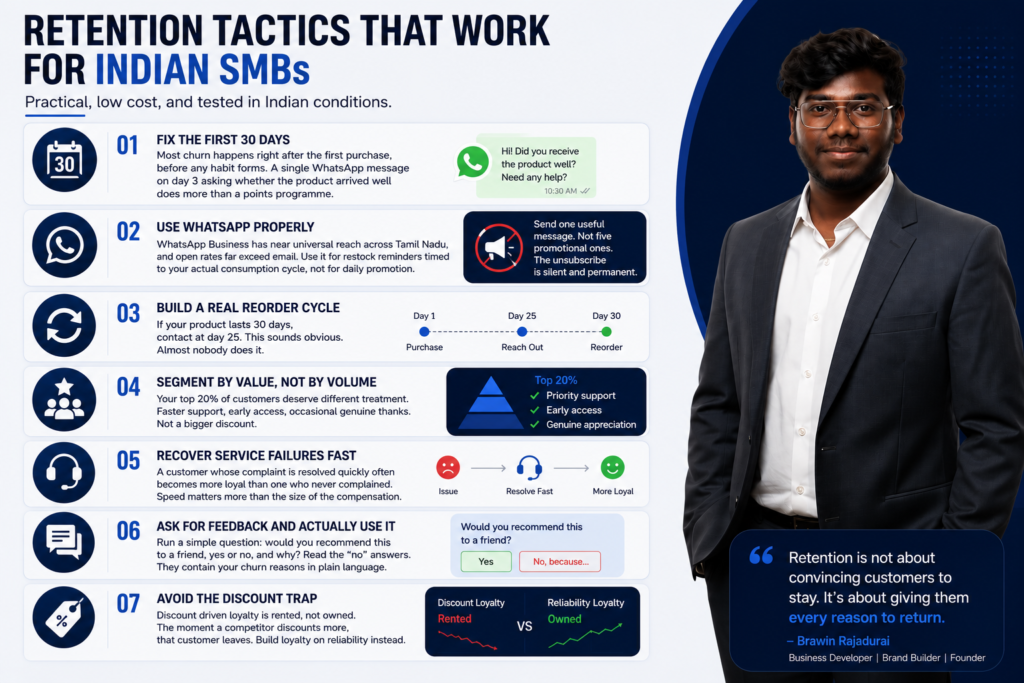
Practical, low cost, and tested in Indian conditions.
Fix the first 30 days
Most churn happens right after the first purchase, before any habit forms. A single WhatsApp message on day 3 asking whether the product arrived well does more than a points programme.
Use WhatsApp properly
WhatsApp Business has near universal reach across Tamil Nadu, and open rates far exceed email. Use it for restock reminders timed to your actual consumption cycle, not for daily promotion.
Send one useful message. Not five promotional ones. The unsubscribe is silent and permanent.
Build a real reorder cycle
If your product lasts 30 days, contact at day 25. This sounds obvious. Almost nobody does it.
Segment by value, not by volume
Your top 20% of customers deserve different treatment. Faster support, early access, occasional genuine thanks. Not a bigger discount.
Recover service failures fast
A customer whose complaint is resolved quickly often becomes more loyal than one who never complained. Speed matters more than the size of the compensation.
Ask for feedback and actually use it
Run a simple question: would you recommend this to a friend, yes or no, and why? Read the “no” answers. They contain your churn reasons in plain language.
Avoid the discount trap
Discount driven loyalty is rented, not owned. The moment a competitor discounts more, that customer leaves. Build loyalty on reliability instead.
11. Acquisition Tactics That Still Work
Retention does not replace acquisition. It funds it.
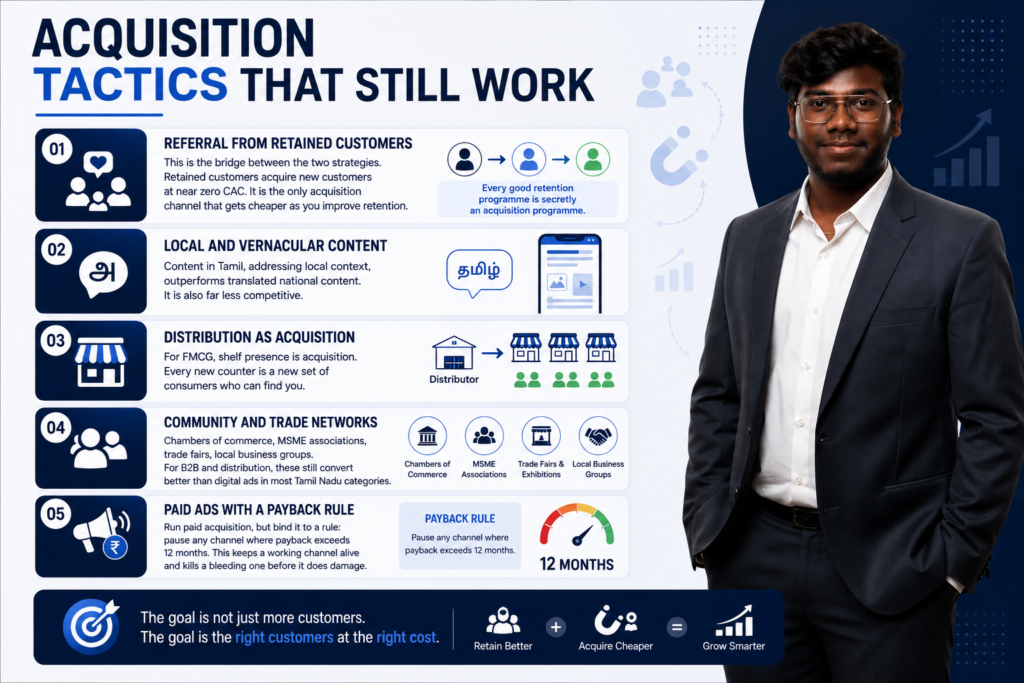
Referral from retained customers
This is the bridge between the two strategies. Retained customers acquire new customers at near zero CAC. It is the only acquisition channel that gets cheaper as you improve retention.
Every good retention programme is secretly an acquisition programme.
Local and vernacular content
Content in Tamil, addressing local context, outperforms translated national content. It is also far less competitive.
Distribution as acquisition
For FMCG, shelf presence is acquisition. Every new counter is a new set of consumers who can find you.
Community and trade networks
Chambers of commerce, MSME associations, trade fairs, local business groups. For B2B and distribution, these still convert better than digital ads in most Tamil Nadu categories.
Paid ads with a payback rule
Run paid acquisition, but bind it to a rule: pause any channel where payback exceeds 12 months. This keeps a working channel alive and kills a bleeding one before it does damage.
12. Five Mistakes That Cost Businesses Money
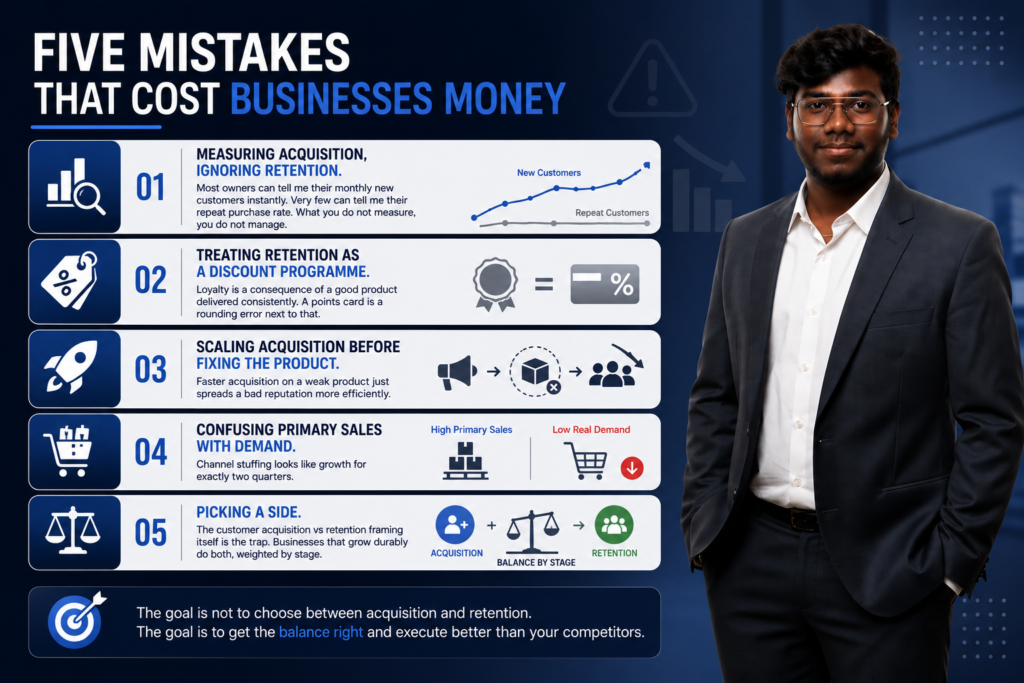
Mistake 1: Measuring acquisition, ignoring retention. Most owners can tell me their monthly new customers instantly. Very few can tell me their repeat purchase rate. What you do not measure, you do not manage.
Mistake 2: Treating retention as a discount programme. Loyalty is a consequence of a good product delivered consistently. A points card is a rounding error next to that.
Mistake 3: Scaling acquisition before fixing the product. Faster acquisition on a weak product just spreads a bad reputation more efficiently.
Mistake 4: Confusing primary sales with demand. Channel stuffing looks like growth for exactly two quarters.
Mistake 5: Picking a side. The customer acquisition vs retention framing itself is the trap. Businesses that grow durably do both, weighted by stage.
13. How to Measure Both Without a Data Team
You do not need software. You need a spreadsheet and discipline.
The five numbers to track monthly
- New customers acquired
- Total acquisition spend
- Customers who bought again this month
- Total active customers last month
- Average order value
What they give you
| Metric | Formula | Healthy signal |
|---|---|---|
| CAC | Spend ÷ New customers | Stable or falling |
| Repeat purchase rate | Repeat buyers ÷ Total customers | Above 25% |
| Retention rate | (End − New) ÷ Start × 100 | Above 60% annually |
| LTV to CAC | LTV ÷ CAC | Above 3:1 |
| Payback | CAC ÷ Margin per order | Under 12 months |
Run a simple cohort view
Group customers by the month they first bought. Track what share of each month’s group buys again in month 2, month 3, month 6.
If March’s cohort retains better than January’s, something you changed worked. Find out what. This one habit teaches more about your business than any report.
Review quarterly, not weekly
Retention moves slowly. Weekly review creates noise and panic decisions. Quarterly review shows trend.
Conclusion
The customer acquisition vs retention debate is usually presented as a fight. It is not.
Acquisition buys you a customer. Retention decides whether that purchase was an investment or an expense.
Early on, acquisition keeps you alive. As you mature, retention keeps you profitable. The businesses that last are the ones that read their own numbers honestly and shift the ratio as they grow, rather than following whatever advice was loudest that year.
If you take one action from this article, make it this: calculate your repeat purchase rate this week. Most owners have never seen the number. It usually explains more than the entire marketing plan does.
And if that number tells you your retention is healthy but your growth has stalled, the constraint is on the other side. In that case, the practical next step is a deliberate Customer Acquisition Strategy rather than more spend on the channels you already run.
Understanding customer acquisition vs retention is not about choosing a winner. It is about knowing which one your business needs more of, right now.
Frequently Asked Questions
1. Is it cheaper to retain a customer than acquire one?
In most repeat purchase businesses, yes. Retention costs tend to be fixed or semi fixed, while acquisition costs are variable and rise as you exhaust the easiest customers. However, this only holds if you have an existing customer base and a product people genuinely want to buy again. A very early stage business or a single purchase category will find retention economics far less favourable, because there is little to retain.
2. What is the difference between customer acquisition and retention?
Acquisition is the work of converting a stranger into a first time buyer through ads, sales, distribution, and trade schemes. Retention is the work of making that buyer purchase again through product quality, service, availability, and follow up. Acquisition creates the customer relationship. Retention determines whether it lasts long enough to be profitable. Both compete for the same budget, which is why the split matters.
3. Which is more important, acquisition or retention?
Neither, permanently. It depends on your stage and category. Below roughly 500 customers, acquisition matters more because you have no base to retain. Above a few thousand customers with a short repurchase cycle, retention usually produces more profit per rupee. The practical answer is to run both and shift the ratio toward retention as your business and your customer base mature.
4. How do you calculate customer acquisition cost?
Divide total acquisition spend in a period by new customers acquired in that period. Include ad spend, the salary share of staff doing new business, sampling, launch discounts, and introductory trade schemes. Excluding these makes CAC look artificially low and leads to bad decisions. Compare the result against customer lifetime value. A ratio above three to one is generally considered workable.
5. What is a good customer retention rate?
It varies sharply by category, so avoid universal benchmarks. For a consumable FMCG product with monthly repurchase, anything below 50% annual retention signals a product or availability problem. For a subscription service, high retention is expected. The more useful practice is comparing your rate against your own past quarters rather than against an industry average that may not fit your model.
6. Can a business grow on retention alone?
Rarely, and only for a while. Retention increases revenue per customer, but your total customer count still shrinks through natural churn, relocation, and life changes. Referral from retained customers can partly replace acquisition, and it is the cheapest acquisition channel available. But most businesses need some acquisition permanently, just at a lower proportion once they mature.
7. How much should a small business spend on retention?
As a starting point, roughly 20% of marketing budget in the validation stage, rising to 50% while scaling and 70% at maturity. Adjust upward if your repurchase cycle is short or your CAC is rising quarter over quarter. Adjust downward if your category is expanding fast or your product is purchased only once. Treat these as starting ratios, not rules.
8. Does customer acquisition vs retention work differently in FMCG?
Yes, because you have two customers. The retailer who stocks you and the consumer who buys you. You can acquire retailers successfully and still fail if consumers do not pick you off the shelf, causing reorders to stop. Retailer retention is measured by reorder rate, not first order. Primary sales can mask this problem for a couple of quarters.
9. What is the LTV to CAC ratio and why does it matter?
It compares what a customer is worth over their lifetime against what you paid to acquire them. Below 1:1 you lose money on every customer. Around 3:1 is generally healthy. Far above 5:1 may mean you are underspending on growth. It is the single clearest test of whether your acquisition spending is an investment or a slow leak.
10. How does WhatsApp help with customer retention in India?
WhatsApp has near universal reach across India and open rates far above email, which makes it effective for restock reminders, delivery updates, and service recovery. The mistake is treating it as a broadcast promotion channel. Frequent promotional messages get muted or blocked silently and permanently. Send fewer, genuinely useful messages timed to the customer’s actual consumption cycle.
Enjoyed this? Get the next one by email.
Occasional, considered notes on brand and building. No noise.